Letitia Carson — Adult / Historian Edition
A Black Pioneer of Oregon — Adult / Historian Edition — By Bob Zybach. Complete audited edition: Summary + ten chapters + Appendices A–C. 2026-06-20.
A few documents and images from Dr. Zybach’s Letitia Carson archive. The full set of figures will be placed chapter by chapter in a later draft.
Summary
Letitia Carson was born a slave in Kentucky, sometime between about 1814 and 1818, and died a free landowner in the Cascade foothills of Oregon on February 18, 1888. Between those two points lies one of the most remarkable lives in the history of the Oregon country — and one of the hardest to recover, because the woman at its center left no words of her own. She could not read or write. She kept no diary, wrote no letters, signed her name with an “X.” Nearly everything we know about her comes from documents that other people made: a wagon-train census that listed her among the livestock, a doctor’s bill, an estate inventory, two lawsuits she brought and won, a homestead patent signed in Washington, a deed, a few lines in other people’s family memories, and a misspelled gravestone. This book is the long work of reading those records carefully enough to give the woman behind them back her life.
This is a documentary history, and it tries to be honest at every turn about the difference between what the record shows and what it cannot. Where the evidence is firm, I say so plainly. Where it runs out and only informed guesswork remains, I say that too, and I mark the guesswork as guesswork. A great deal of Letitia Carson’s life has to be reconstructed from the outside in — from the few hard facts the documents allow, and from the well-researched history of the world she moved through. The reader deserves to know, from the first page, which is which.
Who she was, and the arc of her life
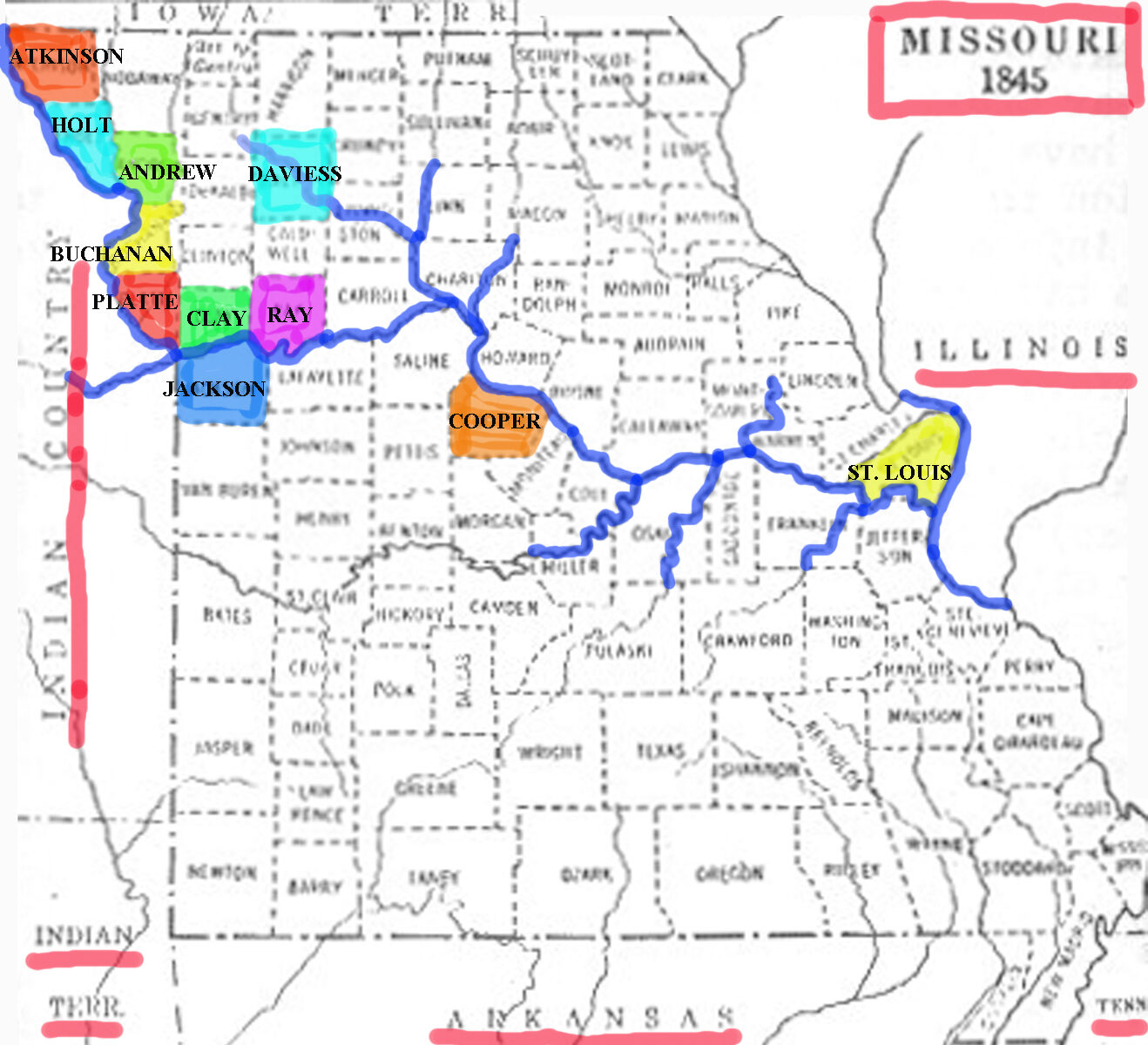
The story begins in Kentucky, where Letitia was born into slavery in the second decade of the nineteenth century — a time and place in which the overwhelming majority of people of African descent were held as property. Of her first quarter-century the record says almost nothing: no parents named, no bill of sale, no birth entry, no childhood that any surviving document will confirm. What can be drawn around that silence is the history of the country she came from — Kentucky’s tobacco-and-hemp slavery, smaller and more intimate than the great plantations of the Deep South; the domestic slave trade that carried tens of thousands of enslaved people west toward Missouri in the 1820s, 1830s, and 1840s, either sold to traders or carried along by migrating slaveholders. By one of those channels, Letitia was moved from Kentucky to the far northwest corner of Missouri — to Platte County, a transplanted piece of the upper South built on hemp and bound labor — sometime before 1845. How, exactly, the documents do not say.
David Carson is the man whose life her own first becomes visible against, and about him the record is more generous. He was born in County Antrim, in the north of Ireland, in 1800 — a Scotch-Irish (Ulster-Scots) Presbyterian, descended from the Lowland Scots who had been planted in Ulster generations before and who left it, wave after wave, for the American backcountry. The Carson family made their crossing in the long tail of that migration; David and several of his brothers came in 1818, settling first in the southern Appalachians of North Carolina and Virginia. David was the restless one, the brother who kept moving west — out of the mountains, into Missouri, and at last onto the Oregon Trail. By the early 1840s he was a settled, landowning, money-lending farmer and freighter in Platte County, and in October 1844 he became a naturalized American citizen, the legal key to the free land that Oregon was about to offer.
Missouri is where the two lives meet. By Christmas of 1844, Letitia was living with David Carson and was carrying his child. The circumstances that brought them together are not recorded and, given a slave code that refused to recognize any union between a white man and a Black woman, may never have been written down at all. What is certain is that in the spring of 1845 they set out together for Oregon, and that the crossing of the state line carried a legal weight that would echo through the rest of Letitia’s life. Under the settled understanding of the day — “once free, always free” — a slave taken by an owner onto free soil became free. When the Carson wagon was ferried across the Missouri River and onto federal ground where slavery was barred, Letitia, whatever her status had been the day before, became a free person. Nine years later, a jury would be asked to make that freedom good in law.
The 1845 emigration was one of the largest yet to cross the plains, and the Carsons traveled in it almost invisibly. Letitia enters the written record of the United States in the enrollment census of the wagon company, where David’s outfit was set down item by item: one wagon, one cow, eight oxen, two horses, four guns, six hundred pounds of bacon, six hundred pounds of flour, three men — and a woman. She is listed the way the oxen are listed, with no name. That single, nameless line is the centerpiece of Letitia Carson’s place in the documentary record, and much of this book is the work of restoring to that “woman” everything the census left out. On June 9, 1845, on the trail near the crossing of the South Platte in present-day Nebraska, she gave birth to a daughter, Martha — born free, on free soil. From that point Letitia Carson has a documented life.
At Fort Boise the family faced one of the great forks of the crossing. David’s own company, the Tetherow train, turned off onto Stephen Meek’s ill-fated cutoff across the high desert — a route that became one of the famous calamities of the overland trail. David, Letitia, and the infant Martha left the train rather than follow it, and so were spared the worst ordeal of the year. The decision is one of the clearest windows we have onto David Carson’s judgment, and it had a long shadow: many of the people who would later fill the Carsons’ lives in Oregon — including the brothers Alexander and Greenberry Smith — came over the Meek cutoff and survived it. (This Greenberry Smith, the future administrator of David’s estate, is the only “Smith” who matters in the early chapters; he is not the explorer Jedediah Smith of the companion book, and the two are kept strictly distinct throughout.)
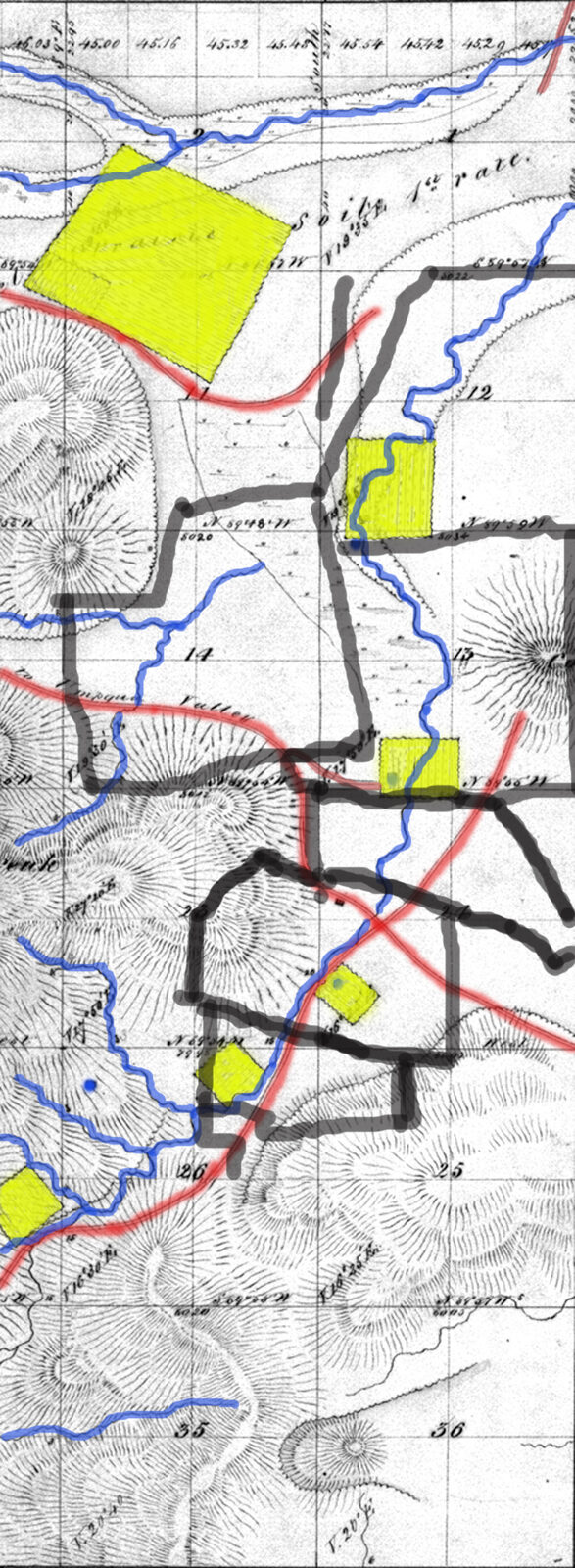
In December 1845 David found and claimed what he had crossed a continent for: a square mile of the finest bottomland in the Willamette Valley, at the Soap Creek crossing of the California Trail, in what would become Benton County. He is believed to have made the first land claim in the county, which makes the Carsons, in the historian’s phrase, the county’s first family. There the family lived for seven years. They built a cabin by the spring, raised cattle and hogs, planted crops, and added a son — Adam, called “Jack,” born September 9, 1849, almost certainly the first Black child born within the future bounds of Benton County. The neighbors knew Letitia by the affectionate name she had earned, “Aunt Tish,” as they called David “Uncle Davey,” and the community counted her an “Old Oregonian,” a badge of pioneer seniority — even though the Territory’s own written law denied that a Black woman could lawfully reside there at all. Both things were true at once, and the distance between them is much of what this book is about.
The law’s refusal to see Letitia ran quietly under those settled years, and it became visible the moment David died. Because Oregon would not recognize their union as a marriage, the federal Donation Land Claim Act treated David as a single man and cut his square mile in half, to 320 acres. Letitia could own no land in her own name; her children, though unquestionably David’s, were not his lawful heirs. So when David Carson fell ill and died at home in late September 1852 — on or about September 22, by the evidence of the only document that fixes it, a doctor’s bill — Letitia found herself, in the eyes of the probate court, nothing at all: not a widow, not an heir, not even property. A neighbor, Greenberry Smith, was appointed administrator. He swore an affidavit naming David’s heirs — brothers and a sister in the Carolina mountains, in-laws in Missouri, a nephew next door — and Letitia, Martha, and Adam appear nowhere on it. The estate was inventoried, appraised, and sold at public auction on January 4, 1853. To keep so much as a cooking pot, Letitia had to buy it back at the sale, as a member of the public, with her own money. She spent $104.87 — a washtub, an iron pot, a skillet, six plates, a bed and bedding, and three head of cattle. Then she left the valley with her two children and never returned.
It would have been worse almost anywhere else. Had the family been in Missouri when David died, Letitia and the children would not have stood at the probate sale as buyers; they would have lain in the inventory as property to be appraised and sold — and by 1852 the Missouri courts had closed the old door of “once free, always free.” In Oregon she had lost nearly everything, but she had not lost her freedom, and that distinction is what made everything that followed possible.
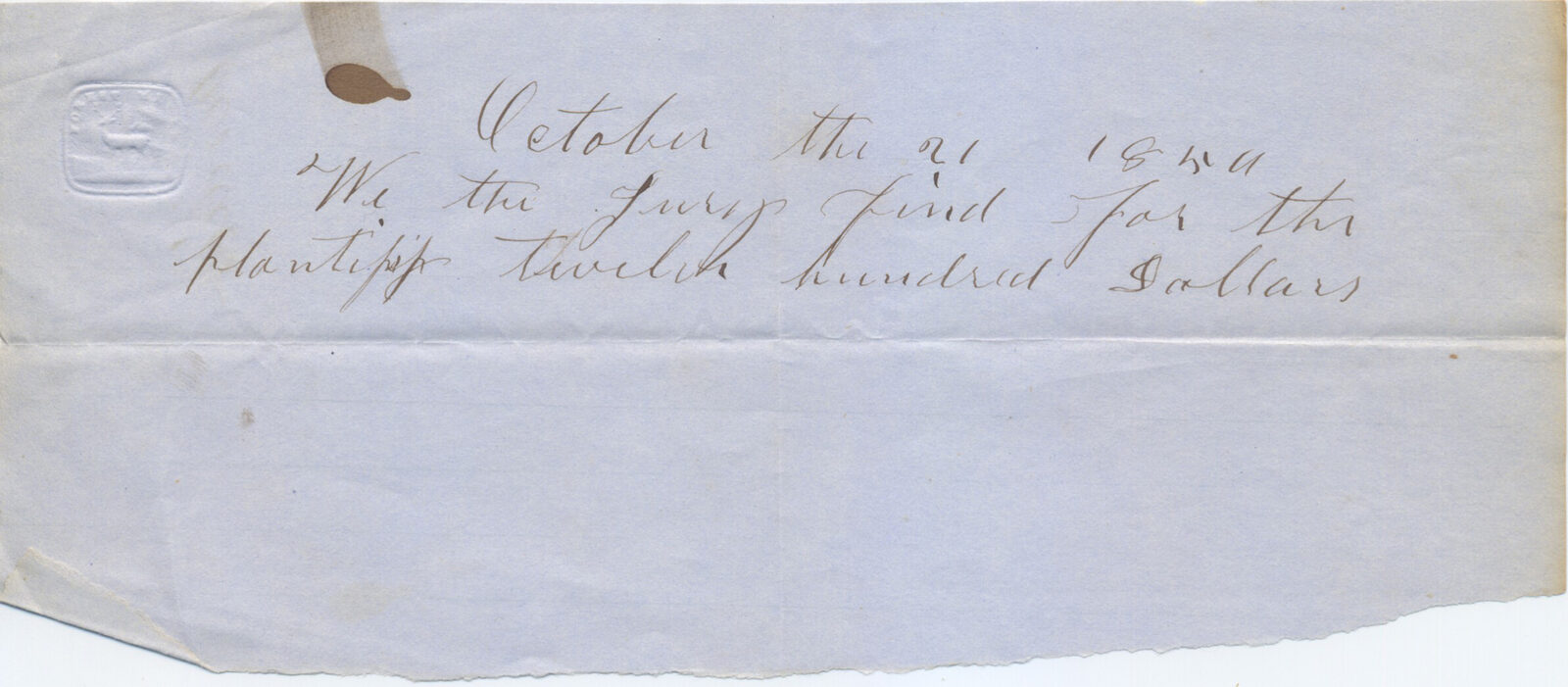
For Letitia did not accept that the law saw nothing of hers in the wreck of David’s estate. Within little more than a year she did something almost no one in her position in the United States of 1854 could have imagined: she hired a lawyer and sued the administrator — not once but twice. She sued first for the wages owed her for seven years of labor, and then for the cattle that had been hers and had been sold out from under her. She sued in a federal territorial court, in a territory that was at that very moment debating whether to bar Black residents from its borders altogether. Greenberry Smith’s defense was that Letitia had been David’s slave the whole time, in Oregon as in Missouri, and so was owed nothing; he even swore he held a bill of sale for her. That bill of sale was never produced. Both times, a jury of white men found in her favor — and to do so, each jury had to find what Smith spent the cases denying: that Letitia Carson was a free woman who could earn wages and own property. She won $300 for her labor in 1855 and $1,200 for her cattle in 1856, the latter on the strength of a neighbor’s deposition that David himself, at his own corral fence weeks before he died, had pointed out “an old pied cow” Letitia had bought on the plains in 1845 and said that twenty-seven head, the cow’s natural increase, “belonged to Lutishia Carson.” The settlement of $778.80 was paid over in 1857 — in the last narrow season before the United States Supreme Court’s Dred Scott decision would have stripped a free Black woman of the very standing to sue in a federal court. The lawyers and judges who argued and decided her obscure cases went on to write Oregon’s constitution and fill the early offices of the state; many of them helped write the exclusion clause that would forbid the very lawsuits she had just won. She is strangely absent from the history they wrote.
From the estate sale, Letitia and her children went south into the Cow Creek country of Douglas County, into the most lightly documented decade of her life. There she lived for years with the family of Hardy Elliff, near Galesville in the upper Cow Creek Valley, at a working way station on the worst pinch-point of the busiest road in the territory — a place where a woman who could cook, keep house, handle cattle, nurse the sick, and deliver babies would never lack for work. She became the community midwife, remembered through four generations of family talk as “Aunt Tish.” She caught the first Elliff baby in 1854. She lived through the Rogue River War, sheltering with the Elliffs and her son Jack inside a frontier stockade for nine months while southern Oregon burned around them. And one story has outlasted nearly everything else: that when a handful of menacing men approached the cabin while the men were away, Letitia stood between them and the children with a knife or cleaver in her hand and drove them off — the core of it almost certainly true, the flourishes about her size and voice the part to hold loosely.
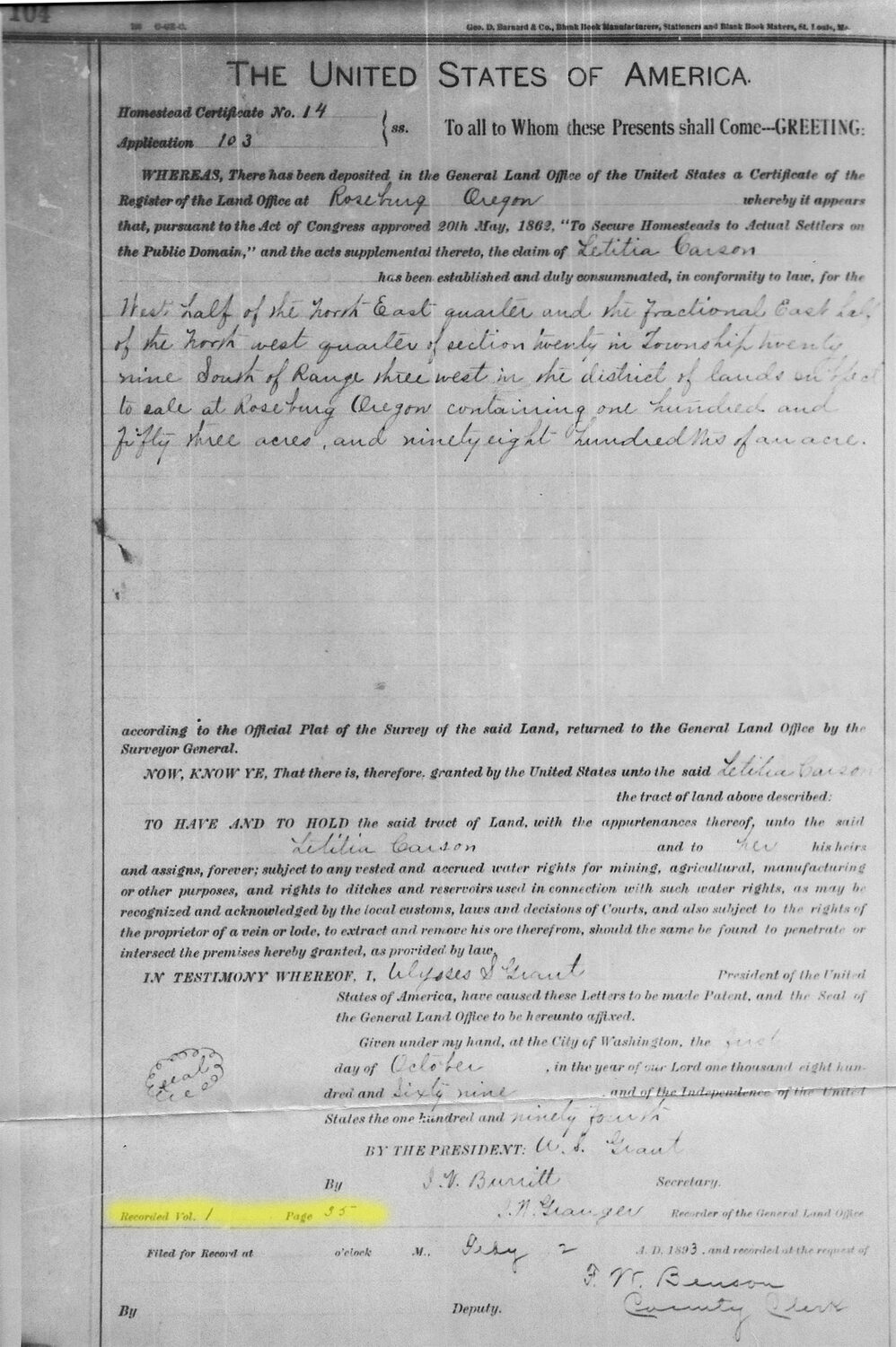
Then the law that had been turned against her became the instrument she used to make herself a landowner. On June 17, 1863 — barely a year after Lincoln signed it, and while her own citizenship as a Kentucky-born former slave was anything but legally settled — Letitia filed Homestead Application No. 103 at the Roseburg Land Office for a quarter-section on South Myrtle Creek. She listed herself as a widow and a citizen, and the officers took her at her word. Over the next five years she did the work the law required and a family requires, which were largely the same: she built a hewn-log house “a comfortable house to live in,” a barn, a granary, a smokehouse, and an orchard of about a hundred fruit trees — and she ran a herd of cattle that, by the 1869 tax roll, numbered thirty-nine head. She proved up the claim in June 1868, and on October 1, 1869, the United States issued her the patent, signed in President Grant’s name, to 153.98 acres “to have and to hold . . . unto the said Letitia Carson and to her heirs and assigns, forever.” Hers was one of the first seventy-one homestead patents ever issued in Oregon, and she was the only Black person among them — so far as the record shows, the first Black person in Oregon to receive a federal homestead patent. Ten years after Oregon entered the Union with exclusion clauses written into its constitution to keep Black people from owning land at all, a woman born a slave owned a quarter-section of that same state, free and clear, in her own name. The creek that drains it carries her name to this day.
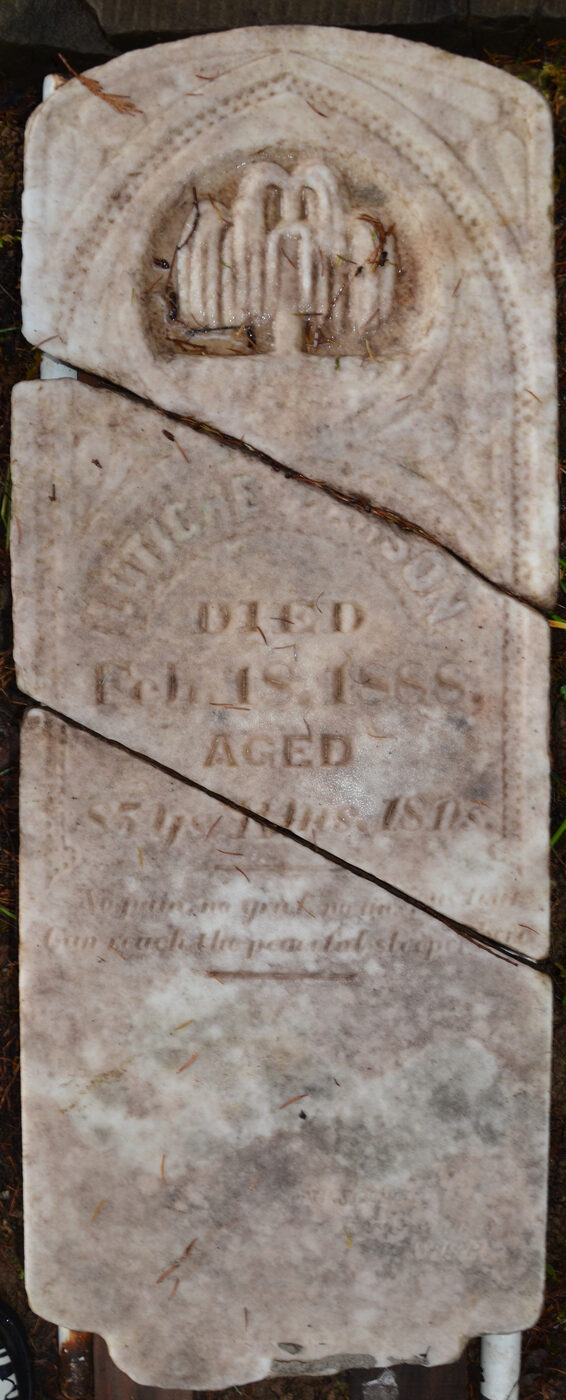
She lived another twenty years on that ground. Her daughter Martha married Narcisse Lavadour, of a Métis and Walla Walla family rooted in the fur trade and the Columbia Plateau, and through that marriage Letitia’s bloodline ran in a single generation onto three continents — her grandchildren descended from an African-American slave, a Walla Walla woman, a French-Canadian trapper, and an Irish immigrant. In 1884 Letitia deeded her homestead to her son Jack; the land was hers to give, and she gave it as she chose. In 1885 the Slater Act opened allotments on the Umatilla Reservation — the diminishing remnant of the very homeland Narcisse’s mother had been born into — and in 1886 Martha, her husband, eight grandchildren, and a great-grandchild left Douglas County for the east, more than four hundred miles away. Letitia, near seventy, was left with only her bachelor son Jack a few miles down the creek. She died on February 18, 1888, and lies in a small pioneer cemetery on a hill above South Myrtle Creek. She left no obituary that has yet been found. The country that had given her a creek, a soil, and a nickname did not, so far as the surviving record shows, mark her passing in print. That marking has had to wait more than a century.
A frank word about the evidence
It is worth being plain, before the reader goes further, about how thin the documentary thread really is, and how much of this book rests on inference rather than on Letitia’s own testimony. She left no account of herself. She could not have; she could not write. Every word attributed to her in the surviving record was written down by someone else — a lawyer drafting a complaint, a clerk recording an oath, a land officer reading a sworn statement back to her before she made her mark. The richest single source for her own family’s history, in the closing chapters, is a hand-written journal kept by a great-granddaughter she never met. Even her gravestone misspells her name as “Lutisha,” and the soil scientists who later named a soil for her misspelled that too. Across the whole record she is “Letitia,” “Leticia,” “Lutishia,” “Lutisha,” and, to the neighbors who loved her, “Aunt Tish.” A life lived so largely off the page can only be told by reading, with care and with discipline, the documents that were made about her by a world that mostly did not see her clearly.
So this book holds two things in tension on every page. It tells, as fully and as warmly as the record allows, the story of an extraordinary woman — born enslaved, freed by a river crossing, dispossessed by a probate court, vindicated by two juries, and made a landowner by her own labor and a Lincoln-era law. And it refuses, just as steadily, to invent what it cannot prove. Where Letitia’s voice is missing, the silence is named rather than filled. Where the records conflict — over a date, a figure, a place — the conflict is set down openly, so the reader can watch the reckoning rather than be handed a false certainty. That is the bargain of a documentary history, and it is the only honest way to write the life of a woman who left her mark, but never her name, on the papers that tell her story.
Sources
This summary draws on the ten chapters that follow and on the documentary record behind them: Bob Zybach’s own decades of research with Janet Meranda; the Benton County probate file of the David Carson estate (1852–1857) and the court file of Carson v. Smith (1854–1857); the 1845 emigrant records and the Soap Creek land, census, and marriage records; Letitia Carson’s homestead case file (National Archives, Record Group 49), including the 1863 application, the 1868 final proof, and the 1869 patent; the Douglas County deeds, tax rolls, and censuses; George Abdill’s 1982 Umpqua Trapper article and the Elliff-family recollections behind the Cow Creek years; and the Lavadour family genealogy and Aunt Martha’s Journal. Full citations appear at the end of each chapter, where the load-bearing documents are quoted in the participants’ own words.
Notes & open questions for Bob
Scope and voice. This is a front-of-book orientation, written in your documentary first person and pitched to a reader who knows nothing of Letitia yet — it sets the arc, names the central tension (a life told from documents others made), and hands the reader off to Chapter 1. It deliberately previews the conclusions the chapters earn rather than re-arguing them, and it keeps the “frank word about the evidence” you asked for as its own closing section. Tell me if you’d rather it run shorter (it’s about 2,250 words) or open on a scene rather than a thesis.
Harmonized facts used. I used the book’s settled figures throughout: Martha born June 9, 1845; Letitia died February 18, 1888; David’s death on or about September 22, 1852; the homestead patent of October 1, 1869, at 153.98 acres; the $104.87 buyback; the $300 / $1,200 / $778.80 lawsuit figures. These match the audited chapters. The one place a chapter still carries an internal fork is the first-verdict costs figure ($222.20 vs. $229.50) — I avoided citing a costs figure in the summary so the front matter doesn’t lock in a number the chapters are still reconciling.
Birth-year range. I gave “about 1814 and 1818” and “the second decade of the nineteenth century,” matching Chapter 1. If you settle on ~1818 as the foregrounded working figure, I’ll tighten the opening sentence accordingly.
Two-Smiths rule observed. Greenberry Smith is introduced by full name and explicitly distinguished from the explorer Jedediah Smith at first mention; no bare “Smith” appears. Dr. S. A. Smith of Albany is not named in the summary (he’s a Chapter 6 detail), so there’s no three-Smiths confusion to manage here.
Sensitivity flag carried forward. The summary states the “daughter of Peopeomoxmox” matter only implicitly (via “a Métis and Walla Walla family . . . rooted in the Columbia Plateau”) and does not assert the Peopeomoxmox descent — keeping the front matter clear of the tradition-vs-proof question that Chapter 10 handles carefully and that you’ve flagged for possible CTUIR/family review. Say the word if you’d like the summary to gesture at that lineage at all.
What I left out by design. No genealogy rosters, no allotment detail, no Ireland/Kentucky background prose beyond a sentence or two each — those are the chapters’ work. The summary names David’s Antrim/Scotch-Irish roots and Letitia’s Kentucky/Missouri passage only as much as the arc requires.
Chapter 1. Kentucky
The first thing to say about Letitia Carson’s early life is that we do not know it. She was born in Kentucky, almost certainly into slavery, sometime between about 1814 and 1818. After that the record goes dark for roughly a quarter of a century. There is no record of her parents, no record of her birth, no bill of sale, no church register, no childhood at all that any document I have found will confirm. The first time Letitia Carson enters the written record as a living, traveling person is in the spring of 1845, when she appears — pregnant, and far from Kentucky — on a wagon train pulling out of western Missouri and onto the Oregon Trail. Everything before that we have to reconstruct from the outside in: from the few hard facts the record does allow, and from the well-documented history of the world she was born into.
This chapter is honest about that division. I will say plainly what the documents show, I will say plainly what they do not, and where I move from fact to informed speculation I will tell you I am doing it. The history of slavery in Kentucky in the 1810s, of the domestic slave trade that carried tens of thousands of enslaved people west toward Missouri, and of the daily lives of enslaved women in the upper South is genuinely well researched. None of it is about Letitia by name. All of it is the country she came from, and it is the closest we can get to her until she steps out of the silence in 1845.
What the record allows
Let me lay out the handful of fixed points first, because the rest of the chapter hangs on them.
Letitia’s year of birth is given as a range, 1814 to 1818, because the sources disagree and none of them is firsthand. The 1850 federal census of Benton County, Oregon Territory — the first census on which she appears — records her age, from which a birth year can be backed out; later records and her own homestead filings give other figures. Our working genealogical file, assembled over many years of research with Janet Meranda, settles on a birth year of about 1818 and a birthplace of Kentucky. Her headstone, in a pioneer graveyard in Douglas County, Oregon, where she was buried in February 1888, does not settle the question either: it misspells her name as “Lutisha,” a reminder of how thin the documentary thread is even at the very end of her life, let alone the beginning. Through the records she is variously “Letitia,” “Leticia,” “Lutisha,” and, to the neighbors who knew her in old age, “Aunt Tish.”
That she was born enslaved is not certain in the way a surviving bill of sale would make it certain, but it is as close to certain as the evidence gets. She was a woman of African descent born in Kentucky in the second decade of the nineteenth century, a time and place in which the overwhelming majority of such people were held as property. When she reappears in 1845 she is traveling with a white man, David Carson, under circumstances that make the most sense if she had been his slave or had recently been freed; and after Carson’s death his estate’s executor, Greenberry Smith, would argue in open court that Letitia and her children had been Carson’s property — an argument that, whatever its legal merits in free-soil Oregon, only makes sense if Letitia had in fact been enslaved at some earlier point. I therefore treat her birth into slavery as a fact, while flagging that it rests on the weight of circumstance rather than on a single naming document.
About David Carson, by contrast, the record is comparatively generous, and because his life is the path along which Letitia walks out of the silence, it is worth setting down here. David Carson was born in County Antrim, in the north of Ireland, in 1800, and emigrated to the United States as a young man. By 1840 the census places him in Ray County, Missouri; by the early 1840s he had moved to the newly opened Platte County, in the far northwest corner of the state, where he obtained a 160-acre farm and a town lot in Platte City. He became a naturalized American citizen in October 1844. He was, in other words, a settled, landowning, slaveholding-country farmer of about forty-five when, in the spring of 1845, he set out for Oregon with Letitia at his side. (David’s Irish origins and his road to Missouri are the subject of their own chapter; here he matters only as the man whose journey first makes Letitia visible.)
The single fact that fixes Letitia in time and place more firmly than any other is the birth of her first child. On or about June 9, 1845, somewhere near the crossing of the South Platte River — where the Oregon Trail leaves the main Platte and begins to follow the North Fork — Letitia gave birth on the trail to a daughter, Martha. From that point forward Letitia Carson has a documented life. Everything in this chapter comes before that point, and so everything in this chapter is reconstruction.
Insights into Letitia’s life
Between her birth in Kentucky and her departure from Missouri lie perhaps thirty years that no document I have found will fill. Here informed speculation has to do the work that evidence cannot, and the only responsible way to speculate is to ground it in what is known about people in her situation.
When Letitia crosses the Oregon Trail in 1845 she is pregnant with David Carson’s child, yet no prior children are listed for either of them in any record. She was somewhere between twenty-five and thirty years old. There is good reason to think she had been formally purchased or leased by Carson before they left Missouri, though it is also possible she had become free and joined him by her own choice. And there is a quiet, painful likelihood folded into those years: a woman of her age, born and raised enslaved, may well have already borne several children before Martha — children who, under slavery, would have belonged to her owner and could have been kept, hired out, or sold away from her. If she did, no record of them has survived, which is itself characteristic of how slavery treated the families of enslaved women.
So the questions that organize the rest of this chapter are not idle ones. What was the life of an enslaved child like in Kentucky in the early 1800s? How were enslaved people typically moved from Kentucky toward Missouri and the frontier? How common, and how coerced, was childbearing among young enslaved women? And, underneath all of it: how did Letitia come to be in Missouri by 1845, and under what conditions? I cannot answer any of these for Letitia in particular. I can describe, from the historical record, the range of likely answers — and that range is the most honest portrait of her early years that can presently be drawn.
Tobacco, cotton, and hemp: slavery in Kentucky in the 1810s
Kentucky entered the Union in 1792 as the fifteenth state, carved out of the western lands of Virginia, and it carried Virginia’s law of slavery with it. This is the first and most important thing to understand about the country of Letitia’s birth, and it cuts against one of the assumptions in my own early drafts. Kentucky slavery descended from the English common-law slavery of Virginia and the Chesapeake, not from the French Code Noir of Louisiana and the lower Mississippi. The distinction matters, and I will come back to the Code Noir below, because it shaped the other end of Letitia’s journey, the Missouri and Louisiana-Purchase country — but it had no force in the Kentucky where she was born. A child born enslaved in Kentucky around 1814 to 1818 was born under a body of law inherited from Virginia.
The Kentucky into which Letitia was born was a slave society, but not the kind of slave society the word “plantation” usually calls to mind. From 1790 to 1860 the enslaved population of Kentucky never rose much above a quarter of the whole; in 1830 enslaved African Americans were about 24 percent of the state’s people, a share that drifted down to under 20 percent by 1860. The farms were generally smaller than the great cotton and sugar plantations of the Deep South, and the typical slaveholding was correspondingly small — a household that owned human beings was far more likely to own two or five than fifty. Subsistence farming could be, and often was, carried on with no enslaved labor at all, while the farmers who held the most people were those raising the labor-hungry cash crops.
Those cash crops were tobacco and, above all, hemp. The first Kentucky hemp crop was grown in 1775, and by 1810 hemp had become the state’s most important crop. Hemp was punishing work — the stalks had to be cut, retted, broken, and the fiber hauled out and dressed, and the labor cost was high enough that hemp was rarely profitable elsewhere. Kentucky was the exception, and the reason it was the exception was slavery: enslaved hands processed Kentucky hemp into rope and bagging right up to the Civil War. Tobacco, the older staple, was similarly labor-intensive, and the planters who grew tobacco and hemp held more enslaved people than the smaller mixed farmers around them. The heaviest concentrations of slavery were in the cities of Louisville and Lexington and across the fertile Bluegrass region in the center of the state, with the Jackson Purchase in the far west a tobacco district as well.
Where in this landscape was Letitia? I cannot say. But the demographic odds, and a few clues from her later life, point in a particular direction, and I will set them out in the section on her likely living arrangements below. The short version is that I think it more probable she was raised in a small household as a domestic servant — which in practice meant housework, gardening, dairying, child-minding — than that she was worked as a field hand on a large hemp or tobacco operation. That is a judgment of probability, not a finding of fact.
The Code Noir and the Louisiana-Purchase country
I include the Code Noir here deliberately, and with a caution, because it belongs to Letitia’s story at one remove rather than directly. The Code Noir — the “Black Code” — was a French royal decree, first issued by Louis XIV in 1685 and reissued in a second version under Louis XV in 1724, that defined the conditions of slavery across the French colonial empire. It required that the enslaved be baptized Catholic, forbade the practice of any religion but Roman Catholicism, ordered Jews out of the French colonies, recognized only Catholic marriages, and handed slaveholders sweeping disciplinary power over the people they held, up to and including the legitimizing of corporal punishment. Its sixty articles ran from the merely controlling to the savage: enslaved people could not carry weapons without permission, could not gather across different masters, could not sell goods on their own account; a fugitive absent a month was to have his ears cut off and be branded, and on a third flight to be executed. At the same time the Code carried provisions that, on paper, restrained owners — they were to feed and clothe even the sick and old; a husband, wife, and their young children under one master were not to be sold apart — provisions that, as historians have long noted, were never effectively enforced. The historian Tyler Stovall has called it “one of the most extensive official documents on race, slavery, and freedom ever drawn up in Europe.”
The Code Noir was applied in the West Indies in 1687, in French Guiana in 1704, on Réunion in 1723, and in Louisiana in 1724. And there is the connection to Letitia: when the United States bought the Mississippi River basin from France in 1803, in the Louisiana Purchase, it acquired the vast country — Missouri among it — that had been governed under French (and briefly Spanish) law and the Code Noir’s legacy. By the time Letitia would have reached Missouri, that territory had long since been brought under American law, and Missouri entered the Union as a slave state in 1821 under the terms of the Missouri Compromise. The Code Noir did not govern Letitia’s life. But it is part of the deep legal history of the western, trans-Mississippi country toward which her life moved, and it stands in instructive contrast to the Virginia-derived common-law slavery of the Kentucky where she began. I lay it beside the Kentucky story not because it ruled over her, but because the two together mark out the legal geography she crossed — from Virginia’s law in the east to the old French country in the west.
Kentucky slaveholdings in the 1820s and 1830s, and the road toward Missouri
If Letitia was born in Kentucky around 1814 to 1818 and was in Missouri by 1845, then at some point in the intervening years she was moved — west and a little north, from the Bluegrass country toward the Missouri River. How that happened is unrecorded for her, but the general mechanism is one of the best-documented features of antebellum American slavery, and it almost certainly accounts for her.
The 1820s and 1830s were the decades in which Kentucky became one of the great exporting grounds of the domestic slave trade. After Congress banned the importation of enslaved people from abroad in 1808, the only way to supply the booming cotton frontier of the Deep South with enslaved labor was to move people who were already held within the United States — and the surplus came overwhelmingly from the upper South, from Virginia, Maryland, and Kentucky. As tobacco cultivation in central and western Kentucky contracted after about 1830 and needed fewer hands, Kentucky slaveholders sold people south in enormous numbers. Over the antebellum decades, Kentucky owners sold something on the order of seventy-one thousand human beings into the trade. Most were carried south to Alabama, Mississippi, and Louisiana; historians estimate that upwards of a million people in all were forced out of the upper South into the cotton states in these years, in what amounted to a second, internal middle passage.
But not every enslaved Kentuckian who was moved was sold to a Deep South trader. A great many were simply carried along when their owners themselves pulled up stakes and moved. From the 1820s through the 1840s and 1850s, white families left Kentucky in large numbers for newer country — west to Missouri, south to Tennessee, southwest toward Texas — and the slaveholding families among them took the people they held with them. Missouri’s richest farming counties were settled in exactly this way, by Kentuckians and other upper-South migrants who brought their enslaved laborers and their tobacco-and-hemp economy with them. This is the more likely channel for Letitia. A young enslaved woman could have been moved toward Missouri by sale to a trader or to a Missouri buyer; she could have been carried there in the household of an owner who emigrated; she could have been moved more than once. Any of these would leave precisely the documentary blank we find. I cannot tell you which it was. What I can tell you is that her passage from Kentucky to Missouri was an utterly ordinary event of its time, repeated tens of thousands of times, and that the silence around it is the silence the trade imposed on nearly everyone it moved.
Living arrangements and conditions
Here I want to set down the reasoning behind my judgment that Letitia was more likely a household servant than a field hand, because it shapes how one should picture her childhood and youth.
During the years Letitia was likely living in Kentucky, most slave-owning families across many counties held only two to five enslaved people. On such small holdings, the enslaved frequently lived in the same house as the family that owned them, or in a cabin a few steps from it, and master and slave lived and worked in close, constant, daily contact — an intimacy that was its own kind of burden, but a very different daily existence from the gang labor of a large plantation. The same pattern held in Tennessee, and in the Missouri country to which so many Kentuckians moved. On the strength of that pattern, and of the small scale of typical Kentucky slaveholding, I think it more probable that Letitia was raised as a domestic — which in that world meant not only housework but gardening, milking, spinning, child-minding, and the endless labor of keeping a household running — than that she came up as a child laborer in the hemp or tobacco fields.
This is reinforced, lightly, by what she became. The enslaved and formerly enslaved women who did domestic and dairy and sickroom work were the women who carried those exact skills into later life, and Letitia, in her Oregon years, was known across her Douglas County neighborhood as a midwife, a stock-raiser, and a capable, self-supporting farm woman — the kind of competence that a domestic upbringing, rather than a field-hand’s, would have built. I do not press this further than it will go. It is a probability resting on a pattern, offered as the most likely picture and labeled as such.
It is worth being clear-eyed, too, about what “a comfortable domestic situation,” in the language of the old histories, actually meant. Even in the smallest and most “intimate” households, an enslaved woman was property. She could be sold to pay a debt, divided among heirs at her owner’s death, hired out by the year, or used by the men who owned her. Closeness to the owning family was not safety; it could be the opposite. Whatever the texture of Letitia’s particular childhood — and we do not know it — it unfolded inside that fact.
The general health and daily round of the enslaved
The day-to-day physical life of an enslaved domestic in the upper South, in the years of Letitia’s youth, was hard but not necessarily, in her younger years, sickly or starved. Owners had a brutal economic interest in keeping the people they held alive and able to work, and the work of a household servant — varied, indoors and out — was less destructive of the body than the relentless grind of the cotton or hemp field. The range of work was wide: house servants in the antebellum South served as cooks, housemaids, nurses, seamstresses, laundresses, dairymaids, weavers, and spinners, and on a small farm one woman might do most of these by turns. I note, as a marker for the fuller treatment a finished book deserves, that the standard accounts describe a potentially healthy enough physical regime for a young domestic woman in these years — adequate, by the grim standard of the institution, rather than good in any free sense.
Markings
The blunt fact behind this short section is that enslaved people were described, in the documents that mattered to their owners, the way livestock and property were described: by age, by color, by height, and by their scars. Runaway advertisements, bills of sale, and estate inventories routinely recorded “marks” — brands, the scars of whippings, smallpox pitting, missing fingers, the physical record of a life lived as property — because those marks were how an owner identified and recovered a particular human being. For Letitia we have no such description from her Kentucky years, and I am frankly glad not to have to reproduce one. I keep the section heading because the practice is part of the truthful context of her early life, and because the absence of any such record for her is itself a small mercy in an archive that was built to dehumanize.
Saturday nights, Christmas, and the hours that were their own
Whatever else slavery took, it could not entirely take the evenings, the Sundays, and the few holidays. In the slaveholding upper South the rhythm of the week left the enslaved a sliver of time that was, in practice, partly their own — Saturday nights and Sundays above all, and the long Christmas break, when work slackened and visiting, music, courting, worship, and rest filled the hours. One tradition I want to carry into the finished book is “patting juba” — the hand-clapping, thigh-slapping, foot-stomping percussion that enslaved people used to make music and dance when drums were forbidden them. It is a small, vivid thing, and it stands for a larger truth: that inside the institution, people made lives, kept time, and held onto joy where they could. Letitia was a young woman in exactly these years and in exactly this culture. I cannot put her at a particular Saturday-night gathering, but the culture of those gatherings was the air she breathed.
Church
Letitia’s later life suggests a churched woman, and the religious world of the enslaved upper South makes that easy to credit. The great majority of enslaved people in Kentucky and the surrounding states who were Christian were Baptist or Methodist — the two denominations that had grown explosively across the frontier South in the revivals of the early nineteenth century and that drew Black worshippers in large numbers. An enslaved woman might attend Sunday services in her owner’s church, seated apart; she might worship in a separate or semi-separate Black congregation; very often she did some of each, and sometimes there was the “invisible church,” the worship enslaved people held among themselves out of the owners’ sight. My best judgment is that Letitia was most likely a Baptist or a Methodist, and that she attended Sunday services in her owner’s church, or with an all-Black congregation, or by turns both. That is conjecture, anchored in the religious demography of the time and place and in the churchgoing pattern of her later life — and I mark it as conjecture.
Platte County slaveholdings in the early 1840s
Letitia’s reconstructed road ends, just before she steps into the documented record, in Platte County, Missouri — David Carson’s county — and so it is fitting to close the chapter there.
Platte County lay in the far northwest corner of Missouri, in the band of rich Missouri River bottomland that contemporaries and later historians called “Little Dixie” because it had been settled so thoroughly by upper-South people who brought their slaves and their staple-crop agriculture north and west with them. It was new country in the early 1840s — the Platte Purchase that added it to the state was completed only in 1837 — and the Kentuckians and other upper-South migrants who poured in found that hemp and tobacco grew well in the Missouri bottoms. Slave labor did the farming, cutting, and processing; in Platte County roughly one person in four was enslaved, and the wealth that hemp and bound labor produced built the fine antebellum houses that still stand in the county today. This was the society David Carson farmed in, and it was, in its economy and its origins, a transplanted piece of the very Kentucky world Letitia had been born into.
How, exactly, Letitia came to be with David Carson in Platte County — whether he bought her there, whether she came into the county already his, whether she was hired and then attached to his household, whether by 1845 she was enslaved or freed or something the law had no clean word for — I do not know, and I will not pretend to. What I can say is that the threads run together here. A woman born enslaved in Kentucky in the 1810s; the great westward churn of the domestic slave trade and of migrating slaveholders that carried upper-South people and the people they owned toward Missouri; a Little Dixie county built by Kentuckians on hemp and slavery; and an Irish-born farmer about to risk everything on the Oregon Trail. In the spring of 1845 those threads cross, Letitia steps out of the silence, and her documented life — the life this book can actually tell — begins on the road west, with a daughter born near the South Platte and a free square mile of Oregon still half a continent away.
Sources
Author-date entries. This chapter is built on Bob Zybach’s own draft material for the Kentucky chapter, with his prose and section structure preserved and his research notes finished into matching prose; the general-history context is drawn from the published sources listed below and is framed throughout as the world around Letitia, not as documented facts about her. Items marked [VERIFY] need source confirmation before print. Citation method per the book’s standard: author-date in text where a specific claim needs it, full list here.
Bob’s own material (the spine of this chapter):
- Zybach, Bob. [c. 2013–2023.] “Chapter 1. Kentucky,” draft (
orww/Letitia_Carson/Biography/1_Kentucky/1_Kentucky.doc). Section headings, the fact-vs-conjecture framing, the “informed speculation” passages, the living-arrangements judgment, and the “patting juba” note are taken from this draft. - Zybach, Bob. [c. 2013–2014.] “The Long Road to Freedom: Letitia Carson in Oregon, 1845 to 1889 — Chapter 1: The Kentucky–Missouri Slave Trade, 1775–1844,” draft (
orww/Letitia_Carson/Biography/0-Archives/1_1775-1845_Kentucky-Missouri.doc). Source of the fuller chapter outline, the Code Noir material, the Kentucky/Tennessee/North Carolina background, and the “Insights into Letitia’s life” passage. Outline credited “Zybach & Meranda, 2013-03-31.” - Zybach, Bob. 2014. “The Search for Letitia Carson in Douglas County, Part I: Who Is Letitia Carson?” (
Letitia_Carson_Part_I-20140705). Source of the canonical biographical-timeline paragraph on Letitia’s Kentucky origins and the David Carson summary (Antrim birth, Platte County farm and town lot, October 1844 naturalization, June 1845 birth of Martha near the South Platte). - Zybach, Bob. 2015. BlackPast.org biography of Letitia Carson, and the 2015-01-15 summary draft (
BlackPast.org_Bio_20150503.doc;BlackPast_Summary_20150115.doc). Polished public phrasings of the origin facts (born enslaved in Kentucky ca. 1814–1818; hemp/tobacco; Baptist or Methodist; field hand or house servant or both). - Zybach, Bob, and Janet Meranda. 1775–1922 Carson genealogical census file (
orww/Letitia_Carson/.../1775-1922_Carson_Census.xls; Soap Creek census compilation1840-1860_Soap_Creek_Census.xlsx). Source of the dated data points: Letitia Carson, b. ca. 1818, Kentucky, d. 1888-02-18, Douglas Co.; David Carson, b. 1800, Antrim, Ireland, 1840 census Ray Co. MO, d. 1852-09-22; Martha Carson, b. 1845-06-08, “Oregon Trail.” - Transcript, Kentucky land grants to “David Carson Jr.” and “David Carson & John Montgomery,” Rockcastle County, Kentucky, 1825 and 1834 (
.../Legal_Kentucky/Kentucky Carson Land.docx). Carson-Meranda transcripts, 2014. Relevance uncertain — see Notes. - “Boyle County, Kentucky wills listing slaves” (
orww/Letitia_Carson/Letitia-Kentucky/KY-Boyle-Wills-listing-slaves.pdf). Primary-source reference Bob gathered for the Kentucky context; not yet integrated.
General history (context around Letitia, supplemented by web research, Dave-authorized):
- “History of slavery in Kentucky.” Wikipedia. (Enslaved share of Kentucky population ~24% in 1830, declining to <20% by 1860; smaller farms and small slaveholdings; hemp first grown 1775 and the leading crop by 1810; enslaved labor processing hemp to the Civil War; concentrations in Louisville, Lexington, the Bluegrass, and the Jackson Purchase; Kentucky as a major exporter in the domestic slave trade, ~71,000 sold.) [VERIFY — settle on Bob’s preferred scholarly authority; Lowell Harrison, The Antislavery Movement in Kentucky, and Marion Lucas, A History of Blacks in Kentucky, are the standard works.]
- “Slave trade in the United States” and “The Domestic Slave Trade.” (1808 federal ban on slave importation; the upper-South-to-Deep-South forced migration of ~1 million people; Kentucky owners selling south to Alabama, Mississippi, Louisiana, especially after the post-1830 contraction of tobacco; slaveholding families carrying the enslaved with them when they migrated west to Missouri, Tennessee, Texas, 1820s–1850s.) [VERIFY — recommend anchoring to a monograph such as Steven Deyle, Carry Me Back, or Walter Johnson, Soul by Soul.]
- Schwartz, Marie Jenkins. Birthing a Slave: Motherhood and Medicine in the Antebellum South; and the scholarship on enslaved women’s labor and reproduction. (After 1808, enslaved women valued as reproducers; childbearing encouraged and rewarded; high infant mortality; the wide range of domestic work — cook, housemaid, nurse, seamstress, laundress, dairymaid, weaver, spinner.) [VERIFY — confirm which works Bob wishes to cite.]
- “Little Dixie (Missouri).” (Platte County in the Missouri River “Little Dixie” band settled by upper-South/Kentucky migrants; Platte Purchase completed 1837; hemp and tobacco worked by enslaved labor; roughly one in four people enslaved in Platte County.) [VERIFY — recommend R. Douglas Hurt, Agriculture and Slavery in Missouri’s Little Dixie.]
- Stovall, Tyler. On the Code Noir as “one of the most extensive official documents on race, slavery, and freedom ever drawn up in Europe.” Quoted via Bob’s draft (which cited the Wikipedia “Code Noir” article). [VERIFY — confirm the original Stovall source and pull the Code Noir facts from a scholarly text rather than the encyclopedia before print; see Notes.]
Notes & open questions for Bob
This is your chapter, finished — not re-essayed. I kept your section structure exactly (Tobacco/Cotton/Hemp; Code Noir; Kentucky slaveholdings 1820s–30s; Living Arrangements; General Health; Markings; Saturday Nights & Christmas; Church; Platte County in the early 1840s) and your own sentences and judgments wherever you had written them — the “we really don’t know anything about Letitia” honesty, the “informed speculation must be based on detailed research” framing, your living-arrangements reasoning (“more possible for Letitia to have been raised as a domestic… than as a child on a hemp or tobacco farm”), and your “patting juba” note. What I added is the general-history flesh on those bones (Kentucky slavery, the domestic trade, enslaved women’s lives, Platte County / Little Dixie), all clearly framed as context around Letitia rather than facts about her. Nothing about Letitia herself is invented.
Birth year: 1814 vs. 1818. Your drafts and bios give the range “1814 to 1818.” Your genealogical census file records her birth as “1818” (entered in the sheet as
17180000— I read that as an obvious keystroke slip for 1818, not 1718). I wrote the chapter around the range and leaned on ~1818 as the working figure. Please confirm which the book should foreground, and whether the 1850 census age and her homestead filings give a firmer number.Martha’s birth date: June 8 vs. June 9. Your Part I and BlackPast bios say Martha was born June 9, 1845, near the South Platte crossing; your Carson census spreadsheet records 1845-06-08. I wrote “on or about June 8” to stay honest to the discrepancy. Tell me which date to fix.
The Code Noir — I moved it but kept it. Your draft pastes the full Code Noir (a French/Louisiana code) into a Kentucky chapter and breaks off mid-sentence at “When the United States government purchased the Mississippi River basin from France in 1803, the area had been…”. Because Kentucky slavery descended from Virginia common law, not the French code, asserting the Code governed Letitia’s Kentucky childhood would be an error. I therefore (a) opened the Kentucky section by stating the Virginia-common-law lineage, and (b) recast the Code Noir as the legal backdrop of the Louisiana-Purchase / Missouri country at the other end of her journey, explicitly framed as “not the law she lived under.” If you’d rather cut the Code Noir entirely, it lifts out cleanly. If you want it kept, we should pull its facts and the Stovall quote from a scholarly source, not the encyclopedia.
The Rockcastle County, Kentucky land grants — almost certainly a different David Carson. Your
Kentucky Carson Land.docxtranscribes 1825/1834 land grants to a “David Carson Jr.” and a “David Carson & John Montgomery” in Rockcastle County, Kentucky. But your own genealogy traces our David Carson from Antrim → North Carolina (Ashe/Stokes) → Missouri (Ray, then Platte) — with no Kentucky residence. “David Carson” was a very common name. I did not assert any Kentucky land or residence for our David, to avoid conflating two men. Flagging so you can decide whether that transcript belongs to this book at all (it may have been gathered on a hunch that didn’t pan out), and whether the “David Carson-2 / Jr., b. ca. 1825, Ashe Co. NC” in your census file is a third thread again.“Markings” section — handle with care. I kept your heading but wrote it as a short, framed paragraph about how owners catalogued the enslaved by scars/brands in ads and inventories, and noted that we have no such description of Letitia (and that its absence is a mercy). If you’d planned this section for something more specific (e.g., a particular runaway ad or inventory you have), tell me and I’ll build it out.
Your page-reference notes (“Page 41–42… potentially healthy lifestyle”; “Page 35… patting juba”). These point to a specific book you were reading for the health/Saturday-night material — I couldn’t identify it from the file. What’s the source? Once I have it I can quote it directly and cite it, which would strengthen the “General Health” and “Saturday Nights” sections considerably.
The “several earlier children” point. Your archive draft raises the real possibility that Letitia had borne children before Martha who were lost to her under slavery. I carried that in (clearly as likelihood, not fact). Confirm you want it in the adult edition — it’s historically sound and humanly important, but it’s a sensitive inference and it’s yours to keep or cut.
Free or enslaved at departure? Your drafts hold both possibilities open (purchased/leased by Carson, or already free and joining him by choice). I preserved that openness rather than resolving it. If later chapters (the estate litigation, Greenberry Smith’s “they were property” argument) settle your view, we may want a forward-pointing line here.
Illustrations/maps you flagged for this chapter. Your draft calls for an Uncle Tom’s Cabin illustration and an “1830 Kentucky and North Carolina Roots” map. Both are easy to place once you confirm the specific images and their permissions. (The Uncle Tom’s Cabin originals are public domain; the map sounds like one of yours.)
Length and register. This runs about 3,500 words — the adult/historian depth you asked for, matching the clean-body + sources-at-end + notes-at-end format of the Ireland v3 draft. If you want it tighter, the Code Noir and the two trade/health context sections compress well without losing the spine.
Two-Smiths note: the only “Smith” relevant to this chapter is Greenberry Smith, the executor of David Carson’s estate (he appears here only by anticipation, as the man who would later argue Letitia had been property). He is unrelated to the explorer Jedediah Smith of the other book. No naive “Smith” appears in the text.
Chapter 2. Ireland
David Carson was a Scotch-Irish emigrant to the United States. “Scotch-Irish” is an American term; the British and the Irish would have said he was “Ulster-Scots.” Not all of the Scotch-Irish had Scottish ancestry, but almost all of the Ulster Irish were Presbyterians. The reasons for these distinctions have an interesting and well-documented history, and that background helps explain how David came to end up in Oregon — with a Black common-law wife, their new baby girl, and a free square mile of the very best Willamette Valley farmland, of his own choosing, in 1845.
Ulster is one of the four traditional provinces of Ireland. It is made up of nine of Ireland’s thirty-two counties; six of those are today called Northern Ireland and are part of the United Kingdom, and the other three are in the Republic of Ireland. The Carson family lived in County Antrim, in the north, and were almost certainly Presbyterians of Scottish ancestry. To understand them is to follow two centuries of migration, war, religion, and the linen trade — a history that begins before there was any such thing as a Scotch-Irishman, and that ends with seven members of one Antrim family stepping off a ship into the American backcountry in 1818.
This chapter sets that stage. It is the story of how a Lowland-Scots Presbyterian people came to live in the north of Ireland, why generation after generation of them left it for America, and how the particular family David Carson was born into joined that long movement. Almost none of it can be told from Carson family papers, because the Carsons left almost none behind from these years. It is told instead from the general record of the Ulster Scots — the chroniclers, the travelers, the churchmen, the census-takers — with the family’s own thin documentary trail folded in where it can be found. Where the record runs out and only conjecture remains, this account says so.
The old order, and the Nine Years’ War, 1594–1603
Before the plantations, Ulster was the most thoroughly Gaelic and the most stubbornly independent corner of Ireland. The old stories of the Ulster Cycle describe the world it came out of: a country with no effective central authority, divided into local and provincial kingdoms often at war with one another. The civilization those stories depict is a pagan, pastoral one, ruled by a warrior aristocracy. Bonds between the great families were cemented by the fostering of one another’s children. Wealth was reckoned in cattle. Warfare took the form mainly of cattle raids, or of single combats between champions at the fords of rivers, and a fighting man’s actions were sometimes hedged about by religious taboos, the geasa. It was a society organized for war and for herding, and it had held off English authority longer than any other part of the island.
That old order was broken in the Nine Years’ War of 1594 to 1603, when the Gaelic chieftains of the north made their last great stand against English rule and lost. With their defeat, the rural Irish lords who had measured their standing in cattle and followers lost title to their lands. The defeat was completed a few years later by the Flight of the Earls in 1607, when the leading Gaelic nobles of Ulster — chief among them the O’Neills and O’Donnells — abandoned the country for the Continent rather than live under English law. Their departure removed at a stroke the native leadership that might have organized resistance, and it left the ground of Ulster legally open. The English crown now had both the will and the legal pretext to settle the province with newcomers.
The Plantation of Ulster, 1609
The Plantation of Ulster was created in 1609 by King James I of England, who had previously been King of Scotland, and it was settled primarily by immigrants from Scotland and from northern England. The idea was to control and “civilise” Ulster, which was almost entirely rural, Gaelic, Catholic, and resistant to English rule. On a political level the plantation was also meant to sever Ulster’s old ties to the Gaelic Highlands of Scotland, the two having long shared a sea, a language, and a kinship of clans. The new colonists were required to speak English, to be loyal to the king, and to be Protestants; in return they became “British tenants,” given the personal use of farmland on very favorable terms.
The terms of the plantation drew a hard line between the newcomers and the people already on the land. All of the Catholic churches were given over to the established Protestant church. The new landowners were forbidden to hire Irish workers or to sell their land to Irish people; workers and landowners alike had to be imported from Scotland or northern England, and they had to be Protestant, English-speaking, and loyal to the king. The policy thus tried to manufacture, on Irish soil, a self-contained Protestant society that owed nothing to the Catholic Irish around it and everything to the crown that had planted it.
Almost all of the towns and villages of the north date from plantation times. Few or none existed before; they were established — and often fortified — by design, laid out as garrisoned market towns to anchor the new settlement and to overawe the countryside. A great migration of Lowland Scots into Antrim and the neighboring counties had in fact begun a few years earlier, around 1606, in a private settlement of east Ulster that ran a little ahead of the official scheme. The official plantation of 1609 turned that early trickle into royal policy. It is worth marking, too, that 1607 was the very year English investors chartered the Virginia plantation across the Atlantic; from the beginning the Ulster settlement and the American settlement competed for the same restless, land-hungry, Protestant population, and the same investment capital. The two frontiers were siblings.
Rebellion, massacre, and war, 1641–1653
A settlement built on dispossession did not sit quietly. Petty violence and sabotage against the planters were common, and many of the dispossessed Irish came to identify with the “woodkerne” — the outlaws and fighters who attacked the new settlements and ambushed settlers from the cover of the woods. That a general uprising took as long as it did owed something to the depopulation of the war years and to the removal of the old native leadership in the Flight of the Earls; those who remained were slow to grasp how completely the plantation would displace them. Resentment built for a generation before it broke.
Even as it built below, the migration from Scotland continued above it — though not without interruption. After about 1630 the flow from Scotland slackened for a decade, in part because the Presbyterians of Scotland had troubles of their own: in the 1630s they rose against King Charles I when he tried to force the Anglican prayer book and the rule of bishops upon their kirk. That quarrel between a Presbyterian people, governed by their own elders, and a crown determined to govern the church through bishops would echo across the next two centuries of Ulster history, and across the Atlantic. But the broader current still ran toward Ireland. In 1634 Sir William Brereton, traveling through Ayrshire, recorded what he saw on the roads:
“Above the thousand persons have, within the last two years past, left the country wherein they lived … and are gone for Ireland. They have come by one hundred in company through the town, and three hundred have gone on hence together, shipped for Ireland at one tide.”
By 1640 it is estimated that as many as 100,000 Scots had settled in Ulster, compared with some 20,000 migrants from England. The province was becoming, in its settled districts, more Scottish than English, and more Presbyterian than Anglican — a fact that would shape everything that came after.
Then, on the 23rd of October, 1641, the Ulster Catholics rose. The mobilized natives turned on the British colonists, killing about four thousand outright and driving perhaps eight thousand more from their homes to die of cold and hunger on the roads. The rising began as a planned seizure of strongpoints and spilled into a sprawling, bitter war. The memory of 1641 — exaggerated in the retelling, but real enough in its horror — would harden Protestant Ulster for two hundred years; it became the founding trauma of the planter community, invoked whenever Catholic Ireland seemed to stir.
In the summer of 1642 the Scottish Parliament sent some ten thousand soldiers to put the rebellion down, and in revenge for the massacres of their countrymen the army committed many atrocities of its own against the Catholic population. Based at Carrickfergus, the Scottish army fought the rebels until 1650, though much of it was destroyed by the Irish at the Battle of Benburb in 1646. When the English Parliamentarians under Cromwell reconquered Ireland from the Catholic Confederates between 1649 and 1653, they were generally hostile to the Scottish Presbyterians as well; the chief beneficiaries of the postwar settlement were English Protestants, not the Scots who had done much of the fighting. What the wars settled for good was that the last of the great Catholic landowners of Ulster were gone, their estates parceled out among the victors. The land question in Ulster was now, permanently, a Protestant question.
Linen, and a threatened prosperity, 1680s–1690s
The arrival of French Huguenots — members of the French Reformed Church, driven out of France by religious persecution — strengthened an already strong woolen industry in Ulster in the 1680s and, more lastingly, introduced improved methods for manufacturing linen from flax. This was a turning point in the economic life of the province. Linen would become the trade that defined Ulster for a century and a half, the thing that the family textile economy of every Antrim cottage turned upon: flax grown in the field, spun and woven in the home, and sold into a market that reached far beyond Ireland.
Ulster prospered, and her prosperity was promptly seen as a threat. In 1698 English commercial interests petitioned the king to protect their own trade, and at his urging the Irish Parliament passed the Woolens Act the following year, prohibiting the export of Irish wool and cloth to anywhere but England and Wales. The Act threw Ulster into a period of economic depression, and pushed the province further toward the linen trade — the one manufacture England was willing to leave it. It was a pattern that would repeat: Ulster industry, grown strong, checked by English law for the benefit of English competitors, with the displaced energy and the displaced people forced to find another outlet. In the long run, one of those outlets was America.
The Williamite War and the Treaty of Limerick, 1688–1691
In November of 1688 the Glorious Revolution replaced the Catholic James II with his Protestant daughter Mary and her husband, William of Orange, who ruled jointly over England, Ireland, and Scotland. As King of Scotland William was styled William II; in Ireland he is remembered to this day as “King Billy,” and his orange colours are still worn in his honour by those who trace their loyalties to the Protestant cause. James kept considerable support in largely Catholic Ireland, where his followers, the Jacobites, hoped he would address long-standing grievances over land, religion, and civil rights. Most Irish Protestants fought for William, though a few members of the Protestant Church of Ireland supported James.
County Antrim — the Carsons’ country — was a center of Protestant resistance against James. During the developing crisis, James’s garrison at Carrickfergus turned back an attempt by local Protestants to storm the castle. The war proper began in March 1689 with skirmishes between James’s Irish army, which had stayed loyal to him in 1688, and the Protestant militia of the north. It turned on the siege of Derry, where the Jacobites failed to take one of the north’s key towns, and so allowed William to land an expeditionary army. That army broke the main Jacobite force at the Boyne in July 1690 — the battle the Orange tradition still commemorates — after which James fled to France. The Jacobites were decisively defeated at Aughrim in 1691, and the war ended with the Treaty of Limerick in October 1691.
One contemporary witness, George Story, reckoned that the war had cost more than a hundred thousand lives, through sickness, famine, and battle together. Later Jacobite risings would be confined to Scotland and England; in Ireland the matter was settled. Its lasting effect was to confirm British and Protestant rule over the whole island for more than two centuries to come — the political fact within which every later Carson would be born, would farm, and would eventually decide to leave.
The last great wave from Scotland, 1690–1698
The successive wars had once again emptied the fields of Ulster. Many of the original settlers had been killed or had gone back to Scotland or England for safety, and the land lay short of hands. An appeal went out for fresh settlers, with twenty-year farm leases held out as the bait. So began the last great wave of Scottish migration into Ulster: in the decade from 1690 to 1700 an estimated fifty thousand people made the crossing. Politically, this wave was the most significant of all — for the future of America, and for the making of that distinct outlook that would in time be called Scotch-Irish. The people who came in the 1690s, and their children and grandchildren, were the people who would later cross the Atlantic.
It was driven from the Scottish side as much as it was pulled from the Irish. In the 1690s tens of thousands of Scots fled the famine remembered as the Seven Ill Years — in Gaelic, seachd bliadhna gorta, the seven years of hunger, named for the biblical famine that Joseph foretold in Egypt. It struck the Lowlands and the border country in the second half of the decade, and by some estimates it killed between five and fifteen percent of the whole Scottish population, with death rates in the worst-hit districts, such as Aberdeenshire, reaching perhaps a quarter. The 1690s were, by the tree-ring record, the coldest decade in Scotland in seven hundred and fifty years; failed harvest followed failed harvest in 1695, 1696, 1698, and 1699, and an economic slump from the Continental wars deepened the misery. People left because to stay was to starve. It was at this point, with so many newcomers arriving at once, that Scottish Presbyterians became the majority community in Ulster. The province had its character set: Protestant, Presbyterian, Scots in stock and speech, industrious in linen, and bound to a crown that did not entirely trust it.
Penal law, expiring leases, and the road out, 1704–1717
Prosperity and numbers did not buy the Ulster Scots security. In 1704 the government of Queen Anne, dominated by the Anglican high-church party, passed an act requiring all office-holders to take communion in the Established Church — a single stroke that all but wiped out the Presbyterians from the civil administration of the north. The law reached into private life as well; it was even seriously proposed that Presbyterian ministers might be hauled before Anglican church courts and charged with living in sin with their own wives, since the establishment did not recognize their marriages. The worst features of the act were removed by the Toleration Act of 1719, but the insult had landed, and full legal discrimination against the Presbyterians of Ireland was not finally ended until the middle of the nineteenth century. A people who governed their own church by their own elders had been told, in law, that they were second-class subjects in the country their grandfathers had been invited to settle.
The economic squeeze came close behind the religious one. By about 1710 most of the farm leases granted to the settlers of the 1690s had run out, and new leases were withheld until tenants agreed to pay sharply higher rents — “rackrents,” the contemporaries called them — that many simply could not meet. The landlords had discovered that a crowded, improving country would bear higher rents, and they meant to collect them. Rather than submit, whole communities, often led by their ministers, began to take ship for America. A new exodus was about to begin, and this one would cross an ocean.
It is worth pausing on what had happened by about 1707. By then the differences that had once separated the original settlers — Scots from English, Lowlander from Borderer — had largely dissolved. In their place there was now a distinct Protestant Ulster identity, recognizably its own thing, no longer simply transplanted Scotland or transplanted England. The people who would shortly begin pouring into the American colonies were not Scots and they were not English; they were Ulstermen, and they were about to become something else again.
The Great Migration, 1717–1775
The Great Migration from the north of Ireland to America began in 1717. A few Ulster families had crossed before then — David Carson’s own oldest brothers, as we shall see, may have been among the early ones — but those instances were few and isolated. Now they came by whole congregations. Some left in search of religious freedom, but most left in response to hard times at home. The final push came as a severe drought that ran from 1714 to 1719, ruining food crops, stunting the flax that fed the linen trade, and bringing the disease called rot upon the sheep that fed the woolen one. The whole economy of the Ulster cottage failed at once. In 1719, the year after the first great wave had moved west, Archbishop William King of Dublin set down what he believed was the true cause of the upheaval, and was careful to correct those who wished to blame it on religion alone:
“Some would insinuate that this in some measure is due to the uneasiness dissenters have in the matter of religion, but this is plainly a mistake; for dissenters were never more easy as to that matter than they had been since the Revolution, and are at present; and yet never thought of leaving the kingdom, till oppressed by the excessive rents and other temporal hardships … The truth is this: after the Revolution, most of the kingdom was waste, and abandoned of people destroyed in the war: the landlords therefore were glad to get tenants at any rate, and let their lands at very easy rents; they invited abundance of people to come over here, especially from Scotland, and they lived here very happily ever since; but now their leases are expired, and they are obliged not only to give what they paid before the Revolution, but in most places double and in many places treble, so that it is impossible for people to live or subsist on their farms.”
It is as clear a statement of cause as the period produced, and it came from an Anglican archbishop, not a Presbyterian partisan: the people were not chiefly fleeing the bishops; they were fleeing the rent.
Altogether, between 1717 and 1775, nearly a quarter of a million people — most of them Protestant, and most of them the descendants of Lowland and Border Scots and northern English who had settled in Ulster earlier — left the province and sailed for America. They were the most numerous group of immigrants from Great Britain and Ireland to the colonies in the years before the Revolution. They settled first in Pennsylvania and western Virginia, and from there they moved southwest into the backcountry of the upland South — the valleys of the Carolinas, the Appalachian Mountains, and on toward Tennessee and the Ozarks. Many came as indentured servants, bound by contract to serve a colonial master for some years — typically four — in exchange for their passage, food, clothing, and lodging; in the 1740s, by one reckoning, nine of every ten indentured servants in Pennsylvania were Irish.
The pace was never steady. After about 1750 the flow slowed for a time, as something like normal conditions returned to Ulster. The calm was brief. In 1771 a fresh wave began, again touched off by the landlords’ raising of rents, and this one carried real political consequence for the British Empire in America. Faced with the new rent hikes, country people at first resisted at home: in Antrim and Down they banded together as the “Hearts of Steel,” a rural protest movement against landlords and middlemen. But the landlords had the law and the army on their side, and the resistance broke; many of the Hearts of Steel men and their families simply joined the ships for America, carrying their grievance with them. It was no accident that the Ulster emigrants of these years arrived in the colonies already angry at landlords, at established churches, and at distant governments — and arrived just in time for a revolution.
A people, and a name
It was in America that the name was made. To the older Quaker and Puritan settlers of the thirteen colonies, mostly English in origin, these newcomers were simply “Irish” — an increasingly common and not always welcome sight. To correct the misimpression, the newcomers reached back for the older description, “Scots,” and in that semantic exchange a new breed took its name: the Scotch-Irish. They had lived for generations on a frontier in Ireland, and it seemed natural to them to push on to a new one, where land was plentiful and cheap. They brought a new urgency and a new restlessness into a settled colonial society. Distrustful of all authority and government, these “backwoodsmen” took hold of the western edge of settlement and fought Indians and wolves there much as their grandfathers had fought wolves and woodkerne; in Pennsylvania they came to dominate the outer reaches of the old Quaker colony almost completely. The Scottish historian Raymond Campbell Paterson described the resulting type:
“He was a farmer so far as was needful and practicable out of the reach of all markets, though as often as not his corn was planted and his grass mown, with the long-barreled short-stocked ponderous small-bore rifle upon which his life so often hung, placed ready and loaded against a handy stump. What sheep he could protect from the bears and the wolves, together with a patch of flax, provided his family with covering and clothing. Swarthy as an Indian and almost as sinewy, with hair falling to his shoulders from beneath a coon-skin cap, a buckskin hunting shirt tied at his waist, his nether man was encased in an Indian breech-clout, and his feet clad in deerskin and moccasins.”
When the Revolution came in 1775, the Scotch-Irish were among its most determined supporters — in interesting contrast, as it happened, to many of their Scottish cousins, who often stood with the crown. George Washington is said to have remarked that if the cause were lost everywhere else he would make his last stand among the Scotch-Irish of his native Virginia. A Hessian officer in British service, Captain Johann Henricks, complained in frustration that the whole thing should not be called an American rebellion at all: “it is nothing more than an Irish-Scotch Presbyterian Rebellion.” It was a people whose toughness, hardihood, and sense of mission helped give shape to a new nation, and would furnish it in time with such figures as Davy Crockett and Andrew Jackson. The line that runs from the Antrim rackrent to the Tennessee frontier rifle is a real one, and David Carson was born squarely upon it.
Antrim, Belfast, and the temper of the age, 1756–1791
The county the Carsons came from was, by the end of the eighteenth century, the heart of the Irish linen country, and Belfast — its commercial capital — was among the most outward-looking towns in Ireland. Antrim and the neighboring County Down were also the most thoroughly Protestant corner of the island. According to an assessment of the population of Belfast in 1756, the town held 7,993 Protestants and only 556 Catholics. This near-absence of a Catholic population had a curious political effect. The sympathy that would grow in Belfast for the Catholic cause rested, almost entirely, on grounds of political principle and social justice rather than on local pressure; in no other part of the country was there so little practical ground for fearing Catholic action, even given the dreadful memories of 1641. A people who had little to fear from their Catholic neighbors could afford to think about justice for them in the abstract — and increasingly, the reformers of Belfast did.
For Belfast was a reforming town, and the great events of the wider world fell on unusually receptive ground there. The connection between France and the north of Ireland was closer than is sometimes remembered — through trade, through the Huguenot families who had built the linen industry and now held positions of importance and respect, and through long commercial ties between Belfast and the French ports. So when revolution came in France in 1789, Ulster did not watch it as a distant spectacle. Among the ardent reformers of Belfast its ideals were taken up as a personal challenge, and assumed a significance unknown in England or Scotland.
The ground had been prepared in the preceding years. In 1784 the Belfast Volunteers — the citizen militia of the town — had thrown their ranks open to men of every religious persuasion, declaring themselves convinced that “a general Union of ALL the inhabitants of Ireland is necessary to the freedom and prosperity of this Kingdom.” To the more cautious, this ecumenical, reforming spirit carried a red light of danger. The Volunteer leader Lord Charlemont, already uneasy at the more extreme opinions abroad, founded a Whig Club in Belfast in 1790, on the model of the one already established in Dublin, hoping to channel the reforming energy into safe constitutional bounds. Yet even the Belfast Whig Club was no reactionary body. Within six months of its founding, the members — chaired by Dr. Halliday, with Henry Joy junior as secretary — passed a resolution that left no doubt where their sympathies lay:
“That considering the French Revolution as one of the most important and universally interesting events which the world ever saw, and as particularly such to the inhabitants of these islands as it promises to lead the way to an orderly and gradual reform of those abuses which have maimed and disfigured the constitution, we shall, as men, as Whigs, as citizens of this empire, meet on the 14th of July next, to celebrate that astonishing event, which constitutes a glorious era in the history of man and of the world.”
To toast the fall of the Bastille as a glorious era in the history of man — and to do it under the chairmanship of a respectable Belfast physician — gives the measure of the town in 1790. This was the world into which David Carson would be born a decade later: a Protestant, linen-working, Bible-reading, fiercely independent corner of Ireland that read its politics in the language of rights and revolutions.
The United Irishmen and Wolfe Tone, 1791–1798
Out of that ferment came the most ambitious political movement Ireland had yet seen. In 1791 Henry Joy McCracken, Thomas Russell, Samuel Neilson, and Theobald Wolfe Tone together founded the first Society of United Irishmen in Belfast. Their aim was radical for the age: to unite Irishmen of every religion — Protestant, Catholic, and Dissenter alike — in a common demand for parliamentary reform, and, in the more advanced opinion that soon prevailed, for an Irish republic independent of Britain. When Thomas Paine published The Rights of Man, it was hailed in Belfast with rapture; in Wolfe Tone’s phrase it became “the Koran of Belfast.” The same men who plotted reform also gathered, in a gentler key, to save what they could of the old culture: in 1792 Belfast hosted a great Festival of Irish Music, summoning the surviving Irish harpers to the town so their airs could be written down before they were lost.
Wolfe Tone is the figure through whom the whole movement is best known, chiefly because his Autobiography brings us into unusually intimate contact with the man and the events he moved through. He was born in Dublin in 1763, the eldest son of a successful coachbuilder who made strenuous efforts to give him a good education with the fixed intention that his firstborn should become a lawyer. At seventeen Tone entered Trinity College, Dublin, having already shown that what he really wanted was a military career. While still a student he eloped with Matilda Witherington — “not yet sixteen, and as lovely as an angel,” he wrote — and after a few days of married happiness at Maynooth the couple returned to Dublin, were forgiven on all sides, and settled in lodgings. After two restless years in London he came back to Dublin, gathered up his wife and child, took up the law again, and was called to the Irish Bar in 1789, the very year the Bastille fell. He soon turned out a pamphlet, A Review of the Last Session of Parliament, in effect a defense of the new Whig Clubs, and from there moved steadily toward the republican cause he would die for.
It is striking how little, at first, these northern reformers actually knew of the Catholics they proposed to make their fellow citizens. As late as 1791 Tone himself wrote that the people of Belfast knew “wonderfully little” about the Catholics — a candid admission that the great alliance of Protestant Dissenter and Catholic began more as an idea of justice than as a settled friendship. But the idea had force. By the middle of the decade the United Irishmen had become a mass revolutionary organization, drilling in secret and looking to revolutionary France for help.
That help came too late and too little. When the rising finally broke out in 1798, Antrim saw real fighting, most of all at the Battle of Antrim, where Henry Joy McCracken led the insurgents of the county. The rebellion was crushed, in Ulster as elsewhere, with great loss of life and great severity in the reprisals; McCracken was hanged in Belfast, and Wolfe Tone, taken after a French landing failed, died in prison. Lord Edward Fitzgerald, the other great name of the rising, had already been mortally wounded resisting arrest in Dublin. But the temper that the rebellion revealed — independent, reform-minded, impatient with landlords and bishops alike, willing to think in the language of rights for people of every creed — was very much the temper of the Presbyterian north, and very much the temper of the people who were already leaving for America, and who would keep leaving after the rising was put down. The Carsons came out of that country, in those years. Whatever their own politics, they were formed by a society that had just risked everything on the proposition that a man’s rights did not depend on his church.
Linen at the close of the century
It is worth setting beside that political ferment the plain industrial fact that underlay it, for the two were connected: a prosperous, literate, town-trading population is a population that reads pamphlets and forms clubs. Linen manufacturing was, by the end of the eighteenth century, the great industry of County Antrim, and Ireland grew a large amount of the flax that fed it. Cotton-spinning by jenny was first introduced to Belfast by the industrialists Robert Joy and Thomas M’Cabe in 1777; and twenty-three years later, by about 1800, it was estimated that more than twenty-seven thousand people were employed in the textile trades within ten miles of Belfast, with women doing much of the fine patterning of the muslin. This was the working world of the Carsons’ Antrim — flax in the fields, spinning wheels and looms in the cottages, cloth and yarn carried to the Belfast market — and it was the prosperity of that world, as much as the misery of its bad years, that made its people the kind who could pack up, take ship, and start again three thousand miles away.
The Carson seven emigrate, 1818
Between the 1680s and 1815, at least a hundred thousand Ulster Scots set out on the new migration across the Atlantic. They were pushed out of Ulster by the established church’s discrimination against their Presbyterian religion, by depression in the linen trade that had given so many of them their living, and by the steep rise in land rents — rackrenting — that came with a growing population pressing on a fixed amount of land. The Carsons left in the long tail of that movement, and their leaving was not a single event but a family decision worked out over more than a decade.
David Carson was born to a large family, probably Presbyterian, in County Antrim in 1800. By the family record assembled from census, land, marriage, and burial records, he was the youngest of eight sons of James Carson and Margaret Smith Carson, with one sister, younger than David, named in the family tradition as Jane. Most of his brothers raised large families of their own. The Carsons did not all cross at once. The two oldest brothers, James and William, appear to have come earliest — perhaps around 1804 — and to have prospered: William became a wealthy businessman in Charlotte, North Carolina, owning a plantation and dozens of enslaved people, and in his 1846 will left his portrait, his library, and five thousand dollars to nearby Davidson College. Several of the remaining brothers — John, Smith, Andrew, and Matthew among them — made the crossing in 1818, the year that the family tradition fixes on as the great Carson emigration, several of them bringing wives married in Antrim and children born in Ireland.
It is the 1818 group, with their families, that Bob’s family record calls the “Seven Carsons” — six brothers and their sister Jane — who left County Antrim for the rural Appalachian Mountains of the United States in that year. (The arithmetic of who counts among the “seven,” and whether the count should run across all eight brothers and the earlier crossings, is a genealogical knot taken up in the notes at the end of this chapter; the family’s own tradition is preserved here as it was handed down.) Most of the first-generation Carsons settled permanently in Ashe County and Alleghany County in the mountains of North Carolina, or just across the state line in Carroll County, Virginia — backcountry of exactly the kind their forebears had taken up a century before, thin-soiled, far from markets, and well suited to a people used to making their own way. John Carson’s family, by their burial records, kept the Presbyterian faith into the new country.
David was the brother who did not settle. He may have fathered a child in Ashe County in 1825, perhaps while living with or near his brother Smith Carson’s family. By family and local memory he was the restless one — the “Uncle Davy” who kept moving west, out of the mountains and on toward Missouri, and at last onto the Oregon Trail. He would not be the only Carson to go west: his nephew Andrew Jackson Carson, son of brother Smith, came overland to Oregon in 1851 and would turn up at David’s own estate sale that winter, buying a watch for seven dollars — but that is a thread for a later chapter.
Why did so many of the Carsons leave Antrim within a single generation, and where exactly did each of them land? Those questions, and the years that carried David from the North Carolina mountains to a Missouri farm and finally onto the trail to Oregon, belong to the chapter that follows. What the present chapter has tried to establish is the world they came from: a Lowland-Scots, Presbyterian, linen-working Ulster, planted by an English crown that never wholly trusted it, hardened by a century of war and a century of grievance, schooled in the language of rights by its own near-revolution, and long practiced in the one solution to bad leases and bad harvests that its people knew best — to take ship for a new frontier and begin again.
Sources
Author-date entries; the works and records drawn on for this chapter, with Bob’s own Ireland draft and his Carson family research file as the spine. Items marked [CITE PENDING] need source confirmation before print. Citation method per Bob’s instruction: author-date in text, full list here, no footnotes; the book’s standard PhD-based reference apparatus to be applied at the end.
- Bardon, Jonathan. A History of Ulster. Belfast: Blackstaff Press. [Suggested standing authority for the general Ulster narrative — Plantation 1609, the 1641 rising, the Williamite War, the linen economy, the eighteenth-century migrations. CITE PENDING — confirm edition and any pages to carry.]
- Brereton, Sir William. 1634. Travel account, Ayrshire (the “Above the thousand persons …” passage), as quoted in Bob’s Ireland draft. [CITE PENDING — confirm the published edition; the passage is commonly reproduced in Ulster-Scots emigration histories.]
- King, William (Archbishop of Dublin). 1719. Account of the Ulster emigration (the “The truth is this: after the Revolution …” passage), as quoted in Bob’s Ireland draft. [CITE PENDING — confirm the published source/letter.]
- Leyburn, James G. 1962. The Scotch-Irish: A Social History. Chapel Hill: University of North Carolina Press. [Standard synthesis for the Plantation, the migrations, indentured servitude, and the frontier settlement. CITE PENDING — confirm any pages to carry.]
- O’Neill, Marie [author name as given in Bob’s draft as “Mary O’Neill”]. The Life and Times of Mary Ann McCracken. (ISBN 0-85640-603-1.) [Source for the 1756 Belfast population figures (7,993 Protestants / 556 Catholics), the Belfast Volunteers’ 1784 resolution, the Belfast Whig Club resolution of 1790, the Hearts of Steel, and the founding of the United Irishmen. CITE PENDING — confirm the author’s correct name (Marie vs. Mary O’Neill) and edition.]
- Paterson, Raymond Campbell (b. 1958). [n.d.] The Scotch-Irish frontiersman passage (“He was a farmer so far as was needful …”), quoted in full from Bob’s Ireland draft. [CITE PENDING — confirm the work and page, and whether Paterson is himself quoting an earlier writer.]
- Story, George. [contemporary, c. 1691] The estimate of “over 100,000 lives” lost in the Williamite War, as cited in Bob’s draft. [CITE PENDING — confirm via Story’s published account of the war.]
- Tone, Theobald Wolfe. Autobiography / Life. [The biographical particulars — Dublin 1763, Trinity College, the elopement with Matilda Witherington, the 1789 call to the Bar, A Review of the Last Session of Parliament — derive from Tone’s own memoir as paraphrased in Bob’s draft. CITE PENDING — confirm the edition used.]
- Zybach, Bob. [n.d.] Letitia Carson, Her Story — “Ireland” chapter draft (
orww/Letitia_Carson/Biography/2_Ireland/2_Ireland.doc). The spine of this chapter; Bob’s prose kept, his research notes finished into matching prose, his block quotations preserved and (per his instruction) restored to full length. [CITE PENDING — Bob’s standard PhD-based references and citations, to be gathered at the end of the book.] - Zybach, Bob. [n.d.] “Notes on the siblings and parents of David Carson” and “David Carson siblings and parents” (
orww/Letitia_Carson/Biography/2_Ireland/), compiled from Ancestry.com (census, death, land, and marriage records), Newspapers.com, Find-a-Grave, and the Oregon Secretary of State’s Early Oregonians Database. Source for the parents (James and Margaret Smith Carson), the eight brothers, the staggered emigration (James and William c. 1804; John, Smith, Andrew, Matthew in 1818), and Andrew Jackson Carson’s later removal to Oregon. [CITE PENDING — Bob to confirm which individual records he wants cited in print.] - General Ulster and Scotch-Irish chronology used for date-checks: Nine Years’ War 1594–1603; Flight of the Earls 1607; Plantation of Ulster 1609; Irish Rebellion 23 October 1641; Battle of Benburb 1646; Cromwellian reconquest 1649–53; Woolens Act 1699; Glorious Revolution 1688; siege of Derry, Battle of the Boyne 1690, Aughrim and Treaty of Limerick 1691; Seven Ill Years 1696–98; Penal/Test Act 1704; Toleration Act 1719; Great Migration 1717–1775; Hearts of Steel c. 1769–1772; United Irishmen founded 1791; Battle of Antrim 1798. Dates verified against standard accounts. [CITE PENDING — settle on Bob’s preferred authority for the dated chronology, e.g., Bardon above.]
Notes & open questions for Bob
Chapter number — flagged per your instruction. Your prompt for this adult edition asked for “Chapter 2. Ireland,” and your own draft file is also headed “Chapter 2. Ireland,” with Kentucky as Chapter 1 — so this chapter is titled Chapter 2 to match the full book’s table of contents. (Note that the earlier short reading draft,
Letitia_Ch1_Ireland_v3_2026-06-20.md, was headed “Chapter 1”; that was the placeholder numbering and is now superseded by the Chapter 2 ordering. Worth a quick confirm that Kentucky-as-Chapter-1 / Ireland-as-Chapter-2 is the settled order for both the adult and the young-reader editions.)Voice and method. This is your own Ireland draft finished into clean, continuous prose for the adult/historian edition. Your sentences are kept; your shorthand notes (the Ulster Cycle, the Gaelic order, the 1607/Virginia competition, the 1630s Scottish church quarrel, the Hearts of Steel, the McCracken/Belfast material, the Whig Club, the United Irishmen, the Tone life, the linen statistics) are completed into the same documentary voice. Nothing here is research I went looking for on my own except the date-checks listed above and the structural stitching.
The held-out material is now IN. Per your instruction for the adult edition, I folded back in everything the short v3 had held out: the French-Revolution sympathy of Belfast, the Belfast Volunteers and Whig Club resolutions, the founding of the United Irishmen, the full life of Wolfe Tone, and the 1798 rising and its leaders (McCracken, Fitzgerald, Tone). These now form three sections (“Antrim, Belfast, and the temper of the age,” “The United Irishmen and Wolfe Tone,” and the linen close). If for any reason you want a leaner adult chapter, these are the cleanest sections to compress — but you asked for depth, and this is the depth your draft already contained.
The Paterson quotation is complete. Your original prompt months ago had cut it off at “a buckskin”; your draft has the full passage, so it is restored in full here (“…his feet clad in deerskin and moccasins”). Still confirm the work, the page, and whether Paterson is himself quoting an older writer (the passage reads like a nineteenth-century source he may be relaying).
“The Seven Carsons” vs. eight brothers — the one real factual knot. Your Ireland draft says David was “the youngest of the ‘Seven Carsons’ — six brothers and sister Jane.” But your own siblings-and-parents research file says David was “the youngest of eight sons of James and Margaret Smith Carson,” with one younger sister — and it shows the brothers crossing in two waves (James and William c. 1804; John, Smith, Andrew, Matthew in 1818), not all seven in 1818. I wrote the body to honor your family tradition (“the Seven Carsons … 1818”) while noting, in the text and here, that the genealogy is more complicated. Please reconcile: Are the “Seven” specifically the 1818 emigrant party (a subset of the family), or is “seven” an older family count that predates your census work? And is the sister’s name Jane confirmed? (Your draft names her Jane; the siblings file says only “one sister who was younger” without naming her — I’d flag “Jane” as [VERIFY].)
Parents named. I named the parents — James Carson and Margaret Smith Carson — in the body, drawing on your siblings file. Confirm you want them named in the chapter (your earlier reading draft left them to the notes). This also lets the Two-Smiths point land cleanly (see below).
“Uncle Davy” / mountain man. Your draft raises David’s restlessness as memory, not documented fact; I rendered it as family/local memory (“the restless one … who kept moving west”) and did not assert a trapping or mountain-man career. Confirm how far you want to go, and whether the “may have fathered a child in Ashe County in 1825” line should stay as written (it is conjecture in your notes and is flagged as such here with “may have”).
Andrew Jackson Carson forward-reference. I added one sentence pointing ahead to David’s nephew Andrew J. Carson coming to Oregon in 1851 and buying a watch for $7 at David’s estate sale (from your siblings file). It’s a nice thread that ties Ireland to the Oregon chapters, but it is a forward-reference — cut it if you’d rather not foreshadow the estate sale here.
Your own open research item, carried forward. Your draft notes: “Need: 1835–1845 David Carson tax records.” Still outstanding; carried here as a reminder for the Missouri/Oregon chapters.
Two-Smiths rule — observed. The only “Smith” in this chapter is the family’s, two ways: Margaret Smith Carson, David’s mother (Smith was her maiden name), and Smith Carson, David’s brother, named for her. Neither is Greenberry Smith of the Oregon estate chapters, and neither is the explorer Jedediah Smith of the companion book. No naked “Smith” appears.
Length. This adult chapter runs roughly 5,400 words — within your 5,000–9,000-word target for the historian edition, and substantially deeper than the ~3,300-word reading draft, chiefly by restoring the United Irishmen / Wolfe Tone / revolutionary-Belfast material and adding connective documentary commentary. Room remains to grow toward the upper end (e.g., more on the linen-cottage economy, or a fuller treatment of the 1798 rising in Antrim) if you want it longer.
Repeating lifestyle material across chapters. Same recommendation as for the Smith book: the texture of backcountry life (food, houses, schooling, neighbors, the family textile economy) can be established once and referred back to, rather than repeated in each chapter. Recommendation only.
Two-Smiths note (restated for the editor): in this chapter “Smith” = the mother’s maiden name (Margaret Smith Carson) and the brother named for her (Smith Carson) — never Greenberry Smith of the estate chapters, and never Jedediah Smith the explorer of the companion volume.
Chapter 3. Missouri
For Letitia Carson, Missouri is where the record finally lets us catch up with her — not by name yet, but by the man whose household she would share, whose child she would carry, and whose surname she would carry west and keep for the rest of her life. For David Carson, Missouri is where a long-roving Irishman finally stopped roving, took up a square of frontier ground, paid for a town lot, lent his neighbors money, served his county, and — at the age of forty-four — at last swore himself an American. The two stories run side by side through the 1840s in Platte County, in the far northwest corner of the state, and somewhere in those years they joined. Exactly when, and on exactly what terms, the record does not say. That silence is itself part of the story, and I will not paper over it.
What can be said for certain is this. By the late 1830s David Carson was living on the Missouri frontier. In August of 1839 he was named to the Platte County “patrol.” In December of 1841 he bought a lot in the brand-new county seat of Platte City for seventy dollars. Through 1839, 1840, 1842, and 1843 he turns up again and again in the county’s court papers — as a man owed money, as a man who lent it, as a freighter hauling goods up the Missouri River. In April of 1843 he hired a young enslaved girl for a year, and in the fall of 1844 he stood trial over how he had treated her. On October 21, 1844, in the same courthouse and the same court term, he became a citizen of the United States. And by Christmas of that year he was living with Letitia, and she was carrying his child. The following spring the two of them set out for Oregon. Those are the documented facts, and the chapters of David’s Missouri life can be hung on them like coats on a row of pegs.
Before the pegs, though, comes the wall they are driven into — the country itself. David Carson did not settle just any patch of Missouri. He settled the Platte Purchase: a wedge of land that had been Indian country until almost the day he arrived, that was annexed to a slave state in defiance of the Missouri Compromise, and that within a generation would call itself, without much exaggeration, the hemp capital of the world. To understand what David did there, and what Letitia’s life there would have been, you have to understand that ground first.
The Platte Purchase, 1836–1837
When David Carson came to it, the northwest corner of Missouri was the newest American ground in the state — so new that it had been Indian country, formally and by treaty, within living memory of every adult on it.
The original 1820 boundary of Missouri ran due north from the mouth of the Kansas River, leaving a triangular wedge of land between that line and the Missouri River outside the state, reserved as Indian country. It was good land — bottomland along the river, rolling prairie behind it — and Missourians wanted it. On September 17, 1836, at Fort Leavenworth, William Clark, the Superintendent of Indian Affairs at St. Louis (the same Clark of Lewis and Clark), presided over a treaty with the Ioway chiefs Mahaska and No Heart and with the leaders of the combined Sauk and Meskwaki, by which those tribes ceded the wedge — some 3,149 square miles — and agreed to remove west of the Missouri River to small reservations in what would become Kansas and Nebraska. In exchange the United States promised, among other things, to build the tribes houses, break and fence two hundred acres for each, and furnish a farmer, a blacksmith, a teacher, and an interpreter. The Senate ratified the treaty on February 15, 1837; President Martin Van Buren proclaimed it on March 28, 1837; and in October of 1837 the Missouri General Assembly accepted the new land and placed all of it, at first, in a single new county — Platte.
Two things about the Platte Purchase are worth holding onto, because both bear directly on the people in this book.
The first is that it was a removal. The land David Carson would farm had belonged, by the United States’ own treaty law, to the Ioway, the Sauk, and the Meskwaki until the year before white settlers were allowed onto it. By the time David appears in the county’s records in 1839, the tribes had been pushed across the river. This matters for one of the genuine puzzles of his life, which I take up below: when he was named to the county “patrol,” who exactly was he patrolling against? The Indians, the obvious answer for a frontier militia, were already gone.
The second is that the Platte Purchase was a deliberate extension of slave territory across a line that was supposed to stop it. The Missouri Compromise of 1820 had admitted Missouri as a slave state but forbidden slavery in the rest of the Louisiana Purchase north of latitude 36°30′. The whole of the Platte Purchase lies north of Missouri’s southern border and, but for the peculiar fact that it was being annexed to an existing slave state rather than organized as new territory, fell squarely within the region where slavery was barred. Annexing it to Missouri carried slavery north of the line by a legal side door. David Carson, when he came, came to a slave country — and it was slave country precisely because the law that should have kept it free had been worked around. Letitia would feel the weight of that fact more than he ever would.
A new county out of raw prairie: Platte City, 1838–1841
The institutions David Carson dealt with were almost as new as the land. Platte County was organized on December 31, 1838. Its first County Court met on March 11, 1839, in a log cabin at the Falls of the Platte that doubled as a settler’s dwelling; the three justices were John B. Collier, Hugh McCafferty, and Michael Byrd, with Hall L. Wilkinson as clerk. On December 4, 1839, the court fixed the county seat at that central spot and named it Platte City. The first town lots were laid out and sold beginning in early 1840. In February of 1840 the county bought a double log structure for one hundred dollars to serve as its first courthouse, and a more permanent building followed in 1841 and 1842.
David Carson was on the ground for all of it. He is in the county’s records by August of 1839 — within five months of the first court session — which makes him not a latecomer but one of the early settlers, arriving as the county was being assembled around him. And he did not merely squat. On December 22, 1841, he bought a piece of the new capital outright. The deed survives, and it is worth reading in the county’s own dry, exact language:
Know all men by these presents that in pursuance of “An act for organizing counties hereafter established” approved Dec. 9th 1836 I Solomon L Leonard Commissioner of the Seat of Justice of Platte County in the state of Missouri for and on behalf of said county, for and inconsideration of Seventy Dollars in hand paid by David Carson of the County and State aforesaid … do bargain sell and convey unto the said David Carson, his heirs and assigns … a certain lot or parcel of ground situate and being in Platte City the seat of Justice of Platte County aforesaid and designated by the official survey thereof as lot number four of block number thirty four … In testimony whereof as Commissioner aforesaid I have hereunto subscribed my name and affixed by seal this 22nd day of December A.D. 1841.
Seventy dollars, paid in hand, for lot four of block thirty-four. It is a small transaction, but it tells us a good deal. David Carson had cash. He was investing in the new town, not just scratching at the dirt outside it. And he intended to stay — the deed runs to his “heirs and assigns forever,” the standard formula, but a telling one for a man who had been, until then, the Carson who never settled.
His farm lay outside the town. Later records — the partition suit that wound up his estate in 1853 and 1854 — fix it precisely: the Northwest Quarter of Section 22, Township 52, Range 35 West, one hundred and sixty acres, in Lee Township, in the river country south and west of Platte City, between Weston on the river and the bottoms below. A quarter-section, a hundred and sixty acres, was the standard unit of frontier ownership — the same square he would later reproduce, doubled, in his Oregon land claim. Bob Whitters and Lila Hyder, who worked the Platte County records, concluded that Carson had been a “sooner” to a 160-acre claim when the land first opened to white settlement, taking it before it was strictly legal to do so, and that he had done well enough to buy his town lot besides. The land records bear out the size and place; the word “sooner,” for the manner of his first taking it, rests on their reading of the early entries and is worth confirming against the originals.
What is not in any record is a wife, or children, in any of this. When David Carson’s estate was finally divided, the heirs were his brothers and his sister and their children — and, the executor noted with some surprise, no one else. “Since there is no mention of a wife or children,” he wrote, “we can safely assume that David was a bachelor.” That single negative fact, drawn from the probate file, is one of the most important in this book. In the eyes of Missouri law and his own Carson family, David Carson went to Oregon a single man. Whatever Letitia was to him, the State of Missouri never recorded her as his wife — and as we will see, it could not have, even had he wished it.
Hard times on the frontier: the Panic of 1837
David Carson settled the Platte Purchase in the middle of the worst economic depression the young country had yet known.
The Panic of 1837 broke in the spring of that year — the same season the Platte Purchase was being proclaimed and accepted — when banks across the country suspended payment in gold and silver. Credit dried up, land speculation collapsed, prices fell, and a depression settled in that lasted into the early 1840s. On the Missouri frontier the panic meant scarce hard money, falling produce prices, and a great deal of debt that could not be paid.
That last fact is exactly what we see David Carson moving through in the county’s court records, and it tells us what kind of man he was in a tight market: a creditor, not a debtor. In the November 1840 term of the Platte Circuit Court he came in as the holder of a five-hundred-dollar bond. The note was plain:
Martinsville September 20th 1839 $500.00 on or before the first of May next one or other of us promise to pay to David Carson the sum of five hundred dollars bearing ten percent from the twenty fifth day of December next for value recd of him as witness our hands and seals. Ira Norris. Wm H Spratt. Pease Morris. Jeremiah H. Spratt.
Five hundred dollars, at ten percent, owed to David Carson by four men — and, the filing went on, “the debt remains unpaid therefore he demands judgment.” A man who can put five hundred dollars on loan in the depth of a depression is a man with money to spare, and one his neighbors came to when they needed it. The case dragged on for years, as such cases did; by 1842 a trustee named Anderson Martin, holding the proceeds of a forced sale of one debtor’s house and lot in Platte City, was answering as garnishee that he had a balance ready “to pay … to whomever the court shall direct,” and in October of 1843 the court awarded Carson thirty-two dollars and thirty-three cents out of yet another garnishee’s hands. The sums and the years tangle together; what comes through them all is a settled, propertied, money-lending Carson, pursuing what he was owed through the courts term after term.
A freighter on the river: the Bullard suit, 1839
The earliest court paper we have for David Carson shows him in another light still — as a man of commerce on the Missouri River.
On August 10, 1839, the firm of James H. and William D. Bullard, with N. E. Broaddus, sued Carson before a Lee Township justice of the peace, claiming he owed them $17.90 “for money paid on freight at sundry times, and for storage on goods (or groceries) at sundry times.” Their itemized bill, filed with the suit, is a small window onto Carson’s business. In October of 1838 they had paid freight on his account — $74.04 for hauling goods 370 miles up the river from St. Louis to Keys Landing, with a further charge for a barrel of flour brought from Lexington — and after his partial payments a balance of $17.90 remained.
Carson fought it and won. On September 14, 1839, “the parties attended, and the plaintiff called upon the defendant to testify … the defendant was sworn and examined … it appeared, that the charges was all denied, in consequence of which, judgment was rendered against the plaintiff for the costs of suit.” The Bullards appealed, posting a twenty-dollar bond, but the picture is already clear: in 1838 David Carson was moving freight up the Missouri — groceries and goods and a barrel of flour — between St. Louis, Lexington, and the landings near his Platte County home. He was a frontier merchant as well as a farmer and a lender. It is a useful corrective to any image of him as a simple dirt farmer. The man who would later choose, with evident care, one of the best square miles in the Willamette Valley was a man who understood markets, freight, and money.
The 1838 Mormon War
David Carson arrived in a Missouri that had just convulsed itself over the question of who belonged in it — a question that, a few years later, would press hard on him and Letitia both.
In 1838, the year before Carson surfaces in the Platte records, the long, bitter friction between Missouri’s old settlers and the gathering communities of the Church of Jesus Christ of Latter-day Saints boiled over into what is remembered as the Mormon War. It was fought mostly to the east of the Platte country, in Caldwell, Daviess, and Carroll counties, in a season of raids, burnings, and pitched skirmishes between Mormon settlers and their neighbors and the state militia. On October 27, 1838, Governor Lilburn Boggs issued the order for which the episode is best known — Missouri Executive Order 44, the so-called “Extermination Order” — declaring that the Mormons “must be treated as enemies, and must be exterminated or driven from the State.” Three days later a mob killed seventeen Mormons at Haun’s Mill. By the next spring the Latter-day Saints had largely been forced out of Missouri altogether, across the river into Illinois.
I do not raise the Mormon War because David Carson is known to have taken any part in it — there is no record that he did. I raise it because of what it reveals about the country he chose, and because of a hard parallel. Here was a state government that, within months of his arrival, had formally declared an entire community of its own residents to be enemies who must be “exterminated or driven from the State.” Missouri in these years was a place that decided, by force and by law, who could remain within its borders and who could not. That habit of mind did not stop with the Mormons. The same statutes that the next chapters will show bearing down on Letitia — the laws forbidding free Black people to settle in the state, the patrols, the lashes, the requirement that a free person of color carry papers or get out — came from the same conviction that the State of Missouri had the right to expel whomever it would not have. The Mormon War is the loud, visible version of a logic that, in Letitia’s case, worked quietly and just as ruthlessly.
David Carson, Platte County patrol, 1839
The first time David Carson appears by name in the standard history of Platte County, William Paxton’s exhaustive 1897 Annals, he appears as a member of the “patrol.” Paxton, a Platte City lawyer who had collected the county’s records from its earliest days and who owned slaves himself, lists Carson among those named to patrol duty in 1839. It is a small entry, but it opens onto one of the genuine puzzles of his life, and onto the central institution of the slave society he had joined.
To understand what a Missouri “patrol” was, you have to read the slave code. Missouri’s General Assembly had, in 1825, directed the county courts to appoint patrols “to visit negro quarters, and other places suspected of unlawful assemblages of slaves.” By the Revised Statutes of 1845 a patrol had standing authority to give up to ten lashes to any slave found “strolling about from one plantation to another, without a pass from his master, mistress, or overseer,” and a justice of the peace could order up to twenty. Patrollers were to work at least twelve hours a month, or as many as the appointing court desired, and were paid twenty-five cents an hour. They were not, by law, to keep slaves from attending Sabbath worship. Historians who have studied the institution agree that the patrols were used sporadically, and most vigorously at moments when white citizens feared a slave rising. In plain terms, the patrol was the armed enforcement arm of slavery at the neighborhood level — the men who rode the roads at night, demanded passes, broke up gatherings, and whipped those found out of place.
That David Carson was one of these men is documented. What it meant in his particular case is not, and here I want to be careful to mark the line between what we know and what we are guessing. By 1839 the Indians of the Platte Purchase had been removed across the river, so a patrol there was not a frontier guard against Native raids in the old sense. The Mormons had been driven out the year before and were not the patrol’s concern. That leaves the slave population — and the free Black people the law was equally anxious to control — as the patrol’s most likely object. The reasonable inference is that David Carson, an early settler with property and standing, was enrolled like other men of his class to help police the county’s enslaved and free Black residents. I draw that inference; I do not have a document that states the patrol’s specific targets in Lee Township in 1839, and it should be read as a careful conclusion from the law and the circumstances, not as a recorded fact.
There is a further, darker possibility that the record raises but cannot answer, and I would rather state it plainly than leave it implied. Some of the men who would later be David and Letitia’s neighbors in Oregon’s Soap Creek Valley — Greenberry Smith above all, who would become Letitia’s adversary after David’s death — came out of this same Platte County world. It is at least possible that David’s patrol duties first brought him into contact with men like Smith. Whether they did is unknown. I note the possibility because the same small society produced both the Carsons and the Smiths, and because the institution David served in 1839 is the very institution whose logic Letitia would have to fight in an Oregon courtroom fifteen years later. The man who rode patrol in Platte County in 1839 left that country, a few years on, with a Black woman as his partner. The record does not explain the turn. It only lets us see both ends of it.
Platte County slaveholdings and the hemp market
To see why Letitia’s situation in Missouri was as precarious as it was — and why getting her out of the state may have been the most consequential thing David Carson ever did for her — you have to understand what made Platte County’s slavery so valuable, and so entrenched. The answer is hemp.
Platte County in the 1840s and 1850s was on its way to becoming, in the words of its own historian, the leading hemp-producing county in the world. Paxton put it without embarrassment: “Platte, for several years before the [Civil] war, was the banner [hemp producing] county of the world. But no machinery ever invented superseded the hand-break in cleaning it; and that was such arduous labor that the abolition of slavery put an end to the culture of hemp. Negroes were, therefore in demand, and stout men sold readily for $1,200 to $1,400.” The logic is brutal and complete: hemp was the money crop; hemp could only be cleaned by the back-breaking hand-brake; that labor could only be got, profitably, from enslaved people; and so the price of enslaved people in Platte County rode the hemp boom up to historic highs. When emancipation came, the hemp industry collapsed with it — proof, written in the county’s own ledgers, that the whole enterprise had rested on forced labor.
What this meant for an enslaved woman like Letitia is best measured the way a slaveholder would have measured it — in dollars — and here Bob Whitters, Lila Hyder, and I have leaned on Dr. Harrison Trexler’s 1914 study, Slavery in Missouri, 1804–1865, which gathered slave values from county tax rolls, public sale notices, probate records, and convention reports. Trexler’s summary of the period is stark: “The golden age of slave values is the fifties. The prime male slave of Missouri in 1860 was worth about $1300 and the negresses about $1000.” The Lexington Pro-Slavery Convention of 1855 reckoned the fifty thousand enslaved people of western Missouri at twenty-five million dollars — five hundred dollars a head, on average — while its president declared that field hands “will now readily sell for $1,200.” Sale notices Trexler reprinted from the mid-1850s show the grim arithmetic in detail: a twelve-year-old girl sold for $942; a three-year-old child for $400; a nine-year-old girl in Hannibal for $450 and a four-year-old boy for $321; a woman of fifty-nine, presumably in failing health, for a single dollar.
Run Letitia and her children through those tables — as Missouri would have, without a second thought — and the result is chilling. In Platte County in the mid-1850s, by my reckoning from Trexler’s figures, Letitia herself would have been valued at something like seven hundred and fifty to nine hundred dollars; her daughter Martha at perhaps three hundred and fifty to six hundred; her son at three hundred to four hundred. Together the family would have been worth on the order of fourteen hundred to nineteen hundred dollars — roughly half the appraised value of David Carson’s entire estate apart from the land. Those are estimates, and I have flagged them as such; the underlying sale prices are Trexler’s, drawn from the record, but the application to Letitia and the children is my calculation, offered to make the abstraction concrete. The point is not the exact figure. The point is that in Missouri, Letitia and her children were not a family. They were inventory — and valuable inventory, in a county where the hemp money kept the price of human beings high.
Carson and the law of slavery: how Letitia and David could come together at all
It is worth pausing on the legal world that governed any relationship between a white man like David Carson and a Black woman like Letitia, because that world is the reason the central fact of their Missouri years — how they came to be together — is missing from the record, and could only have been missing.
Missouri’s slave code descended, by way of the territorial statutes of 1804, from the colonial French Code Noir and from Virginia’s slave law. The American version, the Missouri State Archives observe, “made no distinction between slaves and other personal property.” It forbade the enslaved to leave their owner’s land without a written pass, to carry weapons, to own property, to gather, to do business with a free person without the owner’s leave. It set out, in the patrol laws already described, the machinery for enforcing all of it with the lash. And crucially for Letitia, it bore down on free Black people nearly as hard as on the enslaved. An 1825 statute barred any “free negro or mulatto, other than a citizen of some one of the United States” from coming into or settling in Missouri “under any pretext whatever.” The same year, the law defined as Black — and therefore subject to the slave code — anyone with “one-fourth part or more of negro blood.” During the very legislative session of 1844–1845, as David Carson was becoming a citizen and preparing to leave, the Assembly added a ten-dollar fine, on top of forced removal, for any free Black person who failed to produce a certificate of citizenship; failure to leave the state could bring jail and ten lashes, twenty after 1845.
Two features of that code reach directly into the Carson story.
The first is that Missouri law would not recognize, and indeed forbade, the very thing David and Letitia became. The colonial code that lay behind it had flatly prohibited miscegenation — a child by a white man and a Black woman — and although, as the same sources note, “the increasing presence of mulattos in the territory proved the ineffectiveness of the law,” the prohibition meant there could be no legal marriage between them, no public, recorded union. This is why David Carson’s probate file shows him a bachelor with no wife. It is not that the relationship did not exist; it is that Missouri law gave it no name and no record. Whatever David and Letitia were to one another, they were that in a state whose statutes denied it could be anything at all.
The second is that Letitia’s presence in Missouri was, in itself, legally precarious no matter her status. If she was enslaved, she was property, governed by the whole apparatus above. If she was free, she was — under the 1825 law — forbidden to settle in the state at all unless she could prove citizenship in another, and liable to fine, jail, lashes, and expulsion if she could not. There was, in short, no comfortable or stable footing for a Black woman in Platte County in 1844, in bondage or out of it. That fact will matter enormously when we come to the decision to leave.
Within that pitiless framework, how a free Irish farmer and a Black woman came to share a household can be sketched only in general terms. David Carson held property, lent money, and — as the next section shows — hired enslaved labor by contract. A man in his position came into daily, working contact with enslaved and free Black people as a matter of course: as laborers he hired, as people his patrol policed, as members of the households around his own. Letitia may have come into his orbit as hired labor, as we know at least one young woman did; she may have been purchased or leased by him outright, which the circumstances of their departure suggest; she may already have been free and have joined him by her own decision. The honest summary, which I will repeat because it is the truth, is the one I have given before: the circumstances which brought Letitia and David together are unknown. What the law makes clear is only why the coming-together left no trace it was permitted to leave.
Carson vs. White, 1843–1844
If the patrol entry shows David Carson enforcing slavery, and the deed and the bond show him prospering under it, one surviving lawsuit shows him using it in the most intimate and disturbing way — and it is the hardest document in his Missouri file. I set it out in full, because it does not put him in a good light, and because the temptation in a sympathetic biography is to soften such things. It should not be softened.
On the first of April, 1843, David Carson hired an enslaved girl for a year. The contract survives in his own undertaking:
I Susannah White have this day hired to David Carson my negro girl Ann Eliza for twelve months and said Carson does hereby bind himself to furnish said girl with good & sufficient clothing suited to the season but if she should be sick said S White is to pay all medical attention. Said Carson hereby binds himself to treat said girl humainly and not expose her so as to endanger her health or produce illness and said Carson furthermore binds himself in consideration of the services of said girl for the above period to pay said Susannah White the sum of forty dollars payable at the end of the above named time. Given under my hand & seal this 1St April 1843. David Carson (seal)
The girl’s name was Ann Eliza. The court papers variously call her thirteen, fourteen, fifteen, or sixteen; the defendants’ own witness “proved the girl to be about 13 or 14 years old.” Her owner was Susannah White, who lived with her son John A. White, and who acted through him in hiring out her slaves. The contract bound Carson to clothe the girl, to treat her “humainly,” and “not expose her so as to endanger her health” — the ordinary humane-treatment clause of a Missouri hiring contract, the very promise the law of slavery made and almost never kept.
He broke it. In January of 1844 Ann Eliza left Carson and went back to the Whites. When Carson sent a man named Quimby to demand her return under the contract, John White refused — and the reason he gave, recorded in the bill of exceptions, is as plain as it is terrible:
John A. White upon the demand of said Quimby for said plaintiff refused to permit said negro to return to the service of said plaintiff giving as a reason that she had been badly treated by said plaintiff, and showed to said Quimby a scar on the face of said negro girl about two inches long which said Jno A White stated had been inflicted by said plaintiff, and which had the appearance of having been inflicted by a stone or club …
A two-inch scar on a child’s face, by the look of it from a stone or a club. That is what the Whites said sent her home, and that is why they would not give her back. Carson sued anyway, in replevin — the action to recover possession of property — treating the girl, as the law did, as a thing wrongfully withheld from him. The Whites, in defense, “offered to prove that while said negro girl was in the service of said Carson … she was treated with inhumanity and cruelty by said plaintiff and that said plaintiff had debauched said negro girl while thus in his service and that said plaintiff continued to treat said negro girl inhumanly, cruelly and with debauching till she left him and returned home.”
The word the record uses is “debauched.” In the language of the time it meant sexual violation. The Whites were prepared to prove that David Carson had not only beaten this child but raped her.
They were not allowed to prove it. Here the case becomes a study in how Missouri law protected the man and not the child. Carson’s lawyer objected to the Whites’ evidence of cruelty and rape, “which objection was sustained by the court and the testimony offered as aforesaid by said defendants was rejected by the court.” The Whites then asked the judge to instruct the jury that if they believed Carson had treated the girl inhumanly or in a way that endangered her health, they should find for the defense; the court “refused to give” the instruction. With the evidence of his abuse excluded and the jury barred from weighing it, the outcome was never in doubt. On October 24, 1844, twelve men — William Duff, Johnson Clay, M. M. Logue, Adam C. Woods, Absolam Stayton, Achilles Jasper, William Lewis, W. J. Wright, John Freeland, Peter Rogers, Mickie Maupin, and Robert B. Mitchell — returned their verdict: “We the Jury find the issue for the plaintiff and assess his damages at one cent.” Achilles Jasper signed as foreman. The Whites moved for a new trial and for arrest of judgment; the court overruled them and they filed their bill of exceptions.
David Carson won. The damages — one cent — suggest a jury that did not much care for him even as it followed the law that was on his side; but he won. The contract he had signed, promising to treat the girl humanely, was enforced in his favor while the evidence that he had violated it was kept from the jurors’ ears.
I will not pretend to know more than the record holds, and I will mark the line clearly. What the documents establish is that David Carson hired a girl of thirteen or fourteen; that her owner returned her bearing a two-inch scar he attributed to Carson, by the look of it from a stone or club; that the owners were prepared to testify to cruelty and to rape; that the court excluded that testimony; and that Carson prevailed. The documents do not let us hear Ann Eliza, whose voice the law silenced as a matter of course. They do not let us cross-examine John White’s account of the scar, or test the defense’s offer of proof, because the court never let it be made. What they show, beyond argument, is the shape of the thing: a powerful man, the machinery of a slave court, and a child who could neither testify on her own behalf nor be heard through others. On the surface, as I have written before, it does not put David Carson in a good light. I do not think the surface is misleading.
Two questions arise from this case that I cannot yet answer, and that I would rather leave open in the reader’s mind than pretend away. The Whites — was Letitia ever connected to that family? And Ann Eliza — was Letitia in any way related to her? The names and the timing are suggestive: Carson is abusing one young enslaved woman in early 1844 and, by the end of that same year, living with another, Letitia. Whether there is any link between the two situations, or whether they merely sat side by side in the same small slaveholding world, I do not know. Research on this is still under way. I raise the questions because they are real and because the reader, having read the case, will ask them; not because I have answers.
The Great Flood of 1844
The year that began with the White lawsuit went on to be the most eventful of David Carson’s life, and the country itself seemed to convulse along with it. In the late spring of 1844 the Missouri River rose to the greatest flood ever recorded on it.
The Great Flood of 1844 followed weeks of heavy rain across the lower Missouri basin in May and June and produced the largest water discharge in the recorded history of the Missouri and upper Mississippi rivers — a record that still stood more than a century later. The bottomlands along the river, the richest farm ground in the Platte country and the very kind of land David Carson worked, went under. An army officer, Captain James Henry Carleton, marching up the valley that fall, set down what the flood had left behind. Writing on September 17, 1844, months after the water had gone, he described a country still in ruins:
For the last ten miles of our march to-day, our route has been across a portion of the Bottom that was flooded last spring. From here to St. Louis, a distance of 700 miles by water, the farms along the banks were nearly all ruined, by being covered with the sand, which was deposited by the water while they were inundated. Houses, stock, fences, crops and everything else, were in hundreds of instances swept away; the poor families flying to the high-lands and saving hardly anything but life. As the traveler passes along he sees projecting through this desolate waste, perhaps part of a chimney where was the cheerful fireside, and the comfort, and the happy hearts. They have all gone, and a deep and lonely silence settles over everything like a pall. It is never disturbed now by the silvery ringing laugh of children, and their noisy whoop and halloo, the barking of the faithful dog, the lowing of cattle, or any of the glad sounds that were wont to be heard; but instead, from morning till night, the singing of the wind, or the rushing sound of the sand as it blows about in drifts, is all that breaks its melancholy and desolate repose.
There is good reason to think the flood, and the sickness that came with high water in those years, weighed on David Carson’s decision to leave. A man whose bottomland farm had been buried in sand, in a season when “houses, stock, fences, crops and everything else” had been swept away along seven hundred miles of river, had concrete cause to look west. I should be candid about one detail: my draft notes also speak of “the killing outbreak of cholera that followed” the flood. Cholera was certainly the great killer of the river country and the trails in that era, and disease did follow the 1844 flood — among the worst hit were the Wyandot near the mouth of the Kansas River. But I have not yet pinned a documented 1844 cholera outbreak specifically to Platte County, and the largest documented cholera years on the Missouri and the Platte came a little later, around 1849 through the 1850s. I therefore note the post-flood sickness as a real feature of the moment and a plausible spur to leaving, while flagging the specific Platte County cholera claim as one I still need to source.
The Oregon question and the Great Migration of 1843
David Carson did not decide to go to Oregon in a vacuum. He decided it at the height of a national fever about Oregon, and one year after his own neighbors had begun pouring west in numbers.
By the early 1840s “the Oregon question” was everywhere in American politics. The Oregon Country was held jointly by the United States and Great Britain, and the demand to take it for the United States outright — soon to be shouted in the slogan “Fifty-four forty or fight” — was rising toward the presidential election of 1844, which James K. Polk won on an expansionist platform. For a recently naturalized Irishman who had just sworn off all allegiance to the Queen of Great Britain, an Oregon that Americans meant to wrest from British hands would have carried a particular charge.
More immediately, the road west had just been proven. In May of 1843 the first great overland migration to Oregon — the “Great Migration” — set out from Independence, Missouri: something like a thousand emigrants with a hundred and more wagons and a thousand head of cattle, the train that showed wagons could be got the whole way to the Columbia. The jumping-off towns for that migration — Independence, Westport, and soon St. Joseph — were all in western Missouri, within a few days’ travel of Platte County. David Carson watched the Oregon emigration form up, quite literally, in his own corner of the state. By 1845, the year he went, the Oregon-bound traffic had swelled past three thousand people; the newspaper at the St. Joseph landing alone counted, in that single season, 223 wagons, 954 persons, 545 firearms, 9,425 cattle, and 108 horses and mules setting out. The road David and Letitia took was, by then, a thoroughfare — new, dangerous, but no longer untried.
United States citizenship, October 21, 1844
In the middle of all this — the lawsuit just decided, the flooded farm, the Oregon fever rising — David Carson did a deliberate, formal thing. On October 21, 1844, in the Platte County Circuit Court, he became a citizen of the United States.
The court record places the moment exactly, and the timing is striking: it falls in the very same October 1844 term as the Carson vs. White verdict, in the same courthouse, before the same judge. The clerk wrote it down in the law’s old, sweeping language:
And now have come David Carson and makes application to become a citizen of the United States and the Court being satisfied that he had fully complied with the Acts of congress in such cases made and provided the said David Carson now here takes the final oath to support the Constitution of the United States and otherwise to demean himself as a good and peaceable citizen thereof and that he swears … and abjures forever all allegiance and fidelity to any and every Power, Potentate, and State or Sovereignty whatever and more particularly to Victoria Queen of Great Brittain and Ireland of whom he was heretofore a subject.
Twenty-six years after he had crossed the Atlantic as one of the “Seven Carsons,” and at the age of forty-four, David Carson formally renounced Queen Victoria and took up American citizenship. The act was not idle. Citizenship was the key to land. Under the donation land law that Oregon settlers were already anticipating — and that Congress would pass in 1850 — only a citizen, or a declarant on his way to citizenship, could claim the free acres of the Willamette Valley. A man planning to go to Oregon and take up land needed exactly the paper David Carson obtained in October of 1844. Read against the Oregon fever and the wrecked farm, his naturalization looks less like a sentimental embrace of his adopted country than like the first concrete step of an emigration already decided on. He squared himself with the law, made himself eligible for the land, and prepared to go.
Letitia, and the decision to leave, 1844–1845
By Christmas of 1844, the strands of David Carson’s life had drawn together into a single knot, and at the center of it was Letitia.
The sequence of that year, set down in my notes and borne out by the records behind them, runs like this: in January came the rupture with the Whites over Ann Eliza; in the late spring, the Great Flood; through the year, the sickness that high water brought; in October, within days of each other, the verdict in Carson vs. White and his oath of citizenship; and “by Christmas he was living with Letitia, and she was pregnant with his child.” The child was Martha, who would be born on the Oregon Trail the following summer. When the couple set out in 1845, Letitia was about twenty-five to thirty years old, and David a newly minted American citizen of forty-four or forty-five.
Here we reach the question that hangs over the whole chapter, and I want to state it as my draft has always stated it, without resolving what cannot be resolved: “Had Letitia become a free woman by that time, or was she a runaway, or leased or owned by David? Those questions have never been answered.” There is, as I have said, good indication that David had formally purchased or leased her before they left Missouri; the alternative, that she had become free and chosen to join him, cannot be ruled out. The records that would settle it — a bill of sale, a manumission, a hiring contract like the one he signed for Ann Eliza — have not been found, and given the law’s refusal to recognize their relationship at all, may never have existed in any form that survived.
What the law does let us say with confidence is why leaving mattered so much, whatever Letitia’s exact status. Consider her position in Platte County at the end of 1844. If she was enslaved, she was property — appraisable, salable, and, in a hemp county at the top of the slave market, worth a great deal of money to whoever held title. If she was free, she was an unlawful resident, forbidden by the 1825 statute to remain in Missouri and subject to fine, jail, and the lash if she stayed. Either way, the child she was carrying inherited her condition: by the iron rule of slave law, a child followed the status of its mother, so a child born to an enslaved Letitia in Missouri would be born a slave, the property of her owner, regardless of who its father was. A white father gave such a child nothing under Missouri law — not freedom, not his name, not a claim on his estate. The probate file proves the point at the far end: when David Carson died, his recorded heirs were his Carson brothers and sister and their children. Had Letitia and Martha and the son who came later still been in Missouri, they would not have been mourners or heirs. They would have been inventory in the estate, “evaluated along with David’s other possessions, and most likely sold at a sheriff’s auction or distributed to other family members with no assurance they would have remained together.”
That is the measure of what the road west meant. Oregon was no paradise of equality — its own provisional government was even then passing laws to keep Black people out, and Letitia would have to fight Greenberry Smith through the courts to hold what was hers. But Oregon was not Missouri. It was not a state where the price of human beings was riding a hemp boom, not a place where an enslaved woman’s children were born into someone else’s ledger. For Letitia, the decision to set out in the spring of 1845 — pregnant, attached to a man the law would not let her marry, bound for a country two thousand miles off — was, whatever its terms and whoever made it, a decision that carried her and her unborn child off the auction block and toward the one place where she might, in time, stand before a court as a person rather than as property.
In the spring of 1845, David Carson sold or left behind what he had built in Platte County — the quarter-section in Section 22, the town lot in block thirty-four, the bonds and the freighting trade — and joined the Oregon emigration forming up at the Missouri landings. With him went Letitia, carrying Martha. One month after they left, David’s brother Smith Carson died in Platte County; the two men had been among the Seven Carsons who came from Antrim together in 1818, and now their roads parted for good. David and Letitia were on the Oregon Trail. What happened to them on it — the birth of Martha somewhere along the way, the long road to the Willamette, and the country they were going to — belongs to the chapter that follows.
Sources
Author-date and primary-document citations for this chapter. The spine is Bob Zybach’s own Missouri chapter draft and the Zybach–Meranda research files; the load-bearing facts are quoted from the surviving Platte County records. Items marked [VERIFY] or [CITE PENDING] need source confirmation before print. Citation method per the series standard: author-date and document-date in text where it carries weight, full list here, no footnotes.
Primary documents (Platte County, Missouri, transcribed in the Carson research files):
- David Carson, Platte City lot deed, December 22, 1841. Solomon L. Leonard, Commissioner of the Seat of Justice, to David Carson; lot 4, block 34, Platte City; $70. Recorded by Jesse Moore, by Ira Norris D. Clk. (
Letitia_Carson-2022/Documentation/1839-1844_Missouri/18411222_Land_Deed_Transcript.pdf; original image18411222_D_Carson_Land_Deed.jpg.) - Carson vs. White, Platte County Circuit Court, April Term 1844 (tried October 1844). Replevin; David Carson v. John A. White and Susannah White over the hired enslaved girl Ann Eliza. Includes the April 1, 1843 hiring contract ($40, humane-treatment clause), the bill of exceptions (the two-inch scar “inflicted by a stone or club”; excluded testimony of cruelty and “debauch[ery]”; girl “about 13 or 14 years old”), the named jury and one-cent verdict of October 24, 1844 (foreman Achilles Jasper), and the defendants’ motions and bill of exceptions. (
Letitia_Carson-2022/Documentation/1839-1844_Missouri/18440126_Carson_vs_White.pdf; transcripts inBiography/3_Missouri/Carson Missouri Court Cases 1844.docx.) - David Carson, oath of United States citizenship, Platte County Circuit Court, October 21, 1844 (abjuring “Victoria Queen of Great Brittain and Ireland”). Recorded in the same court file as Carson vs. White. (
18440126_Carson_vs_White.pdf, p. 2.) - James H. Bullard & Brothers v. David Carson, Lee Township J.P. court / Platte Circuit Court, 1839 (freight debt of $17.90; itemized bill showing $74.04 freight, ~370 miles St. Louis to Keys Landing, and a barrel of flour from Lexington, 1838; judgment for Carson, September 14, 1839; appeal bond). (
Letitia_Carson-2022/Documentation/1839-1844_Missouri/1839-1843_Carson_Legal.pdf;Biography/3_Missouri/Carson Missouri Court Cases 1839-41.docx.) - David Carson v. Ira Norris, William H. Spratt, Pease Morris, and Jeremiah H. Spratt, Platte Circuit Court, November Term 1840 (the $500 bond, Martinsville, September 20, 1839, at 10%); with the Anderson Martin garnishee answer (February 22, 1842) and the October 21, 1843 execution. (Same files as above.)
- Probate / partition of the David Carson estate, Platte County Circuit Court, 1853–1854: fixes David’s land as the NW Quarter of Section 22, Township 52, Range 35 West, 160 acres; records the sale to Nathan Pryor; lists the Carson heirs and the executor’s conclusion that David died a bachelor. (
Biography/6_Carson_Estate/Zybach-Meranda_2014_DRAFT-Missouri-b.doc.)
Bob Zybach’s own draft material (the spine of this chapter):
- Zybach, Bob. [n.d.] Letitia Carson, Her Story — “Chapter 3. Missouri” working draft (
orww/Letitia_Carson/Biography/3_Missouri/3_Missouri.docx). Section structure, the year-by-year chronology, the open questions about the Whites and Ann Eliza, the Carleton flood quotation, and the framing of Letitia’s status are all from this draft; fragments completed into matching prose. - Zybach, Bob, and [Meranda]. 2014. Carson estate draft — Missouri probate narrative (
Biography/6_Carson_Estate/Zybach-Meranda_2014_DRAFT-Missouri-b.doc) and slavery/valuation analysis (Zybach-Meranda_DRAFT_2014-slavery.doc). Source for the Seven Carsons’ relocation to Platte County, the bachelor finding, the hemp-and-slavery market analysis, the Trexler valuations, and the Dred Scott / “once free, always free” context. - Zybach, Bob. [n.d.] Letitia Carson archive draft,
Biography/0-Archives/2_1775-1845_Ireland-Missouri.docand1_1775-1845_Kentucky-Missouri.doc(the Code Noir material, the patrol question, and the “informed speculation” framing for Letitia’s early life).
Cited secondary and reference works (per Bob’s research files):
- Paxton, William M. 1897. Annals of Platte County, Missouri. Source for David Carson’s 1839 patrol membership (Paxton 1897: 31, 33) and for the hemp/slavery passage (Paxton 1897: 37, “the banner [hemp producing] county of the world … stout men sold readily for $1,200 to $1,400”). [VERIFY page numbers against the original.]
- Trexler, Harrison Anthony. 1914. Slavery in Missouri, 1804–1865. Baltimore: Johns Hopkins. Slave-value tables and quotations (Trexler 1914: 37–44). [VERIFY exact pages as quoted.]
- Whitters, Bob, and Lila Hyder. 2013. Platte County records compilation (cited in the research files as “Whitters & Hyder 2013: 5–7” for the “sooner”/160-acre claim and the Platte City lot; and “Whitter-Hyder” in the estate partition pages). [CITE PENDING — confirm full title, authors’ names/spelling, and form of publication.]
- Ehrlich, Walter. 2007 [or as cited]. On the Dred Scott litigation and the March 22, 1852 Missouri Supreme Court decision (Justice William Scott, “Times now are not as they were …”). Cited in the slavery draft as “Ehrlich 2007: 58?” [VERIFY citation and page.]
- Missouri’s Early Slave Laws: A History in Documents (Missouri State Archives, Missouri Digital Heritage). Source for the 1804 territorial code, the 1825 patrol law and definition of “negro,” the 1825 bar on free Black settlement, the 1837 anti-abolition act, the 1840s runaway-reward and certificate-of-citizenship provisions, and the 1845 patrol/lash statutes. (
Library/Missouri_State_Archives_20130522.pdf.) - Carleton, James Henry. 1844. The Prairie Logbooks (dragoon expedition journal), entry of September 17, 1844, on the aftermath of the Great Flood. Quoted from Bob’s draft. [CITE PENDING — confirm published edition and page.]
Supplemental historical grounding (web research, June 2026, Dave-authorized; grounded to the story and flagged):
- Platte Purchase: treaty at Fort Leavenworth September 17, 1836 (William Clark presiding; Ioway chiefs Mahaska and No Heart; combined Sauk and Meskwaki); Senate ratification February 15, 1837; Van Buren proclamation March 28, 1837; Missouri General Assembly acceptance October 1837; ~3,149 square miles; extension of slave territory north of the 36°30′ Missouri Compromise line. Wikipedia, “Platte Purchase”; Ioway Cultural Institute, “Treaty of 1836.”
- Platte County organization: county organized December 31, 1838; first County Court March 11, 1839 (justices Collier, McCafferty, Byrd; clerk Wilkinson); Platte City named county seat December 4, 1839; first courthouse (double log, $100) February 1840. Genealogy Trails, “Platte County, Missouri”; Platte County, Missouri (Wikipedia).
- Mormon War of 1838 and Boggs’s Executive Order 44 (“exterminated or driven from the State,” October 27, 1838); Haun’s Mill, October 30, 1838. Standard accounts. [Used only for context; David Carson’s participation is NOT claimed.]
- Oregon emigration: the 1843 “Great Migration” (~1,000 emigrants, 100+ wagons, from Independence); 1845 emigration exceeding 3,000 (St. Joseph landing count: 223 wagons, 954 persons, 545 firearms, 9,425 cattle, 108 horses/mules). History.com; oregonpioneers.com.
- Great Flood of 1844: greatest recorded discharge of the lower Missouri/upper Mississippi; heavy rains May–June 1844; severe post-flood disease mortality (e.g., Wyandot near the Kansas River). Wikipedia, “Great Flood of 1844.” [Specific 1844 Platte County cholera claim from Bob’s draft NOT independently confirmed — see Notes.]
Notes & open questions for Bob
Voice and method. This chapter is built directly on your
3_Missouri.docx— its section list (Platte Purchase, Panic of 1837, Mormon War, Patrol, Carson vs. White, the 1844 Flood, US Citizenship, slaveholdings/markets), your year-by-year skeleton, your open questions, and your Carleton flood block quote are all kept and finished into prose. The new material is (a) the verbatim primary documents I pulled from your transcribed Platte County files (the 1841 deed, the Ann Eliza hiring contract, the Carson vs. White bill of exceptions and verdict, the citizenship oath, the $500 bond, the Bullard freight bill), and (b) your own Zybach–Meranda slavery/valuation analysis (Paxton’s hemp quote, Trexler’s slave values, the bachelor finding). I went to the web only for the four backdrop items flagged at the end of the Sources.The contract price discrepancy — please resolve. The hiring contract instrument in the case file states forty dollars (“the sum of forty dollars payable at the end of the above named time”). The bill of exceptions in the same case says Carson hired the girl “at the price of 45 dollars.” Your draft also says “$45” in one place. I used the contract’s $40 in the body and noted the contract is the firsthand instrument; flag which figure you want, or footnote the discrepancy.
Ann Eliza’s age — the record is inconsistent, on purpose I think. The case caption says “age 16”; the defendants’ witness “proved the girl to be about 13 or 14 years old”; your draft says “12 to 15.” I wrote “thirteen or fourteen” in the body (the proven figure) and noted the range. Confirm.
“Debauched” = rape. I rendered the legal term “debauched” plainly as sexual violation, because I think a modern reader needs it stated and because softening it would betray the record. If you’d rather keep it at the period word and let the reader infer, that’s a one-line change. But I’d urge keeping it plain.
How hard to come down on David. This is the real editorial judgment of the chapter and it’s yours, not mine. I followed your draft’s own verdict (“on the surface it doesn’t put David Carson in a very good light”) and your instinct not to soften it, and I stated explicitly what the record does and does not let us conclude (we can’t hear Ann Eliza; the court excluded the proof; he won anyway). I think this is the honest place to stand, and it does not require us to pronounce him guilty of what the court refused to try. Tell me if you want it harder or gentler.
The patrol — whom was he patrolling? Your draft raises this as a genuine puzzle (“Was he going against Indians … Mormons, and/or slaves?”). I laid out the law (the 1825 patrol statute, the lashes, the pay) and concluded, as an explicit inference rather than a documented fact, that with the Indians removed and the Mormons expelled, the patrol’s object was the enslaved and free Black population. I also kept your open question about whether patrol duty first brought David into contact with Greenberry Smith, clearly marked as a possibility, not a fact. Confirm you’re comfortable with the inference being drawn out loud.
The 1844 cholera claim — I could not source it to Platte County. Your draft says “the killing outbreak of cholera that followed” the 1844 flood. Post-flood disease was real (the Wyandot near the Kansas River were hard hit), but the big documented cholera years on the Missouri/Platte are ~1849–1850s, and I found nothing tying a 1844 cholera outbreak specifically to Platte County. I kept the post-flood sickness as a plausible spur to leaving but flagged the specific Platte cholera claim in the body and Sources. Do you have a source? If not, we should soften it.
Whitters & Hyder citation. Your files cite both “Whitters & Hyder 2013” and “Whitter-Hyder,” and your
3_Missouri.docxreferences “Whitters & Hyder 2013: 5–7” for the “sooner” claim and the Platte City lot. I need the full, correct form (title, authors’ name spelling, whether it’s the 2013 PDF compilation). The “sooner” characterization specifically rests on their reading of the early land entries — confirm you want it stated as their conclusion.Letitia’s status — held open, by design. I did not resolve whether Letitia was enslaved, leased, free, or a runaway when she left with David, because your draft says flatly that “those questions have never been answered,” and I think that honesty is a strength, not a gap. I leaned, as your draft does, slightly toward “purchased or leased” (“good indication that she had been formally purchased or leased by Carson”) while keeping the free/runaway possibilities open. If newer research has tipped this, tell me.
The David Carson middle initial “S.” The probate file repeatedly names him “David S. Carson.” I used “David Carson” throughout (as your drafts and the contract/oath do), but if the “S.” is real and you want it, say so and I’ll add it at first mention.
Chapter placement. Your prompt has this as Chapter 3, following Ireland (Ch. 1) and presumably a Carson-family/Kentucky chapter (Ch. 2). The chapter opens assuming the reader already knows David’s Irish origins and the Seven Carsons (from Ch. 1) and Letitia’s presumed Kentucky birth (from the Kentucky material). If the order shifts, the first two paragraphs may need a sentence of re-orientation.
Two-Smiths note. The only “Smith” in this chapter is Greenberry Smith, named once as Letitia’s future Oregon adversary, and David’s brother Smith Carson (Smith being the family’s maternal surname), named in the closing. Neither is the explorer Jedediah Smith of your other book. Kept strictly separate per the standing rule.
Length. This runs about 6,300 words — within your 5,000–9,000 target for a rich chapter, and the Missouri material is rich (it’s where the documents finally pile up). The Carson vs. White section and the slavery-market section are the two that could be trimmed if you want it shorter, but I’d resist cutting either much; they’re the documentary heart of the chapter.
Figures available (not placed). Strong figure candidates already in your files: the 1845 Missouri counties map (
Presentations/Maps/letitia-missouri_1845.jpg— shows Platte, the river towns, and Indian Country to the west); the Township 52 / Range 35 plat (T52_R35_Missouri.jpg); the original 1841 deed image (18411222_D_Carson_Land_Deed.jpg); and the Whitters-Hyder pages. Say the word and I’ll write captions and call them out from the body text per your figure-numbering rule.
Chapter 4. The Oregon Trail (1845)
In the spring of 1845 a tall, lean, fifty-cent fine for not standing his turn at guard tells us almost everything the record will say of David Carson on the way to Oregon. On May 20, somewhere west of the Missouri, the captain’s book of the Tetherow train noted that “David Carson pays fine of 50-cents for not standing guard” (Tetherow 1969: 27). It is one of only two or three times his name appears in the day-to-day record of the crossing at all. The woman traveling in his wagon, pregnant when they set out and a mother before they reached the mountains, appears in that record exactly once — and not by name. She is “a woman.”
This chapter follows David and Letitia Carson across the Oregon Trail in the year of one of its largest migrations. It is, of necessity, a story told mostly from the outside. Letitia Carson could not read or write and left no diary; David Carson, so far as we know, left none either. To reconstruct their crossing we have to do what I and my co-researcher Janet Meranda did when we first set out to write Letitia’s life: borrow the eyes of their literate traveling companions, fix the Carson wagon as nearly as we can within the long, strung-out column of trains that everyone called “the emigration,” and read the silences as carefully as the words. The large majority of the journalists and memoirists on the 1845 crossing were literate white men. Letitia is almost invisible through most of their pages, and her name, when it is used at all, is used in speculation — where she most likely was, what she was most likely doing. So this is her crossing rendered through other people’s records, with the gaps marked as gaps.
Oregon Fever, 1837 to 1845
“Oregon Fever” was the name given, in the early 1840s, to the rising eagerness of United States citizens to pull up stakes and travel to the Willamette Valley and the country along the Columbia River, there to stake a claim to “free land” — millions of acres of tillable soil and grazing range, with, in the boosters’ telling, fine weather for crops, no hostile natives, and no cholera. It was an exaggeration on every count, but it moved thousands of families.
Explorers, fur trappers, and missionaries had been traveling to the “Oregon Country” since Lewis and Clark reached the Pacific in 1805. For a generation the route belonged to the trade: to mountain men, to the great fur companies, and to the Protestant missions planted among the interior tribes in the 1830s. What turned a trappers’ and missionaries’ road into an emigrants’ highway was the spread of a conviction, among ordinary Midwestern farm families, that a man with a wagon, a team, and the nerve to make the crossing could claim a square mile of the best land on the continent and owe nothing for it but the journey. The emigrant guidebooks of the late 1830s and early 1840s — the pamphlets and lyceum lectures that circulated through Missouri, Iowa, Illinois, and Tennessee — fed the fever and gave it a vocabulary.
The political ground was shifting underneath the fever, and that mattered to the Carsons more than to most. The Oregon Country in 1845 was held jointly by Great Britain and the United States under the Convention of 1818, its sovereignty unsettled and its interior still almost entirely occupied by Indian nations who had lived there for generations. James K. Polk was inaugurated President on March 4, 1845, having campaigned in part on the American claim to the whole of Oregon up to the line of 54°40′. The country David Carson set out for that spring was, in law, nobody’s and everybody’s; in fact, it was the Kalapuyans’ and the Chinookans’ and the many other peoples’; and in the minds of the emigrants it was already, hopefully, American. They went west in part as farmers and in part as a kind of unpaid army of occupation, settling the disputed ground with their families and their cattle and so, as the St. Joseph editor put it that June, “holding for the U. States that territory which is immensely valuable to us on many accounts” (St. Joseph Gazette, June 6, 1845).
By the spring of 1843 the American settlers already in the Willamette Valley had organized a provisional government and laid down the conditions on which a newcomer could claim land (Oregon Encyclopedia, “Letitia Carson”). The provisional government set the prize: a square mile, 640 acres, to an adult white male who would settle and improve it. For David Carson — Irish-born, lately naturalized, a Platte County, Missouri, landowner with a 160-acre farm and a town lot in Platte City — the arithmetic was plain. The land he already held was bought; the land in Oregon was free, four times as large, and his for the taking if he could get a family onto it. He had become an American citizen only in October of 1844 (Oregon Encyclopedia, “Letitia Carson”). Within months he was on his way to claim what citizenship in a land-giving republic had just made possible.
How David and Letitia came to go together
The hardest question about the Carsons’ crossing is the first one: how did David and Letitia come to make it together, and why did they decide to go to Oregon? The honest answer is that we do not know, and the circumstances that brought them together are not recorded. The record will not be pushed past conjecture here, so I will set out the two readings that the evidence allows and let the reader weigh them, as I have had to.
By September 1844, Letitia was living in Missouri with David Carson, and she was carrying his child (Oregon Encyclopedia, “Letitia Carson”). Letitia had been born into slavery in Kentucky, sometime between 1814 and 1818; nothing is known of her early life, or of how she came to Missouri before 1845. It is very possible she had been put to work in the hemp or tobacco trade that Kentucky and Missouri shared, as a field hand or a house servant or both. The timing of her emancipation — if there was a formal emancipation at all — is unknown.
The first reading is that David and Letitia formed a mutual attachment and chose to travel to Oregon together, where their child would be born free and David would provide for the family on his own free land. If they were ever married, it would most likely have happened along the Oregon Trail, before the child was born, with the Reverend Lewis Thompson — the Kentucky-born Presbyterian minister traveling in the same Savannah company — the man most likely to have read the vows. But a marriage would have carried a heavy social cost. To most of their traveling companions, drawn from the slaveholding counties of Missouri, a settled owner-and-slave relationship was ordinary and unremarkable; an open marriage between a white man and a Black woman was, in their judgment, illegal, sinful, or both. In their neighbors’ eyes David would have been shaming himself publicly, and Letitia would have been thought “uppity,” or scheming for her own advantage. That cost is itself a piece of evidence: it helps explain why nothing was written down.
The second reading is plainer and asks less of the heart: that the arrangement was a matter of mutual convenience and opportunity. David wanted free land and the labor to work it; Letitia wanted freedom for herself and her child and a way out of Missouri; each could give the other what was wanted. They would go west, see how things stood when they got there, and decide later whether the relationship would continue. There was a child on the way who would have to be cared for in any case — whether David stood to the child as a father or as an owner.
The two readings are not as far apart as they first appear, and the law of the road did some of the deciding for them. What can be said with confidence is that they went, that Letitia went pregnant, and that whatever their bargain was, the crossing itself changed its terms.
“Once free, always free”: the Nodaway crossing, March–May 1845
In the years just before the Carsons left, the slaveholding emigrant faced a legal trap that the antislavery emigrant never had to think about. To reach the trailhead from Platte County a traveler crossed the Missouri River out of the state of Missouri and into Indian Territory — federal ground, west of the line, where slavery was not permitted. There was, at that time, a settled understanding of Missouri law that a slave taken voluntarily by an owner onto free soil became free, and stayed free on returning: “once free, always free.” It was the principle that would later be litigated all the way to the Supreme Court in the Dred Scott case, and lost; but in 1845 it was the working law of the border.
The Carson wagon was ferried across the Missouri at the Nodaway crossing, in Andrew County, with the Tetherow company, in the company of a hired cattle driver and his wife, Hardin and Evelina Martin (Tetherow 1969: 21). At the moment the ferry touched the western bank, Letitia, by that understanding of the law, became a free person — whatever her status had been the day before. It is even possible that she had become, in the legal sense, a runaway: if her owner was someone other than David, then carrying her across the line without that owner’s consent put her beyond his reach, and she was now a member of the Carson wagon, on free ground, where slavery was not allowed. “Once free, always free.”
This is not a small point, and it is not a sentimental one. It is the legal hinge on which Letitia Carson’s whole later life would turn. Nine years afterward, when she sued David’s estate, the defense would be that she had been David’s slave the entire time, in Oregon as in Missouri, and so was owed nothing for her labor. Letitia’s answer — and the jury’s — would rest on what the crossing had done. The Notice of Complaint her attorney drew up in 1854 fixed the change to the road itself: the agreement between them, it said, was made “Sometime in the months of May or June in the Year AD 1845 . . . while on the road from the state of Missouri to the territory of Oregon and after he had passed the state line” (Notice of Complaint, Feb. 27, 1854, Benton County court file). After the state line. On free soil. The phrase was not an accident; it was the law of “once free, always free” written into a pleading. The crossing made Letitia free in fact in the spring of 1845, and a decade later a territorial jury would be asked to make that freedom good in law.
The Savannah company and the enrollment census
The trip to Oregon officially began at the “jumping-off” places, where the emigrants crossed the Missouri River from the United States into Indian Territory. In 1845 there were three principal jumping-off points along the river, each supplied by steamboat from St. Louis: Independence, in Jackson County; St. Joseph, in Buchanan County; and the smaller, northernmost staging ground around Savannah and Elizabethtown, in Andrew County, with its ferry at Nodaway (Zybach, Savannah draft). It was the northernmost of the three that David Carson and several of his Platte County neighbors used, falling in with the company organized by Solomon Tetherow.
Through April the companies gathered, elected officers, drafted rules of the road, and waited for the prairie grass to come up enough to feed the stock. On April 5, 1845, the men around Savannah and Elizabethtown — Tetherow’s people, many of them out of Clay County — held the meeting of what Bob’s notes call the “Savannah Society” at Elizabethtown (Zybach chronology). Down at St. Joseph the same business was going forward at Mr. Waymire’s encampment, four miles below the town on the far bank of the river, and there the organization styled itself, in the newspaper of the day, the “Oregon Emigration” or the Oregon Emigration Society (St. Joseph Gazette, May 2, 1845). The emigrants of 1845 enrolled themselves in these mutual societies the way a later generation would buy a steamship ticket: it was the act that made you, formally, one of the company, bound to its rules and counted in its census.
It is in the enrollment census of the Carson party that Letitia Carson enters the written record of the United States. The wagon-train census of 1845 set down what David Carson brought to Oregon, item by item. He traveled, the census records, with one wagon, one cow, eight oxen, two horses, four guns, six hundred pounds of bacon, six hundred pounds of flour, three white men — and one woman (Oregon Encyclopedia, “Letitia Carson”; Oregon Black Pioneers). That woman was Letitia.
The line deserves to be read slowly, because of what it is and what it is not. It is an inventory. The clerk who wrote it was counting a wagon’s worth of property and provisions and manpower for a four-month march across a continent: the wagon to carry the goods, the oxen to pull it, the cow for milk, the horses to ride and herd, the guns for hunting and defense, the bacon and flour to live on, the three men to drive and guard. And then, at the end of that column of livestock and weapons and foodstuffs, with no name and no further notice, “a woman.” She is listed the way the oxen are listed. Whatever the bargain between her and David, whatever the law of the free-soil crossing had just done for her, the man with the pen saw a Black woman in a slaveholder’s outfit and recorded her among the supplies.
That single, nameless line is the centerpiece of Letitia Carson’s place in the documentary record, and it is worth being plain about both its power and its limits. Its power is that it is contemporaneous and unsentimental: it shows us, without editorializing, exactly how the world of 1845 categorized her. Its limit is that, in the form in which it has come down through the historians, it tells us nothing she would have wanted told — not her name, not her condition, not the child she was carrying. The rest of this book is, in a sense, the long work of restoring to that “woman” everything the census left out.
A word of caution about the source, because precision matters here and the record is layered. The itemized listing — one wagon, one cow, eight oxen, two horses, four guns, six hundred pounds of bacon, six hundred pounds of flour, three men, “and a woman” — comes to us most reliably through the modern accounts that have worked from the 1845 emigrant census, above all Zachary Stocks’s entry in the Oregon Encyclopedia and the research of the Oregon Black Pioneers. The underlying primary document is a manuscript census of the 1845 emigration; surviving images connected to the Tetherow company are among the Carson research files. The exact transcription and the precise organizational heading under which the Carson outfit was enrolled — “Savannah Oregon Emigrating Society,” “Oregon Emigration Society,” or simply the Tetherow company census — are the kind of detail that should be checked letter-for-letter against the original before this line goes to print. (See the note at the end of the chapter.)
The 1845 emigration: one of the largest
The migration David and Letitia Carson joined was one of the largest yet to cross the plains. The exact count has never been settled — the emigrants counted themselves, the army counted them, the newspapers counted them, and no two tallies agree — but the order of magnitude is clear. In May 1845, David Carson joined more than a thousand emigrants on the road from Missouri to Oregon (Oregon Encyclopedia, “Letitia Carson”); counting the California-bound and the rear trains, contemporary and modern estimates put the whole season’s emigration at somewhere between three thousand and five thousand people, moving in roughly four hundred and sixty wagons (History.com; Oregon Trail histories). It was, by common reckoning, the heaviest single year of overland emigration to that date, far larger than the celebrated “Great Migration” of 1843 and the season of 1844 that followed it.
Bob’s own reconstruction, built from the journals and from the army’s count, takes the measure of the thing from the inside. The Oregon-bound trains formed a strung-out, miles-long, days-long traveling community — by his estimate something on the order of twenty-five hundred people moving toward the Willamette Valley alone — riding by horseback, by wagon, and on foot across more than two thousand miles, “complete with preachers, teachers, fiddlers and dancing instructors. Wagonmasters, cattlemen, guides, doctors, cooks, and midwives” (Zybach, Contents draft). They were, in the main, farm families out of Missouri, with smaller contingents from Iowa, New York, Tennessee, and elsewhere. The great draw was free and fertile land in a new country, and the nearly unlimited business opportunity that went with being first; health, patriotism, and plain curiosity drew others. But the controlling motive was land — first choice of the best of it, claimed by being there.
The trains organized themselves at the three jumping-off points and set out in May. From St. Joseph, William G. T’Vault’s company began rolling out from Waymire’s camp at the end of April and start of May; from Independence, Levin English’s people gathered at the “Spanish Camp”; from Savannah and Elizabethtown, Solomon Tetherow led out the company the Carsons rode with. In all there were fifteen or more separate trains on the road that season, leapfrogging one another, splitting and recombining, their captains elected and sometimes deposed within the week.
The contemporary newspapers caught the scale at the moment of departure. The St. Joseph Gazette of May 2, 1845, after its editor had ridden out a short distance with T’Vault’s company, reckoned that the company “when made up and organized fully, will consist of above one thousand persons, one hundred wagons and about two thousand cattle,” and that “the whole wealth of the company is near one hundred and thirty thousand dollars.” A month later the same paper, gathering the returns from all the companies that had crossed at that point, printed harder figures: “There were four companies which started between the 1st and 24th of May. . . . In all these were 223 wagons, 954 person, 545 fire arms, 9425 cattle and 168 horses and mules” (St. Joseph Gazette, June 6, 1845). The Independence companies reported separately from Kaw Village: “421 males, 138 females, 448 children, 3261 cattle, 223 wagons, and 182 horses.” These are the raw numbers of the emigration the Carsons were one wagon in — and a useful check on the famous Carson census, since David’s eight oxen, four guns, and two horses are exactly the kind of outfit those columns were adding up.
A military escort: Kearny’s dragoons
The emigrants of 1845 traveled, for part of their road, under the eye of the United States Army — the first and last time most of them would. On May 18, 1845, Colonel Stephen Watts Kearny led the First Dragoons out of Fort Leavenworth, fifteen officers and some two hundred and fifty men, on a reconnaissance up the Platte road to Fort Laramie and the South Pass — “the gateway to Oregon” — and back (Franklin: v; Kearny biographies). The march was meant to show the flag on the disputed road, to overawe the Plains tribes, and to take the measure of the emigration. Over ninety-nine days Kearny covered better than two thousand miles, and along the way his column met the emigrant trains coming the other way, train after train, and counted them.
That count is one of the most valuable records of the 1845 crossing, and Bob has reconstructed it into a table — the twenty lead trains Kearny’s dragoons polled between July 3 and July 14, 1845, with their captains, origins, and the wagons, cattle, horses, men, women, and children in each. The Tetherow train, the Carsons’ own, stands tenth in the order Kearny met them, an outfit of twenty-four wagons, five hundred and twenty-four cattle, thirty-three horses, fifty-two men, thirty-three women, and sixty-seven children — one of the larger and better-mounted companies on the road. Across the twenty front trains the dragoons counted 756 men, 473 women, and 908 children: a moving town of better than two thousand souls in the lead alone, with more strung out behind (Zybach, Kearny census table). The numbers also tell a quieter truth about who made the crossing: roughly two children for every woman, and three or four people behind every wagon, walking.
The high point of the army’s road work came at Fort Laramie. On June 14, 1845, Kearny held a great council at the fort with the assembled Plains nations — in Bob’s record, “Pawnee, Shawnee & Kiowa; Sioux, Cheyenne, Arapaho” — and in the standard accounts a gathering of some twelve hundred Sioux (Kearny biographies; W-86). He came to secure safe passage for the emigrant trains, and by the emigrants’ own testimony he largely did. The companies that followed him up the Platte reported the road quiet: when Major Hamilton came back into St. Joseph in early July, he told the Gazette that the emigrants “had met with no misfourtunes; there had been one death, but we did not learn in what family” (St. Joseph Gazette, July 10, 1845). The worst that befell the lead companies was the loss of a few horses and some provisions to the Pawnees, from a rear company of sixteen wagons that “had however overtaken and united with another company and anticipated no further trouble” (St. Joseph Gazette, Aug. 15, 1845, reporting Antonio Robidoux from the mountains). The Carsons crossed the Indian country, that is, in an unusually well-guarded year — a fact that goes some way toward explaining why a pregnant woman could make the journey and bear her child on the trail without disaster.
The road up the Platte, May–June 1845
From the Nodaway and Nemaha crossings the trains struck west and a little north for the Platte, the broad, shallow, island-braided river that was the great highway of the plains. The Tetherow company made its final start onto the Independence Road around May 9, with John Clark hired on as guide for both the Tetherow and T’Vault trains (W-13, W-14). They crossed the Big Blue, passed the Kaw and Sac villages, and on May 28 Tetherow reached the Platte (W-44). The next day, May 29, Kearny’s eastbound dragoons met Tetherow’s westbound train on the river (W-44) — the moment, very likely, when the Carson wagon passed under the eye of the army.
What the Carsons saw on that stretch we can recover from the people who wrote it down. The trains “encountered herds of buffalo and antelope, fearsome prairie storms, scattered tribes of Indians, and enjoyed a military escort, courtesy of the US government” (Zybach, Oregon Trail draft). The diary of the Nahum King family, who crossed in the same emigration, gives the texture of those Platte River weeks better than any summary: the daily mileage goal of fifteen miles and more; the women forming “toileting circles” on a plain with no trees to give cover; the gathering of buffalo chips for fuel where there was no wood; the first rattlesnake (Lute found it; Susan killed it with an axe); the first buffalo sighted and hunted; Captain Barlow riding over to lecture the boys about wasting meat; the “Indian scare” that turned out to be Kearny’s dragoons coming up; the Williams boy playing his harmonica; the fiddle music and dancing when the company reached the South Platte (Nahum and Sarepta King, Oregon Trail diary). These were the Carsons’ days too, somewhere in the same column. Letitia, eight months gone with child, kept the camp and the cook fire through all of it.
The fiddle music is worth pausing on, because it was the sound of the trail. The 1845 companies carried their tunes with them — Bob’s notes preserve a list drawn from the Staats and Wojcik memoirs: “Arkansas Traveler,” “Pop Goes the Weasel,” “Pretty Betty Martin,” “Turkey in the Straw,” “The Girl I Left Behind Me,” “Amazing Grace,” and “The Star Spangled Banner” (Zybach, Contents draft, citing Staats 1877 and Wojcik). A days-long, miles-long rural community on the move kept its preachers and its fiddlers both, and on the good evenings, after fifteen or twenty miles, it danced.
Martha is born, June 9, 1845
In the first week of June the lead trains were well up the Platte. On June 1, Joel Palmer reached the river and the company hunted antelope; that same day Solomon Tetherow buried a son (W-45, W-49). On June 4, the express rider Daniel Finch reached St. Louis carrying the emigrants’ letters home (W). On June 8 a thunderstorm broke over the trains, and that day, far to the east, the seventh President of the United States, Andrew Jackson, died at the Hermitage in Tennessee — a coincidence of dates that fixes the moment with unusual firmness (Zybach, Martha Carson draft). A hailstorm followed.
The next day, June 9, 1845, Letitia Carson gave birth to a daughter. They named her Martha.
We have the date from Martha herself, in a sense: it is the date carried on her tombstone and repeated in her obituary, and it is the date Bob has used throughout his work (Zybach, Martha Carson draft). The place is given as the Oregon Trail in present-day Nebraska — and here the geography can be made a little more precise. The trail up the Platte runs first along the South Platte; at a well-known ford the emigrants crossed from the south fork to the north fork and went on up the North Fork past Ash Hollow, Chimney Rock, and Scott’s Bluff toward Fort Laramie. Bob places Martha’s birth “somewhere near the crossing of the South Platte River, where the Oregon Trail begins to follow the North Fork” — in or near Ash Hollow, in present-day Nebraska (Zybach, Part I; Zybach, Contents draft). It was open, treeless country, the river a mile of braided sandbars, the bluffs just coming into view ahead. Letitia bore her first child there, in a wagon or beside one, with the Martins and whatever women of the company could be spared, and within a day or two the train rolled on. The Carson family now numbered three.
Nothing in the surviving journals of the other emigrants mentions Martha’s birth, or remarks on David and Letitia’s living arrangement at all (Zybach, Contents draft). A white child born on the trail might rate a line in a diary; a Black woman’s child, in a slaveholder’s wagon, did not. The single most important event of the Carsons’ crossing — the birth of the daughter through whom all of Letitia’s descendants would come down — survives only because Martha lived to have it carved on her stone. That, too, is a fact about the record worth holding onto.
If David and Letitia were ever married, the likeliest moment had now passed: a wedding would have come before the birth, on the road, with the Reverend Thompson to read the vows. There is no record that it happened. What is certain is that a free child — free by birth on free soil, in a year when, by the narrowest of timing, Oregon’s first Black exclusion law was being repealed back in the Willamette Valley on July 3, 1845, even as the Carsons came up the Platte (Oregon Encyclopedia, “Letitia Carson”) — was now part of the family bound for Oregon.
Independence Rock and the mountains, July 1845
By the Fourth of July the lead companies were at Independence Rock, the great granite whaleback on the Sweetwater that the emigrants treated as a calendar: a train that reached it by Independence Day was reckoned to be on schedule for the mountains before the snow. Kearny’s dragoons, traveling fast and eastbound, celebrated the Fourth at the Rock itself in 1845 (W-114). The Tetherow company, well up in the order, was through the Sweetwater country and over the South Pass not long after, reaching the Green River by July 17 and trading with the Crows on July 22 (W-143, W-146).
Here the road changed character. The easy, grass-lined highway of the Platte gave way to the harder country of the mountains: the dry stretches, the river crossings, the long pulls up to South Pass and down the far side toward the Snake. At Fort Hall, the old Hudson’s Bay Company post on the Snake, the great division of the emigration took place. The trains arriving from late July onward split there: the California-bound companies turned south and west toward the Raft River, the Sierra, and the Sacramento Valley, while the Oregon companies kept on down the Snake toward Fort Boise and the Columbia. Of the emigration as a whole, Bob’s draft estimates that perhaps a third turned for California and the rest for the Willamette Valley. James McNary’s company reached Fort Hall and on July 30 peeled off five of its twenty wagons for California (W); Tetherow, with the guide Caleb Greenwood, came in about the same time (W-142).
The Carsons went on for Oregon.
The great fork: Meek’s Cut-off, and the road the Carsons did not take
At Fort Boise, in late August, the Oregon emigration faced one of the most consequential decisions of the whole crossing — and the Carsons’ part in it is one of the clearest windows we have onto David Carson’s judgment.
A former mountain man named Stephen Meek, hired as a pilot, proposed to lead the Oregon-bound families off the established road and across the high desert by an old trappers’ trail: from the Malheur country over the Blue Mountains and down to the Columbia, cutting off the long northern loop and, Meek promised, bypassing both the hardest mountain travel and the most dangerous Indian country (Zybach, Oregon Trail draft). On August 24, 1845, Meek led the Samuel Parker train out onto the “Trapper’s Trail” (W-214). Over the next two days more companies followed — Riggs, probably McNary, Waymire on the 25th; Tetherow on the 26th (W-248). By Bob’s reckoning, and the standard accounts’, a contingent of “about” fifty-three wagons turned off first, and at least two more large groups followed, until something like two hundred and fourteen wagons in all had committed to Meek’s route — a train of perhaps nine hundred people, a large fraction of that year’s Oregon emigration (Wojcik 245–248).
What followed is one of the famous calamities of the overland trail. The “Meek Cut-off” of 1845 ran short of water in the high desert, lost its way, and turned into a slow disaster of thirst, sickness, exhaustion, and death; the emigrants who survived it straggled into The Dalles weeks late and badly broken. As Bob puts it, the experiences of the Meek party “were entirely different, and far more unpleasant, than any other train of that size to cross the Oregon Trail in any year before or since 1845” (Zybach, Oregon Trail draft, citing Clark, Ragen, and Wojcik).
Here is the striking thing, and Bob’s research makes it the quiet hinge of the chapter: David Carson did not take Meek’s Cut-off. The Tetherow company, the Carsons’ own train, did — Tetherow followed Meek out onto the Trapper’s Trail on August 26. But David, Letitia, and three-month-old Martha left the train rather than follow it. “Rather than take the Meek Cut-off with other members of the Tetherow train,” Bob writes, “David, Letitia, and baby Martha joined with others to follow the newly established wagon route along the hills and mountains south of the Columbia River until they reached Wascopam Mission” — present-day The Dalles (Zybach, Oregon Trail draft).
It is a decision that repays attention, and not only because it spared an infant and her mother the worst ordeal of the crossing. A great many of the people who would fill the rest of the Carsons’ lives — their Soap Creek Valley neighbors, the men who would appraise and buy David’s estate, the man who would become administrator of it — came over the Meek Cut-off in 1845. Bob’s roster of the 1845 emigrants who became Carson neighbors reads like a casualty list of that route: Joseph Hughart, Thomas Read, the Nahum King clan, the Fullers, the Hawkins family, James Williams — and the brothers Alexander and Greenberry Smith, Virginians traveling with the T’Vault company who took Meek’s Cut-off and survived it (Zybach, Oregon Trail draft, Table 1). Greenberry Smith, then twenty-five, would seven years later have himself appointed administrator of David Carson’s estate and would set in motion the events that made Letitia famous. The man who would become Letitia’s great legal adversary and the man who saved her infant daughter from Meek’s desert by turning off the cut-off were, in the autumn of 1845, two emigrants whose paths diverged at Fort Boise and converged again in Soap Creek Valley. (This Smith is Greenberry Smith, the future estate administrator — not the explorer Jedediah Smith of an earlier generation; the two are kept strictly distinct throughout this book.)
Why David turned away from his own captain’s road we are not told. It may have been simple caution with a newborn and a recovering mother aboard; it may have been that the newly opened route along the Columbia looked the safer bet; it may have been counsel from Henry Knighton or the Martins, who took the same northern road. Whatever the reason, the choice put the Carsons among the first to try the new wagon route to the Columbia, and it kept them out of the year’s catastrophe.
Down the Columbia: the Walk-up Trail and the river to Linnton, October–November 1845
The Carsons reached Wascopam Mission, at The Dalles, in the autumn — among the companies that came in by the new road south of the Columbia rather than by Meek’s desert. At The Dalles every emigrant of 1845 met the last and in some ways the worst problem of the crossing: the Cascade Range stood between the upper Columbia and the Willamette Valley, and there was as yet no wagon road through it. The river itself ran in a gorge of rapids and portages no wagon could follow whole.
Two answers were taking shape that very autumn, and the 1845 emigrants were the ones who worked them out. Samuel Barlow and a party of followers set about building a wagon road around the southern flank of Mount Hood — the Barlow Road, which would open the next year as the first land route into the valley and which Barlow began hacking out in late September 1845, leaving Wascopam with thirteen wagons on September 24 (W-322). Joel Palmer joined him; the road charter would be requested in December and granted on the 18th (W-348). Priority on the river route, meanwhile, was given to these first arrivals, and the rest had to choose between the unfinished mountain road and the dangerous river.
The Carsons split their party to solve it — and here the record thins to careful conjecture, which Bob marks as such. The cattle could not go down the river; they had to go over the mountains by the old Indian “Walk-up Trail” on the northern flank of Mount Hood, a path that trappers and cattle drovers had used in earlier years. On October 1, 1845, “David Carson starts for Walk-up Trail w/150 cattle & 5 drivers” (W-324) — driving the family’s stock, and others’, over the mountain on foot. He went in company with men like Stephen Staats, and on October 4 the Walden family joined the Carson party (W-351). Letitia and baby Martha, by the most likely reconstruction, did not go over the mountain with the cattle. They went down the Columbia by raft or boat — quite possibly taken first to the Hudson’s Bay Company post at Fort Vancouver by the Company’s men, as was often done for women and children, before being set down on the Willamette near present-day Portland (Zybach, Oregon Trail draft).
What became of the Carson wagon is one of the chapter’s open questions, and Bob poses it as a question rather than answering it. The likeliest reconstruction is that the wagon went downriver to Linnton — the new townsite on the Willamette below the falls — in the care of Letitia together with the Knighton and Martin families, who arrived at Linnton on October 23 with their own goods and stock (W-365). On that reading Letitia very possibly stayed at Linnton with the Knightons and Martins, helping to reassemble the wagons, until David came down off the mountain with the cattle and the family reunited on the lower Willamette. Where exactly David and Letitia came back together — Fort Vancouver, Linnton, or the riverbank near Portland — is not established in the record, and Bob flags it plainly as unknown.
By the standard chronology the family was reunited and at Oregon City by October 11, 1845 (Oregon Encyclopedia, “Letitia Carson”) — though Bob’s own day-by-day reconstruction, tracking the cattle drive and the river party separately, runs the reunion somewhat later in October or into November. The discrepancy is a real one and is noted at the end of the chapter; what is not in doubt is that by late autumn 1845 David, Letitia, and Martha Carson had crossed the Oregon Trail and were together in the Willamette Valley, in good health, at the end of a six-month journey of more than two thousand miles.
The California Trail to Soap Creek Valley, December 1845
The Carsons were in the valley, but they were not yet home. David still had to find and claim his free square mile, and the season was late.
Leaving Letitia and Martha with friends — most likely on the lower Willamette — David traveled south through the valley along the route the Hudson’s Bay Company had opened to connect Fort Vancouver with its operations in the Sacramento Valley and California: the road the emigrants called the California Trail, the same trace that would later be known as part of the South Road, the Applegate Trail, and the goldmines road, and that is today, on the Soap Creek stretch, Tampico Road. The trail ran south and then along the western foothills of the valley, swinging wide to avoid an ash swamp on the valley floor, until it came to a crossing of a stream called Soap Creek, to the west of the landmark hill the settlers would call Coffin Butte (Zybach, Oregon Trail draft; Zybach, Soap Creek draft).
There, at the Soap Creek crossing, David Carson found what he had come two thousand miles for. At that point the valley floor opened to nearly a mile wide, coated in native bunchgrass and forage, watered by a year-round stream, with a fine spring and stands of oak. He claimed that mile of bottomland and extended it another mile to the west: one square mile — 640 acres — of the finest and most strategically located pastureland in the valley, ready for the plow, on a well-traveled road (Zybach, Oregon Trail draft). It was, Bob’s research indicates, very probably the first land claim taken in what would become Benton County, staked out in December 1845 (Zybach, Soap Creek draft).
The provisional government’s law made the claim simple for David and impossible for Letitia. An adult white male could claim the square mile; Letitia, a Black woman, could hold no claim in her own name, and indeed under the provisional laws then in force could not legally reside in Oregon at all. The whole of the 640 acres stood in David’s name alone. That legal fact — that the land the family had crossed a continent to win belonged, in law, to David and to David only — would lie quiet for seven years and then, at David’s death, become the engine of everything that followed.
But that is the next chapter. In December 1845 the immediate problem was smaller and more human: David Carson now owned some of the best land in the Willamette Valley, on a good road, with a spring and a year-round creek, and he had to decide how he, Letitia, and baby Martha would get through the coming winter — and where on that square mile to build the cabin that would be the first home the three of them had ever shared.
They had crossed the Oregon Trail. They had arrived in good health. A child had been born free on the road, and a free square mile waited under the December rain. What the family had won, and what the law would let Letitia keep of it, was the work of the years to come.
Sources
Author–date and short-title entries for the works drawn on in this chapter. Bob’s own Oregon Trail chapter drafts and his reconstructed chronology are the spine; the contemporary newspapers, emigrant diaries, and probate filings are the primary anchors; a small number of modern reference accounts are used, and flagged, to corroborate the famous census line and the scale of the 1845 emigration. Items marked [VERIFY] or [CITE PENDING] need Bob’s source confirmation before print, per his standard PhD-based citation apparatus at the end of the book.
Bob Zybach’s own draft material (the spine of this chapter):
- Zybach, Bob. Letitia Carson, Her Story — “Chapter 4. Oregon Trail” working draft (
orww/Letitia_Carson/Biography/4_Oregon_Trail/4_Oregon_Trail.doc). David and Letitia’s decision; the Tetherow crossing and the Martins; “once free, always free”; the 1845 emigration; the Meek Cut-off and David’s turn away from it; the Walk-up Trail cattle drive; the river to Linnton; the California Trail to Soap Creek; the 1845 roster (Table 1) and the Kearny census table. - Zybach, Bob, and Janet Meranda. Letitia Carson’s Diary: Crossing the Oregon Trail in 1845 — month-by-month chapter drafts and 2013 book/documentary outline (
orww/Letitia_Carson/Biography/4_Oregon_Trail/1845_Book/): Contents/outline; “April: City of Savannah”; “May: Independence Road”; “June: Martha is Born”; “July: Independence Rock”; “August: Meek’s Trail”; “September: Barlow’s Trail”; “October: The Walk-up Trail”; “November: The California Trail”; “December: Soap Creek Valley.” Source of the dated chronology, the Kearny poll table, the fiddle-tune list, and the “Q-1/Q-2/Q-3” interpretive questions. - Zybach, Bob. The Long Road to Freedom: Letitia Carson in Oregon, 1845 to 1889, “Part 3: Oregon Trail Crossing, 1845” draft (
orww/Letitia_Carson/Biography/0-Archives/3_1845_Oregon_Trail.doc). Diary-format statement of method (“She is almost invisible through most of this story”); duplicate chronology and Kearny table. - Zybach, Bob. “The Search for Letitia Carson in Douglas County, Part I: Who Is Letitia Carson?” (
orww/Letitia_Carson/Biography/9_Letitia_Creek/Letitia_Carson_Part_I-20140705.doc; also published in the Umpqua Trapper). Letitia’s Kentucky birth (1814–1818); David’s Platte County background and 1844 citizenship; Martha’s birth “near the crossing of the South Platte River, where the Oregon Trail begins to follow the North Fork.” - Zybach, Bob. Letitia Carson, Her Story — “Chapter 5. Soap Creek” working draft (review draft April 22, 2023). The Soap Creek claim, the California Trail crossing, Greenberry/Alexander Smith, and the companion treatment of the census line. [Used here for continuity with the Soap Creek chapter.]
Contemporary primary sources (quoted or relied on):
- St. Joseph Gazette (St. Joseph, Missouri), May 2, 1845, p. 2, col. 3 — “The Oregon Emigrants” and “Oregon Meeting”: T’Vault company’s departure from Waymire’s camp; election of officers (T’Vault captain; John Waymire lieutenant; James Allen, John Martin, William Frazier, and Alexander Smith sergeants; Nahum King superintendent of cattle; Roland Chambers sheriff; Frederick Waymire clerk); “above one thousand persons, one hundred wagons and about two thousand cattle”; whole wealth “near one hundred and thirty thousand dollars”; departure delayed past April 28 by the death of Mrs. Arnold (Sarah) Fuller. Transcription in Bob’s files; rootsweb transcription cited therein.
- St. Joseph Gazette, June 6, 1845, p. 2, col. 1 — “Independence Road”: the four companies that started May 1–24, “223 wagons, 954 person, 545 fire arms, 9425 cattle and 168 horses and mules”; Maj. W. P. Richardson’s report from the Great Nemaha Sub-Agency; the Kaw Village letter (“421 males, 138 females, 448 children, 3261 cattle, 223 wagons, and 182 horses”); the editorial on holding Oregon for the United States. Transcription in Bob’s files.
- St. Joseph Gazette, July 10, 1845, p. 2, col. 1 — “From the Emigrants”: Maj. Hamilton’s report that the dragoons met Kearny “on the 14th of June . . . four miles this side of Fort John,” then “the foremost company of Oregon emigrants” three miles behind, “continued meeting them at short intervals for four hundred miles”; “one death, but we did not learn in what family.” Transcription in Bob’s files.
- St. Joseph Gazette, August 15, 1845, p. 2, col. 1 — “From the Mountains”: Antonio Robidoux’s account; the foremost emigrants “120 miles behind Col. Karney’s company”; a rear company of sixteen wagons robbed of horses and provisions by the Pawnees; grass poor near the mountains and “the cattle were suffering.” Transcription in Bob’s files.
- Tetherow company records, as cited in Bob’s drafts: “David Carson pays fine of 50-cents for not standing guard,” May 20, 1845 (Tetherow 1969: 27); the Carson wagon ferried at Nodaway with Hardin and Evelina Martin (Tetherow 1969: 21). [VERIFY exact citation/edition of the Tetherow source with Bob.]
- King family overland diary, as compiled by Bob: Nahum and Sarepta King, Oregon Trail 1845 (
orww/Letitia_Carson/Biography/4_Oregon_Trail/Nahum and Sarepta King.docx). Departure from Carroll County April 22; Missouri ferry April 25; “St Joseph Company, Oregon Emigration Society” April 28; the Platte River weeks (toileting circles, buffalo chips, the rattlesnake, the buffalo hunt, Barlow’s lecture, the dragoon “Indian scare,” harmonica and fiddle music); crossing from the South to the North fork; Ash Hollow, Chimney Rock, Scott’s Bluff, Fort Laramie. [Cf. Anna Maria King, “A Letter from the Luckiamute Valley,” in Holmes, ed., Covered Wagon Women, vol. 1.] - Notice of Complaint, Letitia Carson to Greenberry Smith, administrator, February 27, 1854, Benton County (Oregon Territory) court file — recital that the agreement was made “Sometime in the months of May or June in the Year AD 1845 . . . while on the road from the state of Missouri to the territory of Oregon and after he had passed the state line.” Transcribed in the companion Carson v. Smith materials. [Quoted here for the trail-contract / free-soil point; full treatment in the Carson v. Smith chapter.]
Modern reference accounts (corroboration; flagged):
- Stocks, Zachary. “Letitia Carson (1814-1818–1888).” The Oregon Encyclopedia (Oregon Historical Society), last updated July 25, 2023. The authoritative modern summary; source, as transcribed here, of the wagon-train census line (“one wagon, one cow, eight oxen, two horses, four guns, 600 pounds of bacon, 600 pounds of flour, three White men, and one woman—Letitia”); “more than a thousand emigrants”; Black exclusion law repealed July 3, 1845; Oregon City by October 11, 1845; claim of 640 acres in Soap Creek Valley in December 1845.
- Oregon Black Pioneers (oregonblackpioneers.org), Letitia Carson Legacy Project, and allied public summaries (Oregon Secretary of State, Black in Oregon, 1840–1870; Ford Family Foundation; BlackPast.org) — independent restatements of the same 1845 census line; used to confirm wording.
- General 1845-emigration scale and Kearny’s reconnaissance: History.com, “A Thousand Pioneers Head West on the Oregon Trail” (May 22 entry); standard Oregon Trail histories and Stephen W. Kearny biographies (Fort Leavenworth departure May 18, 1845; ~15 officers and ~250 men; ~2,000-mile, 99-day march; Fort Laramie council with ~1,200 Sioux on June 14, 1845; season’s emigration commonly estimated at ~3,000–5,000 people in ~460 wagons). [Corroboration only; Bob’s own Kearny-poll table and the St. Joseph Gazette figures are the load-bearing numbers.]
(“W-##” citations in Bob’s chronology are page references to his principal Oregon Trail journal source — most likely Bagley’s or another annotated compilation of the 1845 overland journals; “Wojcik,” “Carleton,” “Cummins,” “Franklin,” “Cook,” and “Staats” are the diarists and secondary works keyed in his notes. The full key belongs in the book’s References. See the note below.)
Notes & open questions for Bob
Built on your own Chapter 4 drafts. This chapter is your “Oregon Trail” chapter finished into clean reading prose. Your section sequence is kept intact (Oregon Fever → Savannah/Nodaway → Independence Road → Martha is Born → Independence Rock → Fort Hall/Boise → Meek’s Cut-off → Wascopam/Barlow → Walk-up Trail → Columbia to Linnton → California Trail to Soap Creek). Your sentences are kept where you wrote them out (the fifty-cent fine, the “once free, always free” passage, the square-mile claim, the Meek turn-away), and your shorthand chronology and your “Q-1/Q-2/Q-3” questions are completed into matching prose with the conjecture marked as conjecture, your way.
THE CENSUS LINE — please verify against the original. The “and a woman” listing is the centerpiece, and it is the one place where the wording we have comes through a modern source (Stocks, Oregon Encyclopedia; Oregon Black Pioneers), not directly from your own draft files — your
18450400_Savannah.docis still a stub. The form I quoted is: “one wagon, one cow, eight oxen, two horses, four guns, 600 pounds of bacon, 600 pounds of flour, three white men — and one woman.” Two things to confirm letter-for-letter from the original manuscript census: (a) the exact transcription (your Soap Creek sample reads “three armed men”; the Oregon Encyclopedia reads “three White men” — which does the original say?); and (b) the heading. You have census images in the files (Letitia_Carson-2012/Book_Oregon_Trail/Oregon_Trail_Census-1845/1845_Tetherow_1845-20.jpgand-25.jpg). If those are the 1845 emigrant census, they are the primary we should be quoting directly. I can transcribe them if you want.“Savannah Oregon Emigrating Society” — the exact name is unsettled. The chapter ToC and the prompt call it the “Savannah Oregon Emigrating Society.” Your own notes call the April 5 Elizabethtown meeting the “Savannah Society”; the St. Joseph Gazette calls the St. Joseph organization the “Oregon Emigration”/Oregon Emigration Society; the King diary calls it the “St Joseph Company, Oregon Emigration Society.” These may be the three separate jumping-off organizations (Savannah/Tetherow, St. Joseph/T’Vault, Independence/English), not one society. Please confirm the precise name under which David Carson was enrolled, since that is the heading over the famous census.
Martha’s birth — June 9, and the place. I used June 9, 1845, per the tombstone/obituary, as you do in the chronology. Note your own
4_Oregon_Trail.dochas one stray line giving “June 8” (“On June 8, on the Oregon Trail near the crossing of the Platte River . . . daughter Martha was born”). I’ve gone with June 9 and flagged the June 8 slip so you can reconcile. For the place I used your Part I phrasing — near the South Platte crossing, where the trail takes up the North Fork, in/near Ash Hollow, present-day Nebraska. The Oregon Encyclopedia says only “present-day Nebraska”; your Ash Hollow placement is more precise — confirm you want it stated that firmly.The reunion date — a real discrepancy to settle. The Oregon Encyclopedia puts the family at Oregon City by October 11, 1845. Your own day-by-day reconstruction (David leaving for the Walk-up Trail with the cattle on October 1; Knighton and the Martins reaching Linnton October 23; the river party with Letitia) reads as a later-October-into-November reunion on the lower Willamette, not Oregon City on the 11th. I wrote it your way (cattle and river parties tracked separately) and noted the Encyclopedia’s earlier date rather than silently picking one. Which is right — and where did David and Letitia actually reunite (Fort Vancouver? Linnton? near Portland)? This is your open “Q-3,” still open.
The wagon — still your “Q-2.” I rendered the wagon’s fate as your most-likely reconstruction (down to Linnton with the Knighton and Martin families, Letitia traveling with them), explicitly as conjecture. If you’ve since pinned it down, say so and I’ll harden the sentence.
Letitia on the Walk-up Trail vs. the river. I followed your reconstruction that Letitia and Martha went down the Columbia (via Fort Vancouver) while David drove the 150 cattle over the Walk-up Trail with five drivers. That’s the humane and likely reading, but it is a reconstruction — confirm you’re comfortable stating it as the probable course rather than the certain one.
The “W-##” source key. Your chronology is densely cited to a “W-” source (e.g., W-86, W-218, W-324) and to “Wojcik,” “Carleton,” “Cummins,” “Franklin,” “Cook,” “Tetherow,” and “Staats.” I’ve named these generically in the Sources note rather than guess the “W-” author. Please supply the key so the References are exact; I suspect “W” is your principal annotated journal compilation.
Co-authorship line. Your diary-format drafts are bylined “Bob Zybach and Janet Meranda,” and Part I credits Jan Meranda’s long collaboration and the OHQ-article origin. This book is authored by you (sole), per our standing rule — but if Jan’s collaboration should be acknowledged for the Oregon Trail material specifically, tell me how you want it credited (acknowledgments vs. byline). I have not put her name on the chapter.
The Smiths. The only Smiths in this chapter are the brothers Greenberry and Alexander Smith, 1845 emigrants and future Soap Creek neighbors (Greenberry the later estate administrator). They are not the explorer Jedediah Smith of the other book; the chapter says so explicitly at first mention, per the Two-Smiths rule.
Numbers to lock before print. Several emigration totals are given as ranges or “about”: the season’s total (~3,000–5,000 people; ~460 wagons), the Oregon-bound share (~two-thirds), the Meek Cut-off contingent (“about” 53 wagons first, ~214 total, ~900 people). Your Kearny-poll table (2,137 in the front 20 trains) and the St. Joseph Gazette figures (223 wagons / 954 persons for the four May companies) are the firmest numbers and are the ones I leaned on; the round national figures are flagged as corroboration. Decide which figures you want to stand on in the text.
Length. This runs about 6,900 words — at the deep end of the adult/historian target, matching the depth of the centerpiece census material and your detailed chronology. It compresses easily (the Kearny-dragoon and Platte-diary sections are the most cuttable) if you want a tighter chapter, and it would expand naturally if the census images and the “W-” diaries give us more of the Carsons’ own days to quote.
Two-Smiths note: Greenberry Smith and Alexander Smith here are the Soap Creek Valley brothers and 1845 overlanders — not Jedediah Smith. Flagged at first mention in the body.
Chapter 5. Soap Creek
“Carson is believed to have been the first person to make a Provisional Land Claim — a square-mile, or 640 acres — in later-Benton County, and the Carsons are believed to be the County’s first historical family.” — Bob Zybach, Letitia Carson, Her Story, “Soap Creek” chapter draft
The Carson family reached the Willamette Valley late in 1845, at the end of the long Oregon Trail crossing that had begun that spring in Missouri. David Carson — born in County Antrim, Ireland, in 1800 — had come west with Letitia, born in Kentucky between 1814 and 1818, and with their infant daughter Martha Jane, who had been born on June 9 along the North Fork of the Platte River, in what is now Nebraska. On the emigrating-society census taken before the wagons left Missouri, David had listed his party as one wagon, one cow, eight oxen, two horses, four guns, six hundred pounds of bacon, six hundred pounds of flour, three men — and a woman. That woman was Letitia.
What the family found at the end of the road was a broad, well-watered valley already emptied of most of its first people. There were likely no Kalapuyan people living in Soap Creek Valley when the Carsons arrived in 1845, and those few they may have met were likely friendly and very sad. In the span of only two generations, the once-numerous Tribes of Kalapuyan people in the Willamette Valley had been decimated by foreign diseases, and now their homelands were being occupied by hundreds of mostly white families with thousands of horses, oxen, and cattle. These few survivors, by the accounts of the time, were treated with disrespect, and some were even reduced to begging food from the newcomers. It was onto that ground — fertile, beautiful, recently grieving — that David Carson staked the first land claim recorded in what would become Benton County, Oregon.
This chapter is the story of the seven years the Carsons spent on Soap Creek: how David came to claim the first square mile in the county, who their neighbors were and why so many of them settled so close together, how the children were born and the farm was built, and how the law of the land changed under the family’s feet — first a Provisional government, then a federal Territory, then a Donation Land Claim Act that rewrote what David could legally hold and, in the rewriting, told Letitia in plain terms what she was and was not. Many of the human questions raised by these years have no certain answers, and never will. Why did so many single people and families from the 1845 crossing make their claims in such close proximity to one another? What did they think of David’s life with a formerly enslaved woman during a decade when slavery was the central question of American politics? How did they treat her and her children? These are questions the documents do not fully answer. But the documents do establish, year by year, a working frontier farm and the community that grew up around it — and that is the story the record can tell.
Part 1. The first claim, December 1845
According to Provisional Government records, David Carson appears to have taken the first land claim in present-day Benton County, staking out a square mile of property in December 1845. The claim straddled Soap Creek and took in several hundred acres of prime grazing land at the mouth of the valley, with stands of oak and camas for his hogs to feed on. It was a chosen place, not a leftover one. By his own daughter’s later account and by the shape of the claim itself, David picked his ground for a combination of advantages that an experienced frontier farmer would have read at a glance: a strategic, commercially valuable, defensible location; a large spring; good irrigation and stock water; privacy; fish and game; pasture and forage; and a natural larder of acorns, filberts, camas, and strawberries.
Commercially, the claim sat at a major creek crossing of the California Trail — at that date the primary overland route between the Hudson’s Bay Company post at Fort Vancouver, the new town of Oregon City, and the Sacramento Valley in what was then Mexican California. A claim at a creek crossing on the main road south was not merely a farm; it was a place travelers had to pass, water their stock, and sometimes stop. In the years just ahead, when tens of thousands of men poured down that road toward the California goldfields, the value of standing at the ford would become very real.
The Carson cabin stood near the large spring at the Soap Creek crossing of the old California Trail. That route would later carry several names — a segment of the South Road of the Oregon Trail, the Applegate Trail, and the California goldmines trail — and is today called Tampico Road. It was used especially heavily during the California Gold Rush of 1848 to 1850, by goldminers heading south, by stock ranchers, and by new arrivals coming over the Oregon Trail from both the northern and the southern routes. The Carsons did not merely live in Soap Creek Valley; they lived on its through-road.
The exact arithmetic of priority is, as always with the earliest claims, a little soft at the edges, and Bob’s own sources do not all agree on who pitched the very first tent. A later county history recalled that “the first settlers in the precinct were Arnold Fuller, who pitched his tent on the south bank of Soap creek in the spring of 1846 . . . while about the same time David Carson took up his residence within its present bounds,” and that “the first house erected in the precinct was in the spring of 1846, by David Stump . . . while the second, it is thought, that was raised was that of David Carson, followed by that of Green Berry Smith.” A house raised in the spring of 1846 is consistent with a claim staked in December 1845; a man claimed his ground first and built on it after. What the Provisional records support, and what Bob carries as the load-bearing claim, is that David Carson’s December 1845 filing was the first land claim in the area that became Benton County — making the Carsons, in his phrase, “the County’s first historical family.”
[FIGURE 5.1 — Map: the Carson Provisional Land Claim straddling Soap Creek at the California Trail crossing, mouth of Soap Creek Valley, present-day Benton County, Oregon. The crossing later became the South Road of the Oregon Trail and is today Tampico Road.]
What the law allowed, and what it forbade
When the Carsons arrived, a Provisional American government had been organized to manage the land claims of new settlers in anticipation of Oregon’s becoming a Territory of the United States — at which time Territorial law would supersede the Provisional government. Under Provisional law, a settler could claim the equivalent of a square mile — 640 acres — as his own property. But the claims were restricted to adult white males and “half-breed” Indian males. Slavery was outlawed. And it was also illegal to be a Black resident or a Black landowner in Oregon — in large part, as the men who wrote those rules reasoned, to discourage enslaved people from being brought into the new country, or from migrating across the Oregon Trail on their own.
The plain consequence of that legal world, for the family standing at the Soap Creek crossing in December 1845, was this: Letitia Carson, a Black woman, could hold no claim in her own name. The entire square mile stood in David’s name alone. The fact would matter little while David lived. It would matter enormously when he died. For the present, it is enough to mark that the first and finest claim in the county was held by half of a partnership, because the law would not see the other half.
It is worth pausing over the timing. Oregon’s hostility to Black settlement was not abstract or distant in 1845; it was the live law of the moment. The Provisional government had passed an exclusion measure — the Peter Burnett “lash law” of 1844 — that would have ordered free Black people out of Oregon under threat of whipping; it was softened, then partly repealed, in the very season the Carsons were on the road. The Carsons settled, in other words, in a place that had just spent two years arguing about whether people like Letitia could be there at all. That argument would resume, in new statutory forms, throughout the years they farmed on Soap Creek.
Part 2. The neighbors, 1845–1847
Within a few months of Carson’s claim, other members of the 1845 crossing began making land claims along Soap Creek and in the neighboring valleys. The brothers Alexander and Greenberry Smith filed adjacent Provisional Claims together on March 21, 1846. Greenberry Smith made his own provisional land claim on May 2, 1846, at the northern end of Soap Creek Valley.
These were not strangers who happened to land near one another. A remarkable feature of the Soap Creek settlement — and one Bob returns to repeatedly, because it is the key to everything that follows — is how tightly the early claimants were bound together before they ever reached Oregon. A majority were former Missouri residents and 1845 Oregon Trail pioneers, and a great many of them had suffered through the same bitter ordeal: the Meek Cut-off, the disastrous 1845 shortcut across the central Oregon desert that cost lives and very nearly cost more. People who have starved and buried their dead together do not scatter when they reach safety. They settle as neighbors. To understand how the Carson estate would later be evaluated and distributed, Bob writes, “it is important to know who the Carsons’ neighbors were, as they did all of the evaluating and most of the purchasing.” Several of those neighbors were fellow 1845 pioneers; a majority had been bonded for life by shared misery on the Meek Cut-off.
A note on two men named Smith. Greenberry Smith — the Soap Creek neighbor who would, six years on, administer David Carson’s estate — and his brother Alexander Smith are the only Smiths who matter in this chapter. Neither is the explorer Jedediah Smith of an earlier generation. And neither is Dr. Sidney A. Smith, the Albany physician who appears in the next chapter. When this book says “Smith” in Soap Creek Valley, it means Greenberry, the neighbor.
Marriage as a land strategy
The land law shaped not only who could claim, but who married whom, and when. Because a married couple could claim more land than a single man, and because the great majority of the 1845 emigrants were single young men, marriage in the early Soap Creek neighborhood often functioned, frankly and openly, as a land strategy. Stephen Staats and his brother Isaac had arrived as single men and soon married young women who had crossed the Trail with their parents — “probably in large part,” as Bob puts it, “so as to claim greater landholdings.” Stephen married Cordelia Forrest on March 29, 1846; Isaac married Orlena Williams, daughter of James E. Williams, on May 10, 1846. The Isaac Staats and Williams families settled adjacent claims near present-day Airlie, a few miles north of the valley; Stephen settled about ten miles north of his brother and next to his brother-in-law, Moses Forrest.
Other single men of the 1845 crossing practiced the same arithmetic. Price Fuller married Abigail King on August 23, 1846. Greenberry Smith married Eliza Hughart, eldest child of Joseph and Martha Hughart, on February 4, 1848, in Benton County; the Smith and Hughart families then held 640-acre claims diagonally from one another at the northern entrance to the valley. Thomas Micah Read, born in New Hampshire in 1812, came to Oregon single in 1845 and married the recently widowed Nancy White Hawkins after his arrival — again, Bob notes, “likely for similar reasons of a larger land claim.” John Wiles, born in North Carolina in 1822, settled his claim on February 15, 1851, and married Martha Hughart — the younger Hughart daughter — that October.
The young women married correspondingly young. The list of girls and young widows who married into the early neighborhood reads almost as a roster of the valley’s future families: Nancy Hawkins, thirty, and her ten-year-old daughter Maryanne; Malissa Williams, eleven; Martha Hughart, twelve; Cordelia Forrest, fifteen; Abigail King, sixteen; Martha’s sister Eliza Hughart, seventeen; Orlena Williams, eighteen. Although the legal age of marriage for females in the Oregon Country was eventually fixed at twelve, most marriages in fact took place when the girls were in their late teens, usually at least fifteen or sixteen. The pattern is jarring to a modern reader, and Bob does not soften it; he records it as the documented practice of the place and the time, driven in no small part by a land law that paid couples in acres.
Families and clans
A second feature of the 1845 emigration distinguishes it sharply from the popular image of the lone pioneer: these were overwhelmingly stable farm families, and some of them moved as whole clans. Joseph and Anna Hughart left their Missouri farm with sons David, sixteen, and William, nine, along with daughters Martha and Eliza and six-year-old Mary. Arnold and Sarah Fuller left their Missouri farm with daughters Tabitha, twenty-one, Malinda, eighteen, and Mary, twelve, and with sons Price, nineteen, Henry, fifteen, Jasper, thirteen, Samuel, twelve, Marion, five, and Dyer, four.
The most striking example is the King family, who settled namesake Kings Valley immediately west of Soap Creek. Beyond patriarch Nahum, sixty-two, and his wife Sarepta Norton King, fifty-three, the migrating group took in son John, thirty-two, and his wife Susan; daughter Hopestill, thirty, her husband Lucius Norton, and their three children; son Stephen, twenty-seven, and his wife Anna; daughter Sara, twenty-two, her husband Roland Chambers, and their two children — traveling together with seven unmarried siblings ranging from Isaac, twenty-five, down to Rhoda Ann, ten. The White-Hawkins group moved much the same way, headed by Nancy Atherton White, widow of Edwin White, born in Kentucky in 1794, emigrating with her grown children, taking a claim of her own, and seeing her daughters married into neighboring claims.
The point of all this genealogy is not antiquarian. It is that the Carsons settled among people who were already knit to one another by blood, marriage, shared origin, and shared catastrophe — and who would, when David died, close ranks as the men who appraised, bid on, and bought the contents of his home. The neighbors were the community; the community was the market; and Letitia, when her turn came, would have to do business with all of them at once.
Filling in the valley, 1846–1847
The claims came in steadily through 1846 and 1847. On September 16, 1846, William R. Johnson filed a Provisional Claim “about half a mile west of David Carson’s house” — a claim he sold, undeveloped and unoccupied, to J. F. Winkley the following October, and which appears later to have become part of the David “Junior” Carson claim. Thomas Micah Read filed his Provisional Claim on October 21, 1846, married three weeks later in Polk County, and recorded the claim in June 1848. Nancy White Hawkins recorded a claim east of Price Fuller on October 28, 1846, then married Thomas Read two weeks later and moved with him and her five surviving children onto his land. Samuel Simpson Hawkins, born in Illinois in 1833, filed a claim on October 16, 1847, within days of his fourteenth birthday. James Wheeler, born in Tennessee about 1820, came as a single man in 1845 and settled his claim near the mouth of Mary’s River on May 26, 1847. David Stump, born in Ohio in 1819, came single and filed on November 20, 1847, his paper stating his intent to occupy “On Soap Creek, where California trail crosses the same” — the same crossing the Carsons already held downstream. Smith Collins, of Virginia, immigrated with his family in 1846 and filed in south Polk County in March 1847. Joseph Hughart made his family’s claim on September 8, 1847. And Francis Writsman, born in North Carolina in 1801, brought his wife Lucinda and their eight children to Oregon in 1847 and selected his claim on November 1, directly north of the Carsons — perhaps taking up ground earlier claimed by David Stump.
On December 23, 1847, the Soap Creek neighborhood was reallocated from Polk County into the newly formed Benton County. The Carsons had not moved; the county line had. From that date forward, the family’s claim, their children’s births, and, in time, David’s estate would all be matters of Benton County record.
[FIGURE 5.2 — Table: Soap Creek Valley Provisional Land Claims, 1845–1850, showing David Carson’s December 1845 claim as the earliest in the neighborhood, with the Smith, Fuller, Read, Hughart, Stump, and Writsman claims that followed through 1847.]
Part 3. The gold rush, 1848–1849
The valley fell quiet in 1848. There were no land claims made in Soap Creek Valley that year — in large part, Bob writes, because gold had been discovered at Sutter’s Mill in the Sacramento Valley on January 4, 1848. The California Gold Rush was on, and nearly every able-bodied man in Oregon, single or married, headed south to try his luck. Many succeeded outright; others made good money in the years that followed by supplying food, clothing, pack animals, and mining equipment to the tens of thousands of men arriving from the eastern states, the Sandwich Islands, western Mexico, and Central America. Oregon, closer to the goldfields than the eastern states and already a farming country, found a market for everything it could grow and haul south down the very road that ran past the Carson cabin.
There is good evidence that most of the men and older boys in Soap Creek Valley traveled south on one or more occasions in 1848 and 1849, leaving their land claims and improvements in the care of their wives and children. Exactly which of them went, and when, is one of the questions Bob has marked as still open — the kind of question that the gold-rush memoirs and the claim-filing gaps may yet answer. (His own working note to his researcher is characteristically blunt: which names from the tables headed south, can we get dates, and do not forget to reference our sources.)
Whether David Carson himself joined that southward rush is not established in the record. Bob’s reading of the evidence is that it “seems likely” David went — along with most other able-bodied men in western Oregon — sometime in 1848 or 1849, and that the family’s later prosperity is consistent with a man who came home from the diggings with money in hand. But “likely” is as far as the documents will carry it, and Bob says so. The honest position, which this chapter keeps, is that David Carson very probably went to California during the gold rush, with whom and exactly when we do not know, and that the proof one way or the other has not yet been found.
What is clear is what came after. For several years following the gold rush, the family prospered in their Soap Creek home. They built a house. They improved their spring. They raised cattle and hogs, planted crops, and put up fences. They added a son. By the measure of a frontier farm in its first decade, the Carson place was a success — a working, improving, growing homestead at the busiest crossing in the valley.
A native Oregonian, 1849
Sometime around January 1849, Letitia became pregnant a second time. There is some evidence that she may have stayed with the Joseph Gage family, on their claim near present-day Rickreall, during part of this period while David was away. Whether she was ill at the time — as Greenberry Smith would later claim in court filings — or whether the arrangement had some other cause, is unknown. It was about this same time that Greenberry Smith lost his own first wife, Eliza, following the birth of their son Alexander; the small community’s sorrows and confinements ran side by side.
On September 9, 1849, David and Letitia had their second child, a boy they named Adam — undoubtedly, as Bob notes, with biblical intent. Adam “Jack” Carson came in time to be considered an “Old Oregonian,” and, more meaningfully, a true native Oregonian — certainly the first child born into either of his parents’ families on Oregon soil. Of far lesser significance, but worth recording, baby Adam is considered to be, and almost certainly was, the first Black child born within the future boundaries of Benton County, Oregon.
The phrase “Old Oregonian” carried real weight in this community, and it is worth dwelling on, because it tells us something about where Letitia and her children stood among their neighbors. In Nimrod, his detailed history of the first extensively documented murder trial held in Oregon Territory — the 1852 trial of Nimrod O’Kelly, himself a fellow 1845 pioneer — Ronald Lansing explains the term:
“Being called an ‘Old Oregonian’ was a label of respect that at first attached to settlers who came in 1845 or before, when the vast Oregon Country yet remained ungoverned and open to joint occupancy by British and American citizens . . . Later on the term ‘Old Oregonians’ was expanded to include those who came in the years prior to Oregon officially becoming a US territory (1848–1849).”
Letitia Carson and her daughter Martha had been Oregon Trail pioneers of 1845, and almost from the time of their arrival on the western side of the Rockies they came to be counted “Old Oregonians.” It is a fact easy to pass over and important to hold: in a Territory whose written law denied that a Black woman could even reside there, the unwritten custom of the community accorded Letitia the same badge of seniority and respect it gave any other settler who had crossed in 1845. She was, by the law, a person who could not legally be present; she was, by the reckoning of her neighbors, an Old Oregonian. Both things were true at once, and the distance between them is much of what this book is about.
Part 4. The land changes underfoot, 1849–1851
The legal ground on which the Carsons stood shifted twice in quick succession at the end of the 1840s, and each shift would prove to matter to the family.
On March 3, 1849, Oregon became a Territory of the United States, and Territorial law replaced Provisional law. The change brought Oregon formally under the federal government, with a territorial governor and a new apparatus of courts and records — and it carried Oregon’s exclusion politics into a new statutory phase. In 1849 the territorial legislature passed a fresh exclusion law, one that allowed Black residents already in Oregon to remain but banned any further Black immigration. Ships’ owners were made responsible for their Black crewmen and could be fined five hundred dollars if a crewman jumped ship and stayed; Black newcomers were to be arrested and ordered to leave. The 1849 law thus drew a line that, by accident or design, fell on Letitia’s side of safety: she was already in Oregon, and so was permitted to stay, even as the door was being shut behind her against others like her. The point is not that the law was kind — it was not — but that its particular shape left the Carsons, for the moment, alone.
On February 1, 1850, in anticipation of a federal land act everyone expected, David Carson filed his claim in Oregon City; his witnesses were Alfred Writsman and Joseph Hughart — two of his Soap Creek neighbors, whose names recur through the Carson land and probate records like a refrain. The act they were anticipating arrived that autumn.
The Donation Land Claim Act and the halving of the square mile
The federal Donation Land Claim Act was enacted by Congress in September 1850 to promote settlement of the Oregon Territory. For most settlers it was a windfall: free land, on generous terms, confirmed by federal patent. For the Carsons, it was a windfall with a sting.
Under the Act, a married couple who had settled before December 1, 1850, could together claim a full 640 acres. A single man could claim only 320. The Act, in other words, paid a premium for marriage — the same premium the Provisional rules had paid, now written into federal law and doubled in consequence. And here the family’s situation collided with the law in a way that would shape what Letitia could ever hope to hold. Because the Territory of Oregon would not recognize David Carson’s union with Letitia as a marriage — she was a Black woman; the law did not see the relationship as a marriage and would not have permitted it as one — the Donation Land Claim Act treated David as a single man. The practical result was stark: the square mile David had claimed in 1845 was reduced by half. His patented Donation Land Claim — Claim No. 44, Notification No. 2278, in Township 10 South, Range 5 West — came to 320 acres.
The mechanism deserves to be stated plainly, because it is one of the quiet injustices of the Carson story and it is easy to miss in the dry language of land law. The land that the law would not let Letitia co-own as a wife was, for precisely that reason, cut to half its size. Had Oregon recognized the marriage, the couple would have held 640 acres; because it would not, David held 320. Letitia lost her half of the claim twice over — once because she could not be on the patent, and again because her not being on it shrank the patent itself.
[FIGURE 5.3 — Plat: David Carson’s Donation Land Claim (Claim No. 44, Notification No. 2278), 320 acres in Township 10 South, Range 5 West, surveyed by the Benton County Surveyor in 1854.]
Recovering the lost ground — in another man’s name
Part of the lost acreage was recovered the following year, but not in David’s name, and the manner of the recovery is one of the genuine puzzles of the Carson record.
David Carson — also known as “Junior” — was born in Ashe County, North Carolina, in 1825. He arrived in Benton County as a single man and filed a land claim adjacent to David and Letitia Carson on September 19, 1851. His exact relationship to “Uncle Davey” was never documented, and Bob describes it candidly as “suspicious,” in part precisely because it cannot be readily established. What can be said is that Junior’s adjoining claim — recorded in Bob’s land tables at 160 acres — restored to the family’s holdings a portion of the acreage the Donation Land Claim Act had stripped from David’s square mile. Whether that was the design of the arrangement or merely its effect, the documents do not say. But the timing is suggestive: the year after the federal act halved David’s claim, a younger man bearing David’s surname filed the adjoining ground, and the family’s effective holdings grew back toward the square mile they had begun with.
That kind of maneuver — using a related or allied claimant to assemble or hold land that one person could not claim alone — was, Bob notes, “a fairly common strategy at that time.” It was common enough, and contested enough, to get men killed: Greenberry Smith himself would later figure in a south-county murder, reported in the local paper, that grew out of a land dispute in the shift from Provisional Claims to Donation Land Claims. David Carson appears to have been attempting, by lawful means, something not unlike what others around him were doing by fair means and foul — to hold for his family the full measure of land the law of marriage would otherwise have guaranteed them.
Junior had not come west alone. In the autumn of 1851 he traveled the Oregon Trail in the company of a second young man, Andrew J. Carson — son of Smith P. and Elizabeth Spence Carson, born March 20, 1830, in Stokes County, North Carolina. Andrew, barely nineteen, was a close nephew of “Uncle David” Carson; the two new arrivals moved into the Carson family’s Soap Creek home in September 1851. The precise relationship between Junior and Andrew, and the exact kinship of each to David, are not established in the record — Bob has, by his own account, found David Carson listed alone among the 1851 emigrants in one master list and paired with an Andrew Jackson Carson in another, and he flags the tangle rather than pretending to have cut it. What is documented is that, a little over a year before David’s death, his Soap Creek household grew to include two young men of his own name and (in Andrew’s case) his own blood.
[FIGURE 5.4 — Plat: David Carson’s 320-acre Donation Land Claim (Claim No. 44, Not. 2278) and the adjoining David “Junior” Carson claim, Township 10 South, Range 5 West, restoring a portion of the acreage lost when the 1845 square mile was reduced by half.]
Part 5. The household in 1850, and the valley around it
On October 7, 1850, the United States Census was taken in the Soap Creek precinct, and the enumerator recorded the Carson household precisely:
David Carson, white, age 50, from Ireland; Letitia Carson, black, age 36, from Kentucky; Martha Carson, mulatto, age 5; and Adam Carson, mulatto, age 1.
It is a spare entry, and a remarkable one. In four lines it records a mixed-race frontier family — an Irish-born father, a Kentucky-born Black mother, and two Oregon-born children classed by the census taker as “mulatto” — living openly and being counted as a household in a Territory whose statutes denied that the mother could lawfully be there at all. The census did not ask whether David and Letitia were married, and so the document is silent on the one question the probate court would later answer so harshly. It simply names them, together, under one roof, in the autumn of 1850: a family of four on an improving farm at the Soap Creek crossing.
[FIGURE 5.5 — The 1850 U.S. Census enumeration of the Carson household, Soap Creek precinct, October 7, 1850: David (50, Ireland), Letitia (36, Kentucky), Martha (5), and Adam (1).]
The same census, and the land filings of the early 1850s, show the valley filling in around them. Within a few miles lived the families that recur throughout this story — the Davises, the Hugharts, the Writsmans, the Fullers, the Reads, the Smiths — alongside a long roll of newer arrivals: the Locke, Knotts, Clark, Drumm, Berry, Allen, Watson, Hayworth, Phillips, VanBibber, and Blodgett households, among others. The David D. Davis family, who had come from Indiana in 1847, had already paid the frontier’s usual price in the valley’s first years: an outbreak of measles took the mother, Hannah, on June 15 of their first summer, only a month after they arrived, and disease would carry off three of the Davis daughters and, in time, David Davis himself. Yet the same family kept the valley’s Saturday-night dances alive — David Davis and his two oldest sons were accomplished on the fiddle, banjo, and mandolin, made their own instruments, and played wherever they went. The detail is worth keeping because it restores the texture of the place: this was not only a community of land filings and lawsuits-to-come, but one of music, marriages, births, and burials, where the Carsons were neighbors among neighbors.
By Bob’s reconstruction of the Soap Creek landowners as they stood in September 1852, the valley’s claims formed a settled patchwork in Township 10 South, Range 5 West: David Carson’s 320 acres; Junior’s adjoining 160; Greenberry Smith’s full 640 at the north end; the Davis, Hughart, Writsman, Garrison, Jones, Modie, Roberts, Wiles, and Last claims filling in between and around. The Carsons were no longer the lone family at the crossing they had been in 1845. They were charter members of an established neighborhood — first in time, and, by the custom of the place, respected for it.
[FIGURE 5.6 — Table: Soap Creek Valley landowners as of September 1852, with claim dates, township and range, and acreage, showing the Carson and Carson “Jr.” claims among those of Smith, Davis, Hughart, Writsman, and their neighbors.]
Part 6. The wider weather, 1850–1852
The Carsons did not farm in a vacuum, and Bob is careful to set their last settled years against the national argument that was, by 1852, tightening toward a breaking point — the argument over slavery, and over the place, if any, of Black Americans in a free country.
Even after Oregon became a Territory in 1849, and even with slavery formally forbidden, Americans were still bringing enslaved people into Oregon. Letitia was not the only person of African descent on Oregon soil who was living in the gap between the law on the books and the facts on the ground. The most consequential test of that gap came near at hand. Reuben and Polly Holmes had been brought to Oregon as enslaved people by Nathaniel Ford; in 1852 they went to court to win freedom for themselves and their children. In 1853, Chief Justice George H. Williams ruled against Ford and declared the Holmes children free and not subject to his ownership, stating that “in as much as these colored children are in Oregon, where slavery does not legally exist, they are free.” The 1849 exclusion law under which all of this played out remained on the books until 1854, when it was repealed in the course of “a general legislative housekeeping act” — possibly, Bob notes drily, without any particular intent to repeal it at all.
Into this charged atmosphere, in the summer of 1852, came a book. Harriet Beecher Stowe’s Uncle Tom’s Cabin was published that June and swept the country, putting the human reality of slavery in front of millions of readers and hardening the national quarrel. Whether word of it reached a Black woman and her Irish-born partner at a creek crossing in the Willamette Valley, Bob does not know, and he frames it honestly as a question rather than a claim: Would someone have told Letitia the story? Would David have read it? The questions cannot be answered from the record. But the timing is its own kind of fact. In the very season that the nation was reading Uncle Tom’s Cabin and beginning, in courtrooms like Justice Williams’s, to test what freedom meant on free soil, the Carson family was living the question in the most ordinary and the most precarious way — as a household whose standing in law depended entirely on the life of one man.
Part 7. The household on the eve of change, autumn 1852
By the autumn of 1852 the Carson place had been a working farm for seven years. The cabin stood by its spring at the busy crossing. The fields were fenced and planted; the cattle and hogs had multiplied; the family had a little money, the fruit of crops, stock, and very probably a season in the California diggings. David held his 320-acre patented claim, with Junior’s adjoining 160 acres restoring much of what the law had taken. Martha was seven. Adam had turned three that September. Two young Carson men, Junior and Andrew, shared the household and the work. By every visible measure, the family was established, prosperous, and rooted — the county’s first family, settled at the head of its own valley among neighbors who knew them and called Letitia by the affectionate name she had earned, “Aunt Tish,” as they called David “Uncle Davey.”
It is worth marking how much of that security rested on a single thread. Everything the Carsons had built was held in David’s name, because the law would let it be held no other way. The land, the patent, the standing in the probate court that did not yet exist for them — all of it ran through one man. While David lived, the arrangement was invisible; the family simply farmed its land like any other. The law’s refusal to see Letitia as a wife and her children as heirs was a sleeping clause, of no daily consequence, written into the deed of their lives in ink that would not show until it was tested.
In September 1852, about a year after the arrival of Junior and Andrew, that thread was cut. David Carson fell ill and, after a short sickness, died. It was a hard year for disease along the overland road — a severe season of cholera had moved west with the wagon trains that summer, and the Carson home sat directly at a major creek crossing of the South Road, where the season’s overland arrivals began appearing, as they did every year, in August and September. What carried David off, and whether anything more than illness was involved, are questions that belong to the chapter that follows, where the documents that can speak to them are gathered and weighed.
What his death set loose — the doctor’s bill that fixes its date, the appointment of a neighbor to gather and sell everything the family owned, the sworn affidavit naming as David’s heirs a roster of relatives two thousand miles away in North Carolina, Virginia, and Missouri, the inventory and the January auction, and the spectacle of Letitia Carson spending her own money to buy back her own household goods before leaving Benton County for good — is the subject of the next chapter. For seven years, on the first claim made in the county, the Carsons had built a life that the community recognized and the law would not. The breaking of that arrangement, and the fight Letitia made against it, is where this story turns.
Sources
Author-date and archival entries; the spine of this chapter is Bob Zybach’s own “Soap Creek” chapter draft for Letitia Carson, Her Story, with his sentences kept and his research notes completed into matching prose. Items marked [CITE PENDING] or [VERIFY] need Bob’s source confirmation before print. Citation method per Bob’s instruction: light in-text author-date, full list here, no footnotes.
- Zybach, Bob. [n.d.] Letitia Carson, Her Story — “Soap Creek” chapter draft (
orww/Letitia_Carson/Biography/5_Soap_Creek/5_Soap_Creek.doc; companion outline4_1845-1853_Soap_Creek.doc). The chapter’s spine: the December 1845 first claim, the California Trail crossing and its later names, the Provisional and Donation Land Claim law, the neighbor and marriage rosters, the gold rush, Adam’s birth, the 1850 census line, David “Junior” and Andrew Carson, the exclusion laws and the Holmes case, and the Uncle Tom’s Cabin framing are all drawn from this draft. [CITE PENDING — Bob’s own PhD-based references and citations, to be gathered at the end of the book.] - Zybach, Bob. [n.d.] “Soap Creek DLC List” (
orww/Letitia_Carson/Biography/5_Soap_Creek/Soap Creek DLC List.doc) and “Soap Creek Valley Landowners, September 22, 1852” table (in the Soap Creek draft). Source for the Donation Land Claim numbers and the township/range/acreage figures: David Carson, DLC #2278 (Not. 2278), 10S 5W; David Carson “Jr.” (“Carson, David-2”), DLC #5029, 10S 5W, 160 acres; Greenberry (“Greenbury”) Smith, DLC #2322, 640 acres; and the witness/affirmant chains (e.g., F. Writsman and J. T. Hughart affirming David Carson’s claim). [VERIFY — reconcile the “Junior” notification number across the surveyor’s index and the DLC list before print; the demo sample carried a competing “Not. 2793.”] - David Carson Donation Land Claim survey and GLO notes (
orww/Letitia_Carson/Biography/5_Soap_Creek/Carson_DLC_Notes-18540713.pdf;Carson_GLO_Notes_18530229.pdf; and the D. Carson DLC survey images,Letitia_Carson-2012/Land_Surveys/Soap_Creek/). Primary source for the 1853–1854 survey of the claim and the 320-acre figure. [VERIFY — confirm exact surveyed acreage (“320 3/5 acres” appears in the surveyor’s record) and the 1854 survey date.] - U.S. Census, Soap Creek precinct, Benton County, Oregon Territory, October 7, 1850 (Carson household: David, 50, Ireland; Letitia, 36, Kentucky; Martha, 5; Adam, 1), as transcribed in Zybach’s Soap Creek draft; cross-referenced with Zybach’s Soap Creek census database (
Letitia_Carson-2022/Documentation/1845-1860_Soap_Creek_Valley/1840-1860_Soap_Creek_Census.xlsx). [VERIFY — the racial designations “white / black / mulatto” are the census taker’s; confirm transcription against the original schedule.] - Provisional and Donation Land Claim records and chronology (
Letitia_Carson-2022/Documentation/1845-1860_Soap_Creek_Valley/1845-1849_Provisional_Land_Claims.pdf;1845-1852_Soap_Creek_Chronology.xlsx;1845-1855_PLC-DLC_Neighbors.xlsx;1846-1852_Soap_Creek_Timeline.pdf). Source for the claim dates of Carson, the Smith brothers (PLCs filed March 21, 1846; Greenberry’s own claim May 2, 1846), Fuller, Read, Stump, Hughart, Writsman, and the others, and for the December 23, 1847 transfer of the neighborhood from Polk County to Benton County. - Lansing, Ronald B. Nimrod: Courts, Claims, and Killing on the Oregon Frontier. Page 13 (definition of “Old Oregonian”), quoted in full as in Zybach’s draft. The 1852 O’Kelly trial is the first extensively documented murder trial in Oregon Territory; O’Kelly was himself an 1845 pioneer.
- Fagan, David D. History of Benton County, Oregon (1885), as quoted in Zybach’s draft (the Soap Creek precinct “first settlers” passage — Arnold Fuller, David Carson, David Stump, the first houses; the Constantine Magruder and William H. Walker claims “next to the claim of David Carson,” Fagan p. 388; and the Greenberry Smith and John Wiles biographical sketches, including Smith’s Meek Cut-off narrative and his executorship of brother Alexander’s estate). [CITE PENDING — confirm full title, publisher, and the page numbers Bob wants carried; note Fagan gives Greenberry Smith’s birth as Grayson/Carroll County, [West] Virginia, Sept. 1820, against the North Carolina/Missouri origins implied elsewhere.]
- Donation Land Claim Act, ch. 76, 9 Stat. 496 (enacted September 1850). The married-couple (640-acre) versus single-man (320-acre) grant, and the December 1, 1850 settlement cutoff, are the load-bearing provisions for the halving of the Carson claim. [VERIFY — Bob’s draft renders the citation “Ch 76-79 Stat. 496”; confirm the exact statutory citation, conventionally ch. 76, 9 Stat. 496.]
- Oregon exclusion and free-soil law: the 1849 territorial exclusion act (Black residents already present allowed to remain; further Black immigration banned; $500 shipmaster penalty; repealed 1854 in a “general legislative housekeeping act”); and Holmes v. Ford (1853), in which Chief Justice George H. Williams ruled the Holmes children free (“in as much as these colored children are in Oregon, where slavery does not legally exist, they are free”). As summarized in Zybach’s draft. [CITE PENDING — Bob’s draft flags Carey (A General History of Oregon) and Nokes (Breaking Chains: Slavery on Trial in the Oregon Territory) as the authorities to be consulted and cited for the exclusion statutes and the Holmes case.]
- Stowe, Harriet Beecher. Uncle Tom’s Cabin. Published June 1852. Used here only for the dated national context Bob raises; the question of whether the Carsons knew the book is framed as an open question, not a claim.
- Marriage, birth, and biographical dates for the Soap Creek neighbors (Staats, Forrest, Williams, Fuller, King, Smith, Hughart, Read, Hawkins/White, Wiles, Stump, Collins, Writsman, Davis, Garrison, Jones, Modie, Hodges, Wheeler, Last, and others), as compiled in Zybach’s draft from county marriage records, census schedules, and DLC files. [CITE PENDING — Bob’s underlying genealogical sources; the demo sample’s specific marriage dates (Staats–Forrest March 29, 1846; Isaac Staats–Williams May 10, 1846; Fuller–King August 23, 1846; Smith–Hughart February 4, 1848) match this draft.]
- Soap Creek Valley reference and presentation materials (
orww/Letitia_Carson/.../20140914_Soap_Creek/Soap_Creek_Newsletter_2014.pdfand_2015.pdf; GLO township plats for T9–T11 S, R4–R5 W, 1852–1860,Letitia_Carson-2012/Maps/Oregon_GLO_Townships/Soap_Creek/). Figure candidates for the claim maps and the valley setting.
Notes & open questions for Bob
Built on your own Soap Creek chapter draft, and on the demo sample. This is your “Soap Creek” chapter (
5_Soap_Creek.doc) finished into clean reading prose and deepened to the historian-edition length you asked for. Your section logic is kept — the first claim, the neighbors and the marriage-as-land-strategy pattern, the Meek Cut-off bonds, the gold rush, Adam’s birth and the “Old Oregonian” passage with the Lansing quotation, the Donation Land Claim Act and the halving of the square mile, the 1850 census line, Junior and Andrew, the exclusion laws and Holmes v. Ford, and the Uncle Tom’s Cabin framing. Your sentences are kept where you wrote them out; your shorthand notes and your “QUESTIONS” list are completed into matching prose with the conjecture marked as conjecture, your way. I also folded in the spine of the June 15 demo sample so nothing it established is lost. Nothing here is research I went looking for on my own except the date-checks below.The 640→320 reduction — please confirm the mechanism in your own words. I have stated it the way your draft and the demo imply it: because the Territory would not recognize David and Letitia’s union as a marriage, the Donation Land Claim Act treated David as a single man, so the 1845 square mile was reduced to a 320-acre patent (Claim No. 44 / Not. 2278). This is the chapter’s central legal turn, so I want your sign-off that the marriage-recognition mechanism is exactly right, and that you are comfortable stating it that firmly rather than as “in effect.” Carey and Nokes (which you flag) will let us cite it cleanly.
“Junior’s” notification number — a real discrepancy to settle. Your “Soap Creek DLC List” enters David “Junior” Carson as “Carson, David-2,” DLC #5029, at 160 acres. The June 15 demo sample, drawing on the Benton County surveyor’s index, gave the adjoining claim as Claim No. 45, Notification No. 2793. These are not the same number. I left the body referring to the adjoining 160-acre claim without pinning a single notification number, and flagged the conflict in Sources. Please tell me which is correct so the plat caption and the Sources entry agree.
Did David go to California? Still your open question. I followed your draft’s position exactly — that it “seems likely” David joined the gold rush in 1848–1849, consistent with the family’s later prosperity, but that it is not documented (with whom, when). I did not assert it. If the memoirs or the claim-gap evidence has since let you harden this, say so and I’ll firm the sentence.
Greenberry Smith’s origins conflict in your own sources. Your neighbor roster and DLC list have Smith coming from Missouri (and your draft says the brothers crossed in 1845 via the Meek Cut-off); Fagan’s 1885 sketch, which you quote, gives Greenberry Smith born in Grayson County, [West] Virginia, September 1820, the family then in St. Joseph County, Indiana, then Platte County, Missouri. I kept the body to what’s uncontested (1845 emigrant, Meek Cut-off, Soap Creek neighbor, brother Alexander died in the Sandwich Islands) and left the birthplace out of the running text. Flag how you want his origins stated, here and in the estate chapter.
Andrew vs. “Junior,” and the year of arrival. Your draft notes the tangle plainly: one master list shows David Carson alone among the 1851 emigrants; another pairs an Andrew Jackson Carson with a David Carson; and you have a stray “1849” for Andrew’s arrival that you’re still sourcing. I wrote it as a 1851 joint arrival (September 1851) with the relationships left expressly undetermined, which matches your strongest statements. Confirm, and tell me whether you want Andrew’s later DLC (“occupancy commenced… 14 March 1854”) mentioned — I left it out as past the chapter’s 1852 horizon, per your “don’t need any info after 1853, except DLC” note.
Kalapuyan depopulation framing. I kept your own framing (“likely no Kalapuyan people living in Soap Creek Valley… friendly and very sad… decimated by foreign diseases… some forced to beg”), as the demo flagged it for verification. It is your sentence; confirm you’re comfortable with it as written, and whether you want a citation (your thesis, or a standard Kalapuya source) attached.
Exclusion-law sequence — get the statutes exact with Carey/Nokes. I carried your account of the 1844 “lash law” softened/repealed in 1845, the 1849 exclusion act, and the 1854 “housekeeping” repeal, plus Holmes v. Ford (1852 filing, 1853 ruling). You yourself note you hadn’t yet worked through Carey and Nokes on these; before print we should pin the statute dates and the Holmes citation to them. Nothing here should outrun what those authorities support.
Things I deliberately held back for Chapter 6. Per the book’s structure, I built toward David’s death but did not tell it: I name the September 1852 illness and death and the cholera-season context, then explicitly hand the death date, the doctor’s bill (Dr. S. A. Smith of Albany), the cause, the probate, Greenberry Smith’s appointment as administrator, the heirs’ affidavit, the inventory, the January auction, and the $104.87 buyback to the next chapter, where your existing
06_carson_estate.mdalready develops them in depth. This keeps the two chapters from overlapping. Tell me if you’d rather pull any of that forward.Lifestyle / texture material set once. As with the Ireland and Oregon Trail chapters, the food-and-forage, music, and neighbor-texture detail can be established here and referred back to rather than repeated each chapter. I used the Davis-family music and the valley’s deaths sparingly, as texture; trim or expand to taste.
Length. This runs about 5,400 words — within your historian-edition target. It expands naturally if you want me to quote the Fagan precinct history and the Greenberry Smith / John Wiles biographical sketches at greater length (I summarized them), or to bring in the gold-rush memoirs once we identify which Soap Creek men went south. It compresses easily by tightening the neighbor roster in Part 2.
Two-Smiths note: the only Smiths in this chapter are the brothers Greenberry and Alexander Smith — 1845 overlanders and Soap Creek neighbors, Greenberry the future estate administrator. They are not the explorer Jedediah Smith of the other book, and not Dr. Sidney A. Smith of Albany (the next chapter). Flagged at first mention in the body.
Chapter 6. The Carson Estate
When David Carson died at his Soap Creek home in the early fall of 1852, he left behind a square mile of donated Willamette Valley land, a herd of cattle and hogs, a wagon and a horse, the ordinary tools and furnishings of a frontier farm, and a little over two hundred dollars in cash. He also left behind the woman who had crossed the plains with him, borne him two children, and worked the claim at his side for seven years — and the two children themselves, Martha, seven, and Adam, three. Under the law of the Oregon Territory, the land, the cattle, the wagon, and the cash were an estate to be inventoried, appraised, advertised, and sold. Under that same law, Letitia Carson and her children were none of those things. They were not heirs. They were not, in the eyes of the Probate Court of Benton County, anything at all.
This chapter is the record of what happened to David Carson’s property after he died, and of what did not happen for the people he left. It is built almost entirely from a single, remarkable file: the probate papers of the David Carson estate, kept by the Benton County Probate Court between 1852 and 1857, and the parallel papers of his Missouri estate, settled in Platte County between 1853 and 1859. Those documents — the administrator’s oath, the heirs’ affidavit, the inventory, the appraisal, the sale bill, the bills and receipts and the final accounting — were transcribed, placed in chronological order, and studied alongside the census and land records of the Soap Creek neighborhood. When I first set out to write this story with my co-author Janet Meranda, I expected the chief interest to be the comprehensive list of a pioneer Oregonian’s possessions at the time of his death, with their appraised values: a useful window onto what an Oregon Donation Land Claim farmer actually owned in 1852. The more documents we gathered, the more the list gave way to the people. Certain questions began to take precedence over the values and totals: When, exactly, did David Carson die, and where was he buried? How did he die? Who, exactly, was David “Junior” Carson, and what role, if any, did he play in David’s death and in the disposition of his estate? Was Letitia Carson David’s common-law wife, or was she his property? And what were the legal rights of their children?
Many of those questions have no certain answers, and some never will. But the documents answer one of them plainly, and that answer is the spine of this chapter. In the Oregon Territory in the winter of 1852–1853, Letitia Carson had no legal claim on anything David Carson had owned — not on the land they had improved together, not on the cattle she had tended, not on the cabin where her children had been born. The estate that was hers in every practical sense passed entirely, by operation of law, to a neighbor she had not chosen and to white relatives she had never met. To take so much as a cooking pot out of the wreck, she had to buy it back at auction with her own money. She spent $104.87 doing exactly that. Then she left the valley with her two children and never returned.
David Carson’s death, September 1852
The exact date of David Carson’s death is not recorded in any document that survives. The probate file opens not with a death certificate — there were none in territorial Oregon — but with the administrator’s paperwork, weeks later. The best evidence of when Carson died is a doctor’s bill.
On January 10, 1853, a physician in Albany, across the Willamette in Linn County, submitted an account to the estate. It reads, in full:
Albany Jan 10th 1853. The Estate of David Carson To S.A. Smith Dr.
Sept 20th & 21st 1852 to medicines, attendance &c — $25.00 " 22nd " " " " — $25.00 Due This Sum — $50.00. S.A. Smith.
Dr. Sidney A. Smith of Albany — a physician, and no relation to Greenberry Smith, the neighbor who by then administered the estate — billed the estate for medicine and attendance on the 20th, 21st, and 22nd of September, 1852. The bill was sworn before James P. Miller, clerk of the United States District Court for Linn County, on January 10, 1853. From this single piece of paper it is reasonable to conclude that David Carson died on or about September 22, 1852, after a short illness — long enough to require a doctor’s repeated attendance over three days, but only three days. Adam had turned three earlier that same month; Martha had turned seven the previous June.
How David died, and where his body was laid, are not stated anywhere in the record. The doctor’s bill describes “medicines, attendance &c” but names no disease. The year 1852 was a hard one along the overland road. A severe season of cholera had moved west with the wagon trains that summer, and the Carson home sat directly at a major creek crossing of the South Road of the Oregon Trail, where overland arrivals began appearing in August and September, as they did every year. Whether cholera, or some other illness, carried David Carson off cannot be established from the documents, and I will not assert what they do not say.
One detail of the doctor’s bill is worth pausing over, because it is the kind of small irregularity that, multiplied, gives the whole episode its peculiar cast. Dr. Smith billed $50 and was paid $40 — “Deducted on the above Bill $10.00 Recd forty dollars in full of all demands against said Estate.” Nearly every other bill submitted against the David Carson estate was paid in full. Why the doctor accepted forty dollars on a fifty-dollar account is not explained. It may be nothing. But it is one of several places in this file where the ordinary arithmetic of a frontier probate does not quite add up, and where the reader is left to wonder.
There is a second, deeper uncertainty about the death date that honesty requires me to flag. My own working files have not always agreed with one another. The draft on which this chapter is built places the death “in late September, possibly the 22nd,” in 1852, anchored to Dr. Smith’s bill — and that is the date I have followed here. An earlier working file of mine, however, carried the death as late as October 1853, plainly an error introduced somewhere in the long course of assembling these papers; the companion court records of Carson v. Smith, examined in the next chapter, fix the death firmly at September 22, 1852, and add a place not given in the probate file — the Albany home of Dr. S. A. Smith. The weight of the evidence is for September 22, 1852. I note the discrepancy openly because it is exactly the sort of thing a careful reader should be able to see me reckoning with, rather than smoothing over.
David Carson died without a will. That fact — stated in the administrator’s first sworn paper, and never contradicted anywhere in the file — set everything that follows in motion. Had Carson left a will naming Letitia and the children, the law of intestacy would not have governed, and a neighbor would not have been appointed to gather and sell his property. He left no will. Whether that was carelessness, or the brevity of his final illness, or something else, the documents do not say. But its consequence for Letitia was total.
Why the law did not see Letitia
To understand why a man’s common-law wife and his own children could be passed over entirely in the settling of his estate, it is necessary to understand the legal world they were living in.
When the Carsons reached the Willamette Valley late in 1845, a Provisional American government had been organized to manage the land claims of new settlers in anticipation of Oregon’s becoming a Territory of the United States. Under Provisional law, a settler could claim a square mile — 640 acres — but the claims were restricted to adult white males and to “half-breed” Indian males. Slavery was outlawed in the new country. So, in the same breath, was Black residence and Black landownership — in large part, as I understand the reasoning of the men who wrote those rules, to discourage slaves from being brought into Oregon, or from coming on their own across the plains. Letitia Carson, a Black woman, could hold no claim in her own name. The square mile David staked in December 1845 stood in his name alone.
The legal regime tightened, not loosened, as Oregon became a Territory. On March 3, 1849, Oregon became a Territory of the United States, and Territorial law replaced Provisional law. The federal Donation Land Claim Act of September 1850 then rewrote the rules of landholding once more. It granted a married couple who had settled before December 1, 1850, a full 640 acres — but it granted a single man only 320. Because the Territory would not recognize David Carson’s union with Letitia as a marriage, the law treated David as a single man. The practical effect was that the square mile he had claimed in 1845 was cut in half. His patented Donation Land Claim — Claim No. 44, Notification No. 2278, in Township 10 South, Range 5 West — came to 320 acres. The land that the law would not let Letitia co-own as a wife was, for that very reason, reduced to half its size.
That is the standing — or, rather, the absence of standing — that Letitia carried into the probate court when David died. Under territorial law, she was not his widow, because the Territory did not recognize the marriage. Her children, though they were unquestionably David’s, were not his lawful heirs, because the law of intestate succession ran to a man’s legitimate kin. And as a Black woman, Letitia could not have taken the land even if the law had somehow found a way to give it to her, because Black Oregonians could not own land at all. The estate would therefore go where intestate estates went: to the decedent’s heirs at law. The law’s task was to find them. They turned out to be living two thousand miles away.
It is worth setting beside this the fact that Letitia’s situation in Oregon, bad as it was, was far better than what the same death would have brought her in the slave state the Carsons had left. Had the family been in Missouri when David died, Letitia and the children would in all likelihood not have been mourners at a probate but property in one — appraised alongside the cattle and the cooking pots, and sold or distributed among David’s relatives with no assurance that a mother and her children would be kept together. I return to that grim comparison at the end of this chapter, because it is the measure of how narrow the ground was on which Letitia would shortly make her stand. But it begins here, in the simple, brutal arithmetic of the probate court: in Oregon she was no one’s property, and that mattered enormously; in Oregon she was also no one’s heir, and that mattered too.
Greenberry Smith is appointed administrator
When a man died intestate in territorial Oregon, the probate court appointed an administrator to gather his property, pay his debts, and distribute whatever remained to his heirs. For David Carson, that administrator was a neighbor: Greenberry Smith.
A word of disambiguation is needed here, and I will make it once, plainly, because two men named Smith move through this story and they must never be confused. The Smith who administered David Carson’s estate is Greenberry Smith, a Soap Creek Valley landowner and a fellow 1845 Oregon Trail pioneer. He is not Jedediah Smith, the explorer and fur-trade leader of an earlier generation whose 1828 passage through western Oregon is the subject of a separate book. And he is not Dr. Sidney A. Smith, the Albany physician who attended David Carson in his last days. Greenberry Smith — neighbor, administrator, and, before long, defendant — is the central figure of this chapter after Letitia herself.
Greenberry Smith and his brother Alexander had crossed the plains in 1845 in the same great migration as the Carsons, both of them suffering the ordeal of the Meek Cut-off that bound so many of the future Soap Creek families together. The brothers filed adjacent Provisional Land Claims on March 21, 1846, and Greenberry made his own claim at the northern end of Soap Creek Valley on May 2, 1846. On February 4, 1848, he married Eliza Hughart, eldest child of his neighbors Joseph and Martha Hughart; the Smith and Hughart families then held their 640-acre claims diagonally from one another at the head of the valley. Eliza died after the birth of their son Alexander; Greenberry married again, Mary Baker, on February 21, 1850.
By the time David Carson died, Greenberry Smith was an experienced hand at administering the dead. His brother Alexander had died unexpectedly in the Sandwich Islands — present-day Hawaii — in January 1850, still a single man, and Greenberry had been named executor of Alexander’s estate, both in Oregon and in the Islands. There is some suggestion in the record that a measure of Greenberry’s own standing and wealth derived from that role. Whether it was this experience, his ability to post the required bond, his simple willingness to serve, or some combination, the probate court turned to him to settle his late neighbor’s affairs. I will not pretend to know his motives, and I will not assign him villainy the documents do not support. But it is fair to observe — as one of several oddities in this file — that the man who took control of a dead neighbor’s entire estate was a man who had recently profited, or at least prospered, from controlling another dead man’s estate. The reader may make of that what the reader will.
On November 25, 1852 — roughly two months after David’s death — Greenberry Smith appeared before A. G. Hovey, clerk of the Benton County Probate Court, and applied for letters of administration. He swore an oath that is the most important single document in this chapter, because it names, in the administrator’s own hand and under oath, exactly who the law considered David Carson’s heirs to be:
Personally appeared Greenberry Smith of said county applicant for Letters of Administration on the Estate of David Carson deceased late of Benton Co O.T. who being duly sworn says that to the best of his knowledge and belief the names and Residences of the Heirs of the said David Carson are as follows to wit: John Carson, Andrew Carson, Mathew Carson and Mrs. Jane Blevens, Residents of Ash County, North Carolina, James Carson of Carroll County Virginia, Mrs. Elisabeth Carson of Platt County Missouri and her heirs to wit: Mrs. Margaret Robinson and Robert Carson of Platt Co Mo: and the heirs of Mrs. Elisabeth Prior of said Platt Co Mo, and Andrew Carson of Benton Co Oregon Territory, and further says that the said deceased died without a will, and that he will make a perfect Inventory of and faithfully administer all the Estate of the deceased, and pay the debts as far as the assets will extend, and the law direct, and account for, and pay all assets which shall come to his possession or knowledge.
Read that list of heirs again, and then consider who is not on it. David’s brothers John, Andrew, and Matthew Carson, and his sister Jane Blevins, all of Ashe County, North Carolina. His brother James of Carroll County, Virginia. The Missouri line descending from his late brother Smith P. Carson’s widow, Elizabeth. And Andrew Carson of Benton County — the young nephew, Andrew J. Carson, who had come west in 1851 and was living in the Carson household. These were the heirs at law: brothers and a sister in the southern Appalachians, in-laws and nieces and nephews in Missouri, and a nephew next door.
Letitia Carson is not named. Martha Carson is not named. Adam Carson is not named. The two children who carried David Carson’s blood and his name, and the woman who had borne them, do not appear in the sworn list of those entitled to inherit anything he owned. Neither, for that matter, does David “Junior” Carson, the other young man who had arrived in 1851 and whose exact kinship to David was never documented — though, as we will see, Junior was paid and provided for by the estate in ways that Letitia and the children never were. The omission of Letitia and her children was not an oversight by Greenberry Smith. It was the law working exactly as the law was written. The list of heirs is, in its way, the whole tragedy of this chapter set down in a clerk’s hand: a roll call of distant white relatives, with the family that actually lived on the land left entirely off the page.
Two neighbors accompanied Smith to the courthouse that day and stood as his sureties. John Wiles and Joseph Hughart joined Smith in signing a bond binding the three of them to the Territory of Oregon in the sum of four thousand dollars, conditioned on Smith’s faithful administration of the estate:
Know all men by these present that we Greenbury Smith, John Wiles and Joseph Hughart of the County of Benton Oregon Territory are held and firmly bound unto the Territory of Oregon in the sum of Four thousand dollars good and lawful money of the United States of America to be paid to the Probate Court of the County and Territory aforesaid… The conditions of this Bond is that if the said Greenberry Smith, administrator of the Estate of David Carson deceased late of Benton Co. O.T. shall faithfully administer said estate, account for, pay and deliver all money and property of said estate and perform all other things touching said administration required by law or order or decree of any court having jurisdiction, then the above bond to be void otherwise to be and remain in full force.
With the bond posted and the oath sworn, Greenberry Smith was the administrator of the David Carson estate. Everything David had owned was now, in law, in his hands.
The inventory, December 4–7, 1852
Nine days later, on December 4, 1852, the estate was inventoried. Smith was joined in the task by John Wiles, one of his sureties, and by Andrew Carson — the nephew who had been living in the Carson home, and who, by all appearances, knew where things were kept. The inventory was written out in the plain, phonetic spelling of a frontier hand, and it is worth quoting exactly as it stands, because the spelling and the run-on cadence carry something the corrected version would lose:
December the 4th 1852 Inventory of the Estate David Carson,
One wagon two yoke oxens one horse fourty head of hoges one plow one iron barrow three hog chains one hoe one spade one shovel one old axe on two yir old steer two yirling steers eight of last Springes calves thirteen12 cows one bull four two yirs old heifers one shotgun hous hould furniture therein two hundred sixteen dollars eighty nine cents. Ates John Wiles, Ates Andrew Carson
The “two hundred sixteen dollars eighty nine cents” — $216.89 — at the end of that list is not a valuation of the goods. It was the cash found in David Carson’s possession at the time of his death. How that exact figure came to be known is one more small mystery of the file, and it is probably the reason Andrew Carson was included in the inventory at all: the young man living in the house likely knew where the money was kept and how much there was. On December 7, Smith swore before clerk Hovey that the inventory was “a full inventory and description of the property of said Estate both real and personal, and that he was not indebted or bound in any contract to the deceased at the time of his death.”
The bare inventory was only the first step. The law required that the personal property be appraised — assigned a fair value — by disinterested men. That same December 7, three neighbors swore that they were “in no way interested in the estate of David Carson deceased late of said County or of kin to any Person interested in the same,” and that they would “to the best of their ability view and appraise the personal estate.” The appraisers were Jacob Modie, Joseph Hughart, and David D. Davis — Soap Creek men all. (Hughart, having signed the administrator’s bond, appears to have stepped back from the appraisal itself; the appraisal as filed is signed by Modie and Davis.)
The appraisal they produced is a precise, line-by-line valuation of David Carson’s worldly goods. It runs to a total of $1,462.50, with a further $76.30 in items “omitted to appraise and added according to the bill of sale,” for a grand total of $1,538.80. Grouped by kind, it gives as clear a picture as we will ever have of what a successful Oregon Donation Land Claim farmer owned in 1852:
The livestock dominated. Thirty-five head of cattle — a red bull at $30, twelve cows at $520, four two-year-old heifers at $140, three yearling heifers at $45, three heifer calves at $35, two steers (one brindle, one red) at $95, three two-year-old steers at $90, two yearling steers at $30, and five steer calves at $60 — came to $1,045 by themselves. Add four oxen, two of them white, at $180; twenty-six hogs at $78; and a four-year-old horse at $45, and the living stock of the farm was appraised at $1,303 of the total.
The field tools were modest by comparison: a wagon at $35, a plow at $22.50, a harrow at $18, tools and a benchscrew at $6, three log chains at $6, six more chains at $4, a shovel at $2, and a spade at $1.50.
The house and garden held a lot of cupboard ware at $15, seven pieces of pot metal at $10, four firkins, a cask, and a bucket at $6, and half an acre “in a patatoe patch” at $17.
And the personal effects — the things that say most about the man — were few: a gun at $15; two trunks with bedding and books at $20; a clock at $6; a “whatch” at $5; and a thermometer at $1.80. A gun, some bedding, a few books, a clock and a watch and a thermometer. That is nearly the whole of what David Carson had to show, after fifty-two years of life and seven years of Oregon farming, beyond his cattle and his land.
That appraisal — $1,538.80 in personal property — together with the $216.89 in cash and the 320-acre Donation Land Claim, was the sum of David Carson’s Oregon estate. Note what is, and is not, on the list. The land is named but not valued in the personal appraisal; it would be sold separately, years later, after the personal property had been exhausted. And nowhere on the inventory or the appraisal — this is the point — is there any line for Letitia, or Martha, or Adam. In a Missouri appraisal of an estate this size in 1852, there might well have been such lines, with dollar figures beside them. In Benton County there were not. The people were not property here. They were simply absent.
The auction, January 4, 1853
Having inventoried and appraised the estate, the administrator’s next task was to turn it into cash to pay the estate’s debts. That meant a public auction. Greenberry Smith advertised the sale three times in the Oregon Statesman, the Salem newspaper published by Asahel Bush, at a cost of five dollars, and on January 4, 1853, the personal property of the David Carson estate was sold at public auction on the Soap Creek claim. J. Q. C. vandenBosch served as clerk of the sale, later swearing that he was “in no way interested nor of kin to any heir or devisee of said Estate, and that the above List is a true account of the Sales made by said Administrator.” The sale bill was filed with clerk Hovey on January 20, 1853. The auction brought $1,818.81 — comfortably above the appraised value, as a well-attended estate sale among neighbors who knew the quality of the stock might be expected to do.
The sale bill is the human heart of this chapter, because it does not merely total the proceeds. It records, purchaser by purchaser and item by item, who carried away what. To read it is to watch the Carson household dismantled and distributed across the valley in a single winter day — and to see, in the cold ledger of who bought what, the relative standing of the people who had gathered at the sale.
The largest buyer was Thomas Read, a neighbor and 1845 pioneer, who spent $267.50 — mostly on cattle, but also on six chairs, a coat, a trunk, a pitcher, and a set of dish knives and forks. Read took eight steers and a heifer and a good deal of the household’s furniture.
The second-largest buyer was the administrator himself. Greenberry Smith, charged by law with conducting a fair sale on behalf of the estate, was also a bidder at that sale, and he reserved for himself a notably good share of it. For $254.65 he took David Carson’s velvet vest at $1.12 and his winter coat at $3.00; the best yoke of oxen at $96; a steer at $63; a black yearling steer at $30; a cow at $42; a sow and three pigs for only $4.50; and a heifer calf at $15. The administrator, in short, came away with the dead man’s good clothes and the pick of his livestock, at prices he himself helped set. I do not need to characterize that arrangement; I need only record it, and let the reader weigh it against the situation of the woman who had actually worn out her years on the place. There is something to be said, too, about the heifer calf: the sale bill carries a notation that “the heifer calf was not found and if not found will cause a reduction of 15 dollars to the Administrator,” and a later private-sale paper shows Smith selling “1 Calf — $15.00” along with four head of hogs on February 20, 1853, “the same not being found on the day [of] Public sale.” The bookkeeping is meticulous about a fifteen-dollar calf. It is silent about the family.
David D. Davis, the Carsons’ nearest neighbor — he lived just across Soap Creek, and had aspirations to run a store catering to local residents and to travelers on the California Trail — bought with a merchant’s eye. For $223.50 he took twenty hogs, a red cow, and a yoke of white oxen; he also bought most of the Carsons’ dairy equipment, including a bucket, a milk strainer, and a churn, along with David’s carpenter’s tools, the family clock, and the half-acre patch of potatoes. J. M. Horne bought four head of cattle for $205.50. Michael Last took cattle for $151. Smith Collins bought a cow, a heifer calf, and an iron pan for $80.60. Others took smaller lots: Joseph Hughart a horse, a spade, and an iron pan for $64.05; James Wheeler the family Bible, David’s shotgun, his plow, and a few other items for $42.75; and a long list of neighbors — Roberts, McDonald, Writsman, Horn, Revfort, Smith, Chamberlain, Taylor, Hodges, Fulton, Williams, Carson, Toppin — carrying off a steer here, a chain there, a vest, a hat, a watch, a shovel.
Two purchasers at that sale deserve to be set apart from the rest, because of who they were.
The first is David “Junior” Carson — the young man who had arrived in 1851 and filed a claim adjacent to David and Letitia’s, and whose exact relationship to “Uncle Davy” the records never establish. Junior had little money to spend, and his purchases were practical and personal. For $11.60 he bought a bucket, an iron pot and lid, two large dishes, a copper kettle, four plates, four small pans, a trunk, and — this is the line that stops a reader — “1 lots shirts & drawers” for $1.50. Junior Carson bought the dead man’s underwear and shirts, and most of the family’s cooking and serving ware: enough to cook and serve meals for four or five people. It is hard not to wonder how he felt, sitting down to eat off the plates Letitia had set, in the shirts David had worn. The documents do not tell us. They only tell us he bought them.
The second purchaser to set apart is Letitia Carson herself.
What Letitia bought back: $104.87
Letitia Carson came to the auction of David Carson’s estate not as his widow, and not as an heir, but as a bidder — a member of the public, buying at a public sale the goods of a household that had been her own. She had no money beyond what she could muster, and she spent it on the irreducible necessities of keeping herself and two small children alive and housed. The sale bill records her purchases under the name “L. Carson,” and the line items are these:
L. Carson 1 tub — $1.00 1 large iron pot — $1.25 1 scilet & lid — $2.00 ½ doz plates — $1.12 1 bed & bedding — $10.00 1 roan cow — $53.50 1 brindle cow & calf — $36.00 — $104.87
A washtub. A large iron pot. A skillet — “scilet,” in the clerk’s spelling — and its lid. Half a dozen plates. A bed and its bedding. A roan cow. A brindle cow and her calf. For these things, Letitia Carson paid $104.87 of her own money. The figure is exact, and it has come down to us as one of the few hard numbers that fix Letitia’s life in the documentary record: $104.87, the price of buying back a fraction of her own household at the sale of the man she had crossed a continent with.
Look at what the list is, and at what it is for. The tub, the pot, the skillet, the plates, the bed and bedding: these are not the goods of a woman furnishing a home. They are the goods of a woman who means to survive — to wash, to cook, to feed her children, and to have somewhere for the three of them to sleep. And the cattle — the roan cow, and the brindle cow with her calf — are at once food and income and a future: milk now, and the beginnings of a herd later. There is a quiet, terrible economy in that list. It is exactly, and only, what a mother would buy if she were starting over from nothing and could afford nothing extra.
It also raises a question this chapter cannot answer but is bound to ask. Where did the $104.87 come from? Letitia could hold no property in Oregon and was entitled to nothing from the estate. Yet she had, on the day of the sale, more than a hundred dollars in cash — enough to buy two milk cows and a calf and the makings of a household. The likeliest explanation is the one the next chapter takes up: that some of the cattle on the Carson place had always been hers, brought across the plains or bought with her own money along the way, and that she came to the sale with means of her own. But that is to get ahead of the story. Here it is enough to record the fact and the figure: Letitia Carson spent $104.87 buying back her own goods at the auction of David Carson’s estate.
A note on the count of the cattle, since precision matters in a documentary record. The sale bill itself lists, under L. Carson, “1 roan cow” and “1 brindle cow & calf” — that is, two cows and one calf — together with the tub, pot, skillet, plates, and bed. My own narrative summary of the sale has at times described the same purchase simply as “two cows and a calf,” and the companion Carson v. Smith materials recount it the same way. The underlying document is the sale bill, and it is the sale bill’s itemization that should govern: a roan cow at $53.50, and a brindle cow with calf at $36.00, the two purchases of livestock totaling $89.50, with the household goods bringing the whole to $104.87. The arithmetic closes exactly.
The distant heirs, and the years of paperwork
The auction did not end the administration; it began the long bureaucratic afterlife of the estate. Over the next several years, Greenberry Smith paid the bills, sold the land, settled the lawsuits Letitia would bring, and accounted to the court — and meanwhile, two thousand miles to the east, David Carson’s distant relatives set about collecting their shares.
The Oregon side of the ledger is a thicket of small receipts, each one a window onto the cost of dying intestate on the frontier. The doctor was paid forty dollars. Asahel Bush was paid five dollars for the newspaper notices, and again for later ones. The probate judge and clerk took their fees. The sheriff collected the estate’s taxes — forty-five cents for 1853. Junior Carson and Andrew J. Carson were paid for labor: Junior billed “4 months labour @ $50 per month” and was paid; Andrew received eighteen dollars “due debts and demandes” in May 1853. The land itself — the 320 acres David had claimed, surveyed in May 1853 at the estate’s expense — was eventually sold. On May 30, 1857, Greenberry Smith sold the Carson claim to George Fogle for $860, and the probate court confirmed the sale that June. The square mile of “the very best Willamette Valley farmland,” halved to 320 acres by a law that would not call David a married man, ended in another man’s hands for eight hundred and sixty dollars.
The heirs named in Smith’s 1852 affidavit were scattered across the upland South and the Missouri border, and gathering them into a distribution took years and a great sheaf of powers of attorney. But David Carson had not only an Oregon estate; he had a Missouri estate as well — the 160-acre claim in Platte County, the N.W. quarter of Section 22, Township 52, Range 35 West, that he had taken as a “sooner” before leaving for Oregon. That estate was administered separately, in Platte County, by John Robinson, beginning in 1853, and it was the Missouri land — sold by order of the Platte Circuit Court — that produced most of the cash the heirs actually divided.
The mechanics are tedious, but the human shape of it is plain enough. David’s brother Matthew Carson of Ashe County, North Carolina, became the collecting agent for the southern heirs. One by one, the relatives executed powers of attorney appointing Matthew to “demand collect sue for and receive” their shares: William Carson of Surry County and Benjamin Young of Carroll County, Virginia (the latter in right of his wife Jane, daughter of David’s late brother James); Joseph Blevins of Ashe County, in right of his wife Jane, David’s sister; James H. Carson of Mecklenburg County; and a whole cluster of John Carson’s heirs — Robert, Thomas, William, Andrew, and Edwin Carson, and the husbands of the daughters. Even Andrew J. Carson of Lane County, Oregon — David’s nephew, the one heir who lived in the same Territory — executed a power of attorney in 1858 appointing a Missouri relative to collect his share. The receipts run from 1858 into 1859: $259.60 to the heirs of James Carson; $222.25 to Joseph Blevins and his wife Jane; $262.75 to brother Andrew Carson; $197.58 to the John Carson heirs; $24.67 to James H. Carson; and so on, the Platte County sheriff Lycurgus Shepard paying out the shares as the partition decree directed.
I lay this out not because the genealogy of the Carson heirs is the point, but because the contrast is. These were people who had not seen David in years — some of them, perhaps, never; a brother in Virginia, a sister in the Carolina mountains, nieces and nephews who knew their Oregon uncle only as a name on a legal paper. They signed their powers of attorney, and in due course they received their tens and hundreds of dollars from the sale of land in two territories. Letitia Carson, who had buried him, received nothing from the estate — not as widow, not as heir. What she got, she had bought: $104.87 of goods, at the sale.
“Much worse” in Missouri: the measure of the ground she stood on
There is one more piece of arithmetic to set down before Letitia leaves the valley, because it is the piece that gives all the rest its weight. As poorly as Letitia was treated in Oregon following David’s death, things would have been far worse for her and the children had they been in Missouri when he died. The difference is the difference between standing at a probate sale as a buyer, however dispossessed — and lying in the inventory as a thing to be sold.
This is not speculation. By 1852, Missouri law had closed the door that might once have made Letitia free. For thirty years, beginning with Winny v. Whitesides in 1821 — decided by the Missouri Supreme Court in 1824 — Missouri had honored the doctrine of “once free, always free”: a slave taken to free soil and then returned to Missouri could sue for, and win, freedom. Hundreds of slaves had won their freedom on that principle in the St. Louis Circuit Court, among them, in 1846, a man named Dred Scott. But on March 22, 1852 — the same year David Carson died — the Missouri Supreme Court overturned that thirty-year precedent. In Scott v. Emerson, Justice William Scott, writing for a divided court, swept the doctrine away with the words, “Times now are not as they were, when the former decisions on this subject were made.” (This 1852 Missouri ruling is distinct from, and five years earlier than, the more famous decision of the United States Supreme Court in Dred Scott v. Sandford in 1857; the federal case is taken up in the next chapter. The point here is the state ruling, and its timing.) With that decision, the long Missouri rule of “once free, always free” was dead. Had Letitia and her children returned to Missouri before David’s estate was settled, they would have been, in law, the private property of that estate.
And the timing could hardly have been worse, because the 1850s were the golden age of slave values in Missouri, driven above all by the hemp boom in Platte County — David Carson’s own Missouri county. Platte was, for several years before the Civil War, the banner hemp-producing county in the world, and hemp could be cleaned only by hand, by arduous slave labor; the abolition of slavery would, within a decade, kill the culture of hemp entirely. While it lasted, it drove the price of slaves — especially young, strong men — to record highs. Drawing on Harrison Trexler’s 1914 study of slavery in Missouri and on William Paxton’s 1897 history of Platte County (Paxton himself a Platte City attorney and slaveholder, which lent his records a grim authority), it is possible to estimate what Letitia and her children would have been worth as property in Platte County in the mid-1850s. The figures of the time are explicit and chilling. Prime field hands “will now readily sell for $1,200,” the Lexington Pro-Slavery Convention of 1855 was told; a girl of nine sold for $450 and a boy of four for $321 in Hannibal in 1855; a woman of twenty-six and her infant brought $1,102.50. Applying such figures, Letitia — a woman of her age and condition — would likely have carried a value of $750 to $900; Martha, around eight, $350 to $600; and Adam, around four, $300 to $400. The family’s total value as property would have fallen somewhere between roughly $1,400 and $1,900 — about half the appraised value of David Carson’s entire Oregon estate, livestock and all, the land alone excepted.
Hold those two columns side by side. In the Oregon probate, Letitia and the children appear nowhere — not as heirs, which wounded them, but also not as property, which saved them. In a Missouri probate of the same estate, they would have appeared as line items worth some $1,400 to $1,900, to be appraised and sold like the cattle, with no guarantee that a mother and her children would even be kept together. That is the ground Letitia Carson stood on in the winter of 1852–1853: a ground on which she had lost nearly everything, and on which, precisely because she had not lost her freedom, she would soon be able to fight for some of it back.
She leaves the valley
When the auction was over, Letitia Carson had a tub, a pot, a skillet, six plates, a bed, and three head of cattle, bought with her own $104.87. She had no land — she could own none. She had no claim on the estate — she was neither widow nor heir in the eyes of the law. She had two children, Martha and Adam, and she had her freedom, which in the comparison just drawn was no small thing. What she did not have was a home. The square mile she had helped improve for seven years would pass to George Fogle; the cabin, the spring, the fences, the herd she had tended were sold off across the valley to the neighbors who had appraised and bought them.
So she left. With her two children and the few goods she had bought back, Letitia Carson left the Soap Creek country — left Benton County, and the valley where she had been one of its first settlers, where her son had been born the first Black child within its future bounds — and she did not return. She went south, eventually, into the Cow Creek country of Douglas County, where the later chapters of her life would unfold. The first settler’s wife of Soap Creek Valley walked away from it with a washtub and a milk cow.
But Letitia Carson’s departure was not the end of her dealings with Greenberry Smith and the David Carson estate. It was very nearly the beginning. For Letitia did not simply accept that the law saw nothing of hers in the wreck of David’s estate. Within little more than a year of the auction, she would do something almost no one in her position in the United States of 1854 could have imagined doing, let alone done: she would hire a lawyer, and she would sue the administrator of the estate — in a territorial court, in a territory then seriously debating whether to bar Black residents from its borders altogether — for the value of her seven years of labor and for the cattle that had been sold out from under her. How that came about, and how it ended, is the story of the chapter that follows.
Sources
Author-date and document-by-document. The spine of this chapter is the Benton County probate file of the David Carson estate (1852–1857) and the Platte County, Missouri estate papers (1853–1859), as transcribed and arranged in the author’s working study with Janet Meranda. Document short-titles below follow the dated filenames used in that transcription. Items marked [CITE PENDING] or [VERIFY] need Bob’s confirmation before print.
- Zybach, Bob, and Janet Meranda. [working draft, 2014.] Estate Sales of David Carson in Benton County, Oregon and Platte County, Missouri, 1852–1859. NW Maps Co. / ORWW (www.ORWW.org/History/Letitia_Carson). The chapter’s spine; the author’s own prose, framing questions, appraisal tabulation, and document transcriptions are kept and finished into matching prose. Page references in the draft (e.g., “Zybach & Meranda 2014: 5, 9–12”) point to the transcribed probate documents listed below.
Benton County (Oregon) probate documents, David Carson estate (transcribed in the file above):
- Administrator’s Oath / Heirs Affidavit, Greenberry Smith before A. G. Hovey, Probate Clerk, Benton Co. O.T., November 25, 1852 (“18521125_Administrator_Smith-1”). Names the heirs; states David Carson “died without a will.” Quoted in full.
- Administrator’s Bond, Greenberry Smith, John Wiles, and Joseph Hughart, $4,000, November 25, 1852 (“18521125_Administrator_Smith-2”). Quoted in part.
- Estate Inventory, December 4, 1852, attested by John Wiles and Andrew Carson; sworn by Smith December 7, 1852 (“18521204_Estate_Inventory”). Quoted in full. Document image:
18521204_Estate_Inventory.jpg(Documentation/1852-1857_Oregon_Probate). - Appraisers’ Oath, Jacob Modie, Joseph Hughart, and David D. Davis, December 7, 1852 (“18521207_Appraiser_Statements”).
- Estate Appraisal, December 7, 1852, signed Jacob Modie and David D. Davis; total $1,462.50, plus $76.30 “omitted… added according to the bill of sale,” grand total $1,538.80 (“18521207_Estate_Appraisal-1” and “-2”). The chapter’s grouped subtotals (livestock $1,303; etc.) follow the author’s tabulation of this appraisal. Document images:
18521207_Estate_Appraisal-1.jpg,-2.jpg,-3.jpg. - Notice / Newspaper Billing, Asahel Bush, $5 for three insertions of the notice of administration in the Oregon Statesman (“18530000_Receipt_Bush”); further Bush receipts October 10, 1854, March 7, 1856, etc.
- Estate Sale Bill (Public Auction), January 4, 1853, clerk of sale J. Q. C. vandenBosch; filed January 20, 1853; total $1,818.81 (“18530104_Estate_Sale-1,” “-2,” “-3”). The purchaser-by-purchaser itemization — including the “L. Carson” line totaling $104.87, the “G. Smith” line totaling $254.65, and the “D. Carson” [Junior] line totaling $11.60 — is transcribed from this document. Document images:
18530104_Estate_Sale-1.jpg,-2.jpg. - Private Sale, February 20, 1853, Greenberry Smith (“18530220_Private_Sale_Smith”): “1 Calf $15.00” and “4 Head of Hogs $12.00,” “the same not being found on the day [of] Public sale.”
- Doctor’s Bill, S. A. Smith, M.D., Albany, January 10, 1853, sworn before James P. Miller, clerk, U.S. District Court, Linn Co. O.T.; $50 billed for “medicines, attendance &c” of September 20–22, 1852; “$40 in full” (“18530110_Doctor_Billing,” Voucher No. 24). The chapter’s death-date inference (on or about September 22, 1852) rests on this bill. Document images:
18570100_Estate_Summaryseries. - Labor billings/receipts, David “Junior” Carson and Andrew J. Carson, March–October 1853 (“18530304_Billing_D_Carson”; “18530404_Billing_AJ_Carson”; “18530508_Receipt_AJ_Carson”; “18531002_Receipt_D_Carson”; “18531215_Billing_D_Carson”).
- Land Survey of the Carson claim, D. Hathorn, Dep. Surveyor, May 1853, “320 Acres more or less” (“18530500_Land_Survey_Hathorn”; “18530500_Survey_Receipt_Hathorn,” $18.84).
- Probate accountings and summaries, June Term 1856 and January Term 1857 (“18560600_Estate_Accounting”; “18570100_Estate_Summary-1,” “-2,” “-3”). Probate-judge note of February 29, 1856 (A. N. Locke) summarizing funds and the Letitia Carson judgment (“18560229_Estate_Funds”). Document image:
18560600_Estate_Accounting.jpg. - Petition to Sell Real Estate, Greenberry Smith, January 6, 1857, before Judge Wm. Cardwell; describes the 320 acres, values it at $1,500, and re-states the list of heirs (“18570106_Petition_to_Sell_Smith-1,” “-2,” “-3”).
- Land Sale, 320 acres to George Fogle for $860, May 30, 1857; confirmed June Term 1857 (“18570530_Land_Sale”; “18570600_Sale_Confirmation”).
- Receipts on settlement of the lawsuits, including Sheriff T. J. Wright’s receipt of $529.50 on the first Carson judgment, June 22, 1855 (“18550622_Receipt_Wright”); judgment certificate of $1,200 + $199.95 costs, October 25, 1856 (THB Odeneal, Clerk; “18561202_Judgment_L_Carson”); and Letitia Carson’s receipt of $778.80 “in full of all demands against estate,” June 2, 1857 (“18570602_Receipt_L_Carson,” by A. J. Thayer her atty). These belong chiefly to Chapter 7 and are listed here only as they touch the accounting.
Platte County (Missouri) estate documents, David S. Carson estate (transcribed in the file above):
- Property tax receipts 1850–1852 and administrator’s settlements, John Robinson, administrator, 1853–1857 (“18530000_Property_Taxes_1850-1852”; “18530006_Robinson_Receipt”; “18550000_Estate_Expenses”; “18570000_Estate_Settlement”). The Missouri land: N.W. quarter of Section 22, Township 52, Range 35 West, 160 acres.
- Appraisers’ oaths, R. F. Mason, Josiah Farley, William English, July 8, 1853 (“18530708_Appraiser_Oaths”).
- Powers of attorney and distribution receipts of the Carson heirs, 1857–1859, naming Matthew Carson of Ashe County, N.C., as collecting agent and recording the shares paid by Sheriff Lycurgus Shepard (“18570302/0403_Power_of_Attorney” through “18591022_Estate_Payment-A_Carson,” “-Blevins,” “-J_Carson”). Source for the heir-by-heir distributions.
- Final Settlement notice, John Robinson, Platte Argus (Weston, Mo.), February–April 1857 (“18570404_Newspaper_Billing”).
Secondary works drawn on:
- Paxton, William M. 1897. Annals of Platte County, Missouri. Cited in the draft for David Carson’s 1839 “Patrol” service (Paxton 1897: 31) and for Platte County hemp and slave values (Paxton 1897: 37).
- Trexler, Harrison A. 1914. Slavery in Missouri, 1804–1865. Johns Hopkins University Studies. Cited for the value-of-slaves analysis (Trexler 1914: 37–44), including the Lexington Pro-Slavery Convention of 1855 and the 1855 sale figures used to estimate the hypothetical Missouri value of Letitia, Martha, and Adam.
- Whitters & Hyder. 1993/2013. [Platte County study cited in the draft as “Whitters & Hyder 1993” / “2013”: 5–11] for David Carson’s Platte City town lot, his 160-acre Platte County claim, and the Missouri heirs table. [CITE PENDING — confirm authors, full title, and year.]
- Ehrlich, Walter. 2007. [cited in the draft as “Ehrlich 2007: 58”] for Scott v. Emerson (Mo. 1852) and Justice William Scott’s “Times now are not as they were” opinion. [CITE PENDING — confirm the Ehrlich title/edition.]
- Scott v. Emerson, 15 Mo. 576 (1852) — the Missouri Supreme Court decision ending the “once free, always free” doctrine. Winny v. Whitesides, 1 Mo. 472 (1824) — the founding “once free, always free” case. [VERIFY the formal citations against a Missouri reporter before print.]
- Donation Land Claim Act, ch. 76, 9 Stat. 496 (September 1850). [DRAFT renders the citation “Ch 76-79 Stat. 496”; confirm the exact statutory citation.]
- General Oregon territorial probate/intestacy context and the Black-exclusion legal background are summarized from the author’s draft and standard accounts of early Oregon law; the chapter asserts only what the probate file and the draft support. [CITE PENDING — settle the preferred authority on territorial probate procedure and the exclusion laws, e.g., Carey’s Oregon Constitution proceedings and R. G. Nokes’s Breaking Chains.]
Notes & open questions for Bob
Voice and method. This chapter is built directly on your own Estate Sales of David Carson draft (the “DRAFT_2014g” polished version, plus the receipts/heirs/slavery sub-drafts). Your framing introduction (“When we first began writing this article…”), your four governing questions, your appraisal tabulation, your auction commentary (Greenberry “reserved the best spoils,” Junior “wearing David’s clothes,” Davis “with aspirations to make money in a store”), and your Missouri slave-value analysis are all kept and finished into clean prose. I added no facts beyond what your drafts and the transcribed documents contain; the only outside material is the standard legal context (DLCA mechanics, the formal Missouri case citations), all flagged.
The death date — the one real factual fork. I have followed your “g” draft and led with September 22, 1852, anchored to Dr. S. A. Smith’s January 10, 1853 bill, and I have stated the inference openly (a three-day attendance → death on or about the 22nd). I also flagged, in the body, that an earlier working file of yours carried “October 1853” (clearly an error) and that the companion Carson v. Smith file fixes the death at Sept. 22, 1852, at Dr. Smith’s Albany home. Please confirm Sept. 22, 1852 is the date you want carried, and whether you want the Albany/Dr. Smith place-of-death stated here or held for Ch. 7. Your draft itself notes you have never located the “doctor customarily stays in the home of a mortally ill patient” custom — I therefore did not lean on it for the death-date inference; confirm you’re comfortable with that.
The $104.87 cattle count. The sale bill lists, under “L. Carson,” “1 roan cow” + “1 brindle cow & calf” (= two cows and a calf). Your narrative summary and the Ch. 7 materials sometimes say “two cows and a calf.” I went with the sale bill’s exact itemization and added a short note reconciling the two; the arithmetic ($1.00 + $1.25 + $2.00 + $1.12 + $10.00 + $53.50 + $36.00 = $104.87) closes exactly. Confirm you want the document’s itemization to govern.
Where did Letitia’s $104.87 come from? I raised this as an open question and pointed forward to the cattle-ownership issue (the “old pied cow” and her increase) that Ch. 7 resolves via Henry Knighton’s letter and William Walker’s deposition — without telling that story here. Confirm that forward-pointing is where you want it, and that you don’t want any of the cattle-provenance argument pulled into this chapter.
Greenberry Smith’s self-dealing. I recorded — without editorializing beyond the record — that the administrator was also the second-largest buyer, took David’s good clothes and the pick of the livestock at prices he helped set, and that the file is meticulous about a missing $15 calf while silent about the family. This matches your draft’s framing (“reserved the best spoils and best prices for himself”). Tell me if you want this sharpened, softened, or left exactly here. (Your own marginal caution — “Careful with speculations that aren’t referenced” — guided me to keep it to what the sale bill shows.)
David “Junior” Carson. I kept him as a documented presence (adjacent claim 1851; bought the shirts/drawers and cookware for $11.60; paid for labor by the estate) and kept his kinship to David explicitly unestablished, per your drafts. Your introduction raises the pointed question of Junior’s “role, if any, in the death of David Carson.” I carried that question in the framing but did not insinuate anything the documents don’t support. Confirm that’s the right restraint, or tell me how far you want to go.
Andrew J. Carson vs. David “Junior” Carson. These two young 1851 arrivals are easy to conflate (and your source notes wrestle with their identities). I kept them distinct: Andrew J. Carson (son of Smith P. and Elizabeth Spence Carson; named both as a Benton Co. heir and as an inventory attestor) and David “Junior” Carson (adjacent claimant; auction buyer). Please verify I’ve kept them straight, especially the heirs affidavit’s “Andrew Carson of Benton Co Oregon Territory.”
Missouri “Dred Scott.” Your slavery sub-draft uses “the 1852 Dred Scott decision” to mean the Missouri Supreme Court’s Scott v. Emerson (March 22, 1852), distinct from the U.S. Supreme Court’s 1857 Dred Scott v. Sandford. I made that distinction explicit in the body to avoid reader confusion, and held the 1857 federal case for Ch. 7 (where your Ch. 7 sample already uses it). Confirm you want both, separated this way.
Citations to confirm. Whitters & Hyder (authors/title/year — your files give both “1993” and “2013”); Ehrlich 2007 (title/edition) for the Scott v. Emerson quotation; the exact DLCA statutory citation; and the formal Missouri reporter citations for Winny and Scott v. Emerson. All are flagged [CITE PENDING]/[VERIFY] in Sources.
Figures available. The probate file includes scanned images suitable as figures: the December 4, 1852 inventory (
18521204_Estate_Inventory.jpg), the December 7, 1852 appraisal (three sheets), the January 4, 1853 sale bill (two sheets — the page bearing the “L. Carson $104.87” line would be a powerful illustration), the June 1856 accounting, and the 1857 estate summaries. I referenced them in Sources; tell me which you want placed in the body, and I’ll add figure callouts and captions to match the Ch. 5 / Ch. 7 format.Tables. Your draft carries four/five tables (1845 pioneer roster; Soap Creek landowners Sept. 22, 1852; the appraisal; the auction purchasers; the Missouri heirs). I folded the appraisal and the auction into the prose rather than reproducing the tables, to keep the reading body clean. If you’d prefer the auction-purchasers table (Table #3/#4) reproduced as a figure/appendix, say so — it’s ready in your draft.
Length. This chapter runs about 6,700 words — in the lower-middle of the 6,000–10,000 target. The material could carry more (the full purchaser-by-purchaser auction table; a fuller Missouri-heirs walkthrough; more on the Davis family and the neighborhood), but those risk turning the chapter into a ledger. My recommendation is to keep the body lean and put the exhaustive tables in an appendix. Your call.
Two-Smiths (and three-Smiths) note: the “Smith” who administers and then is sued is Greenberry Smith, the Soap Creek neighbor — not the explorer Jedediah Smith of the companion book, and not Dr. Sidney A. Smith of Albany, who attended David in his final illness. All three are named with their roles at first mention and kept distinct throughout. (David’s North Carolina brother Smith P. Carson, and the mother’s maiden name “Smith,” are a fourth and fifth use of the name in the wider family record — relevant only in the genealogy.)
Chapter 7. Carson v. Smith
“Twenty seven head of the cattle belonged to Lutishia Carson. . . . the natural increase of said cow.” — Deposition of William Henry Harrison Walker, Deer Creek, Douglas County, Oregon Territory, October 8, 1856
When the auction of David Carson’s estate ended on a January day in 1853, Letitia Carson walked away from Soap Creek Valley with a washtub, an iron pot, a skillet and lid, six plates, a bed, and three head of cattle — the goods she had bought back with her own $104.87 at the sale of the man she had crossed a continent beside. She had no land, because the law would let her own none. She had no claim on the estate, because the law made her neither David Carson’s widow nor his heir. What she had, besides two small children and a few cooking pots, was her freedom — and, as it turned out, a stubborn refusal to accept that the law saw nothing of hers in the wreck of David’s estate.
This chapter is the record of what she did about it. Within little more than a year of the auction, Letitia Carson did something that almost no one in her position in the United States of 1854 could have imagined doing, let alone carried through: she hired a lawyer, and she sued the administrator of David Carson’s estate. She sued him not once but twice — first for the back wages owed her for seven years of labor, and then for the value of the cattle that had been hers and had been sold out from under her. She sued in a territorial court, in a territory that was at that very moment debating, in its legislature and soon in its constitutional convention, whether to bar Black residents from its borders altogether. And both times, a jury of white men found in her favor.
The whole of this story comes from a single, extraordinary file: the court papers of Lutishia Carson v. Greenberry Smith, Administrator of the Estate of David Carson, Deceased, kept by the Probate and District courts of Benton County, Oregon Territory, between 1854 and 1857. Those papers — the notice of complaint, the itemized accounts, the subpoenas and the sheriff’s returns, the sworn answer and the replication, the depositions, the jury verdicts, the bills of cost, and the final receipts — were transcribed, placed in order, and studied alongside the census, land, and probate records of the Soap Creek neighborhood and the published proceedings of Oregon’s constitutional convention. What follows is built on that record, and quotes it, wherever it can, in the participants’ own words. It is a story that the prominent men who took part in it — and there were a remarkable number of them — almost entirely declined to tell. Letitia Carson, who could not write her own name, left her mark on the papers that tell it for her.
A word of disambiguation is needed at the outset, and I will make it once, plainly. The Smith at the center of this chapter is Greenberry Smith, the Soap Creek Valley landowner and 1845 Oregon Trail pioneer who was appointed administrator of David Carson’s estate and who became, in these two lawsuits, the defendant. He is not Jedediah Smith, the fur-trade explorer of an earlier generation whose 1828 passage through western Oregon is the subject of a separate book. He is not Dr. Sidney A. Smith, the Albany physician who attended David Carson in his last illness. And he is not Delazon Smith or I. N. Smith, two of the several attorneys who move through these pages. Greenberry Smith — neighbor, administrator, defendant — is the man Letitia Carson took to court.
The country that was arguing about slavery
To understand how unlikely Letitia Carson’s victories were, it is necessary to understand the legal and political weather of the place and the years in which she won them. Through most of the nineteenth century, the question of slavery was the central fact of American public life, and nowhere more so than in the territories applying for statehood, where the whole national quarrel came down to a single question: would the new state be a “slave state” or a “free state”? That quarrel led directly to the Civil War in 1861. It was no coincidence that Oregon, admitted to the Union in 1859, became a state by making slavery illegal — and, in the same breath, by making future Black immigration and residence illegal as well.
Oregon had been writing Black people out of its law almost from the beginning. The first exclusion law was passed in 1843 by the self-appointed Provisional Government, the temporary structure organized by retired French-Canadian (Métis) fur trappers and the earliest Oregon Trail settlers to farm the Willamette Valley. That first law banned slavery and required slaveowners to free their slaves — but it also provided that Black people who remained in Oregon after being freed would be publicly whipped and expelled, and whipped again if they were found in the Territory within six months. The whipping provision was soon amended to substitute hard labor, and the law was repealed in 1845 before it could take effect, if it ever would have; there was no practical way to enforce such a thing in the thinly settled country.
In September 1849, the first session of the new Oregon Territorial Legislature passed a second exclusion law. This one let Black residents already in Oregon remain but banned any further Black immigration; ship captains were made responsible for their Black crewmen and could be fined $500 if a crewman jumped ship and stayed. New Black arrivals were to be arrested and ordered out. Then, in the Territorial Legislature of 1854 — the very year Letitia filed her first suit — a proposal was made to exclude “free negroes” and Chinese from the Territory, and a Jackson County representative moved to amend the bill so that slaveholders might bring and hold slaves in Oregon. The bill failed, and in the legislative confusion the existing 1849 exclusion law was, apparently inadvertently, voided in the process. That accident of legislative housekeeping is worth holding onto: for a narrow window in the mid-1850s, the formal machinery for excluding Black Oregonians had quietly lapsed, even as the political appetite for it was rising. Letitia Carson’s lawsuits fall squarely inside that window.
All of this unfolded against the loudest national argument the country had yet had about slavery. Harriet Beecher Stowe’s Uncle Tom’s Cabin began as an anti-slavery magazine serial in June 1851 and was published as a book in March 1852, as David Carson lay dying. Its first printing of 3,000 copies sold out on the first day; eight presses ran full-time to meet the demand, and 300,000 more copies sold in the first year. By the end of the century, only the Bible had outsold it in the United States. The moral and political quarrel between abolitionists and the defenders of slavery was understood, by nearly everyone, to be a question about the future of the nation. It is into that charged air that a Black woman in Benton County walked, in February 1854, to claim what the law said she could not have.
Holmes v. Ford: the precedent next door
Letitia Carson did not file her suit into a legal vacuum. A year and a half before she served her notice on Greenberry Smith, another Black family in the next county over had already tested — and won — the question on which her own cases would ultimately turn.
On April 16, 1852, just as Uncle Tom’s Cabin was reaching the height of its fame, Robin and Polly Holmes filed suit against Nathaniel Ford to free their four children, whom Ford had kept enslaved on his Polk County farm. Ford had owned the Holmes family in Missouri and had brought them over the Oregon Trail with him in 1844 on the promise of freedom in exchange for helping build his Oregon farm. He freed Robin and Polly but insisted on keeping their children, at least until they came of age — and when Robin Holmes pressed the matter, Ford threatened to take the children back to Missouri and sell them there.
The Holmes suit went nowhere for more than a year. It took over a year to reach a first hearing, at which Ford asked for further delay and offered a $3,000 bond as security that he would not carry the children to Missouri to sell. In June 1853, Holmes renewed his petition; the judge tried to postpone the case another six months.
Then the calendar, and the appointment book of President Franklin Pierce, intervened. On July 2, 1853, George H. Williams arrived in Oregon by steamboat from San Francisco with his wife, Kate. He had just turned thirty. He had never attended college, but he had been practicing law successfully since the age of twenty-one, and he came as the newly appointed Chief Justice of the Oregon Territory Supreme Court. Robin Holmes brought his complaint to the new judge almost at once, and Holmes v. Ford became the first major case over which Williams presided in Oregon. On July 13, 1853 — less than two weeks after his arrival, and after a two-day trial — Williams ruled that, “inasmuch as these colored children are in Oregon, where slavery does not legally exist, they are free.”
That ruling is the legal hinge of everything that follows in this chapter. Williams had established, from the bench Letitia Carson would shortly stand before, that slavery could not exist in Oregon without a law to authorize it — and that there was no such law. A Black person on Oregon soil was, by the absence of any statute making them otherwise, a free person. Letitia’s own cases would never be argued as freedom suits in name; she sued for wages and for cattle, not for liberty. But underneath both suits lay the same proposition Williams had just affirmed for the Holmes children, and her adversary understood it perfectly: if Letitia Carson was a free woman, she could be owed wages and could own cattle. If she was a slave, she could own nothing and be owed nothing, because she herself would have been property. Every contested question in the years that followed was, at bottom, a fight over that single point.
The demand: $11,200, February 1854
The month after Williams freed the Holmes children, the lawyer who would carry Letitia Carson’s case arrived in Oregon. In August 1853, thirty-five-year-old Andrew Jackson Thayer — like Williams, a New York native and an established attorney — came over the Oregon Trail and set up practice in Corvallis, the Benton County seat. Six months later, on February 27, 1854, Thayer, acting as Letitia Carson’s legal representative, served a Notice of Complaint on Greenberry Smith, administrator of the David Carson estate, demanding more than eleven thousand dollars.
It is unknown whether Letitia approached Thayer, whether he sought her out, or whether sympathetic neighbors arranged the meeting; the record is silent on how a Black woman with no money and no standing came to be represented by a Corvallis attorney. But the notice itself survives, in Thayer’s hand, and it recited a contract said to have been struck on the overland road:
Take notice that I shall present to the Probate Court of the County in & for Benton . . . the damages which I have sustained in consequence of the non performance of the following personal contract made & entered into by & between the said David Carson during his life time and myself . . . Sometime in the months of May or June in the Year AD 1845 David Carson since deceased while on the road from the state of Missouri to the territory of Oregon and after he had passed the state line of the said state of Missouri stipulated & agreed to & with me that in consideration that I would live with & work for the said David Carson for and during the term of his natural life that at his decease he would make me his sole heir or that he would give me his entire property . . . that in pursuance of said contract I continued to live with & work for the said David until the time of his decease, but the said David not regarding his said contract neglected to make me heir to his entire property or to give me the same or any part thereof either by will or otherwise wherefore I have sustained great damage to wit five thousand dollars.
Annexed to the notice was an itemized account totaling $11,200:
Damages on contract — $5,000.00 To 7 years 5 months labor at $500 per year — $3,750.00 To 29 head of Cattle at $50.00 per head — $1,450.00 To the use of 10 cows 7 years — $1,000.00
The notice was signed in Letitia’s name — the clerk’s variant spellings of it, “Lutershia” and “Lewticia,” appear on the very document — “Pr A. J. Thayer,” her attorney, and it was served on Smith the following day, February 28, 1854, by reading, the deputy noting his fees: “Reading 1.00 — Mileage 3.00.”
[FIGURE 7.1 — Complaint of Letitia Carson, filed February 27, 1854 — the opening pleading in her suit against Greenberry Smith, administrator of David Carson’s estate (Benton County court file).]
[FIGURE 7.2 — Map: the Carson claim in Soap Creek Valley, Benton County, and Letitia’s route south into the Cow Creek country of Douglas County, where she was living during the lawsuits.] [DRAFT — verify route detail w/ Bob]
The structure of the claim repays a moment’s attention, because it tells us what Letitia and Thayer believed the record could support. The $5,000 “damages on contract” rested on the alleged promise to make her David’s heir — a promise that, by its nature, would be the hardest thing in the world to prove, depending as it did on words spoken on a wagon road nine years earlier. The $3,750 for seven years and five months of labor was a fallback that did not depend on the contract at all: even if no one would credit the promise of inheritance, the labor itself had value, and a free woman who works is owed her wages. The $1,450 for twenty-nine head of cattle, and the $1,000 for the use of ten cows, asserted that Letitia had owned livestock in her own right — property that the administrator had sold as if it belonged to the estate. Read together, the four lines are a careful hedging of bets. And, as the cases unfolded, it was the two fallback claims — the wages and the cattle — that would carry the day, while the grand $5,000 contract claim quietly fell away.
Kelsay’s defense, and the question underneath
To answer Letitia’s demand, Greenberry Smith retained an attorney as new to Oregon as Thayer. John Kelsay, also thirty-five, had crossed the Oregon Trail with his wife in the summer of 1853. He was an outspoken pro-slavery Democrat, born in Kentucky and raised and trained in the law in Missouri before emigrating; he was, in background and conviction, almost the mirror image of the men on the other side of the case. Kelsay’s first response was a long, technical demurrer — a lawyer’s attack not on the facts but on the form of the complaint — running to seven sworn pages, objecting that the declaration did not say in what court the action lay, did not say who the plaintiff was, did not allege where the seven years’ labor was performed or for whom, did not establish that the twenty-nine cattle had ever been Letitia’s property, and was throughout “uncertain and obscure,” disfigured by “divers blanks and void spaces.” On the merits, stripped of the lawyer’s repetitions, his position was simple: there was no proof of seven years’ labor, no proof that Letitia owned the cattle, and no proof of any agreement to rent ten cows.
Subpoenas began going out across Soap Creek Valley. Probate Judge Abram N. Locke — who was also a county commissioner and a territorial representative — issued them, and Deputy Sheriff William Jackson served them, on Letitia’s old neighbors and on David Carson’s two young kinsmen: Andrew Carson and David “Junior” Carson, and the landowners Francis Writsman, Alfred Writsman, Joseph Hughart, and John Wiles. Two witnesses crucial to the cattle question, however, could not be found. Henry M. Knighton, a fellow 1845 Missouri emigrant who had crossed the plains with the Carsons and could speak to where the cattle had come from, and William Henry Walker, a former Soap Creek neighbor and family friend who had cared for the Carsons just before David’s death and could speak to which cattle were whose, were both “not found in County,” the deputy returned, and the proceedings stalled.
That early failure to produce Knighton and Walker is the reason the cattle claim would have to wait for a second lawsuit, two years later. But Thayer had foreseen the problem. On March 13, 1854, he swore an affidavit that is one of the most important documents in the whole file, because it lays out, in advance, the entire theory of the cattle case:
Andrew J. Thayer . . . being duly sworn deposes & says that he is atty for the plff . . . that he is informed by said plff that Henry W. Knighton is a material witness for said plff . . . that deponent has in his possession two letters purporting to have been written by the said Knighton wherein the said Knighton states that sometime during the fore part of the year AD 1845 he the said Knighton sold a cow to David Carson deceased that the said David informed him the said Knighton that he was purchasing said cow for said plff & with her money, and deponent further says that he is able to prove by William Walker the other witness now absent from said county that the 29 head of cattle originated from said cow.
There, two and a half years before a jury would award her the cattle, is the spine of Letitia’s property case: a single cow, bought in 1845 with Letitia’s own money — David buying it on her behalf because she could make no contract herself — and a herd of twenty-nine descended from that one cow. Knighton’s letters spoke to the purchase; Walker would speak to the herd. The problem in 1854 was simply that neither man could be put on the stand. So Thayer set the cattle to one side and pressed forward on the wages.
Letitia comes to court: the reduced claim
On July 17, 1854, Letitia Carson did something the record shows her doing only rarely: she appeared in person. Before Justice of the Peace D. W. Russell, she sharply reduced her demand. The grand contract claim was gone; what remained was a sworn labor account:
David Carson &c To Lutishia Carson — To Seven years & six months labor done & performed for the said David Carson between the 1st day of May AD 1845 and the 1st day of March AD 1853, at $200.00 per year making in all $1,500.00. David Carson &c by board & clothing for children during a part of the above mentioned time, whole amount — $500.00 Leaving now due the said Lutishia Carson over and above all setoffs — $1,000.00
She had cut her wage rate from $500 a year to $200, set the term at seven and a half years for a total of $1,500, and — in a stroke that reads as both fair-minded and shrewd — allowed the estate a $500 credit for the board and clothing of her two children, leaving a net demand of exactly $1,000. Then she swore to it, signing as she signed everything, with her mark:
Lutishia Carson being duly sworn deposes & says that the above claim of one thousand dollars is justly due deponent, that no payments have been made thereon, and that there are no offsets to the same to the knowledge of Deponent. [signed] Lutishia X Carson
The reduction was a concession to reality. A jury asked for $11,200 might balk; a jury asked for a year’s wages at a modest rate, net of a credit the plaintiff herself had volunteered, would find the figure hard to call greedy. It did Letitia no good with Greenberry Smith. On July 31, 1854, he refused it flatly, in his own hand: “I hereby refuse to Allow the within Claim or demand. Green B Smith.” His refusal was filed with the court on October 10, 1854.
With the claim refused, Thayer took it to the District Court. In September 1854 he again requested subpoenas for several of Letitia’s former neighbors — by this time she and the children were living far to the south, in Douglas County — and, tellingly, he left the two Carson men, Andrew and Junior, off the plaintiff’s witness list. On September 22, 1854, he filed a fresh complaint in the United States District Court for Benton County, suing for the $1,000:
Lutishia Carson plff . . . by AJ Thayer her atty Complains of the Deft Green B Smith Administrator of the Estate of David Carson deceased for that whereas the said plaintiff worked labored & performed services for the said David Carson during his life time & at his special instances & request for the term of seven years & six months in the county of Benton territory of Oregon and also on the road while crossing the plains . . . which said work labor & services were done & performed between the 1st day of May in the year AD 1845 and the 1st day of March AD 1853 . . . and that said work labor & services were reasonably worth the just & full sum of one thousand dollars over & above all setoffs.
Because Letitia herself was now two hundred miles away in Douglas County, Thayer swore to the truth of the complaint on her behalf, founding his belief, he said, on “information derived from different individuals residing in said county & who crossed the plains during the summer of AD 1845 and saw said plff at work for said Carson & have known of her working for said Carson until the time of his death.” Clerk James H. Slater issued the summons, warning Smith that “judgment by default will be taken against you” if he failed to answer.
Where the trial was held
For want of a courthouse, the October 1854 trial almost certainly took place in a private home. The first Benton County courthouse was not completed until 1855, and so the most likely venue was the Corvallis home and store of Joseph Avery — and the reasoning behind that conclusion is worth setting down, because it ties Letitia’s obscure case to the most famous one the county had yet seen.
Avery was another of the “Old Oregonians,” very likely an 1845 overland traveler who may even have come west in company with the Carsons. He had taken his claim at the mouth of the Mary’s River where it joins the Willamette, laid out the original Corvallis townsite with his neighbor William Dixon, and grown wealthy on the trade of the California Gold Rush. His store sold the major local and regional newspapers, and his home became the county’s hub of news, commerce, and politics. When Territorial Governor Joseph Lane needed a place for county business in 1849, he designated Avery’s house; and when the county’s first murder trial came on in June 1852 with no courthouse to hold it, Avery’s home was rented for the purpose.
That murder trial involved yet another 1845 Old Oregonian, Nimrod O’Kelly, who had shot and killed a man he said was knowingly trespassing on his claim. O’Kelly had traveled the Trail with his friend Avery and lived fifteen miles south of Corvallis; but after the shooting he went north — past Avery’s house and on to Soap Creek Valley, to the home of his fellow 1845 traveler Greenberry Smith — for shelter and advice, and Smith advised him to turn himself in. The connections fold back on themselves: the man who would shortly be Letitia’s courtroom adversary had, two years earlier, counseled the defendant in the county’s first murder trial to surrender.
There is a further, poignant thread. According to the historian Ronald Lansing’s study of the O’Kelly case, David Carson himself had been slated to sit as a juror at that 1852 trial, and likely appeared on the first day, June 1 — though Lansing notes the juror “could have been . . . ailing . . . at age fifty-two the oldest juryman on the panel,” and that “Carson, or whoever it was . . . was paid his fee nonetheless.” David died about two months after the trial. If he was indeed too ill to serve that June, then the same decline that kept him off the O’Kelly jury was carrying him toward the death that would set Letitia’s whole ordeal in motion. Whether Letitia or either of the two Carson young men attended the sensational O’Kelly proceedings as spectators is unknown; but the news would have been inescapable, with her neighbors Greenberry Smith and the juror Thomas Read both directly involved.
The O’Kelly murder trial drew dozens, perhaps hundreds, of spectators, and probably spilled out of doors. How many attended Letitia Carson’s case, by contrast, is nowhere reported. The autumn weather may have dictated the setting and limited the crowd; or, as I cannot prove but think worth raising, people may have been quietly cautioned not to attend or to write about a Black woman’s suit against a white administrator. Either way, the contrast in the surviving record is stark: the white man’s killing is documented in a book; the Black woman’s lawsuit had to be reconstructed from the court file.
The answer: “a relation of master and slave”
On October 10, 1854, Greenberry Smith answered Letitia’s complaint through Kelsay — and his answer is the moral center of this chapter, because in it the defendant admitted the relationship between David and Letitia and then recast its entire meaning. The strategy was clear: if Smith could persuade the jury that Letitia had been David’s slave rather than his free servant, then she could be owed nothing, and the suit collapsed of its own weight.
The answer began by denying the labor outright — “it is not true the plaintiff worked labored and performed services for David Carson deceased for seven years & six months . . . neither were the[re] any services performed by said plaintiff for said Carson reasonable [sic] worth one thousand dollars.” Then it turned to the heart of the matter:
Defendant further answering says that he is informed and verily believes that said plaintiff was a slave in the State of Missouri and owned by David Carson deceased at the time said Carson re-moved with said plaintiff to Oregon sometime in the year 1845 and so remained up to the time of the death of David Carson . . . That as such slave said deceased moved from the state of Missouri to Oregon some time in 1845 bringing said slave with him and she continued to reside with said Deceased as one of his family for the term and during the time stated in the plffs complaint and not otherwise.
From that premise, Smith built a remarkable ledger of counter-credits, each meant to show that whatever Letitia had given David, David had repaid in kind. Her board and clothing, he swore, “was reasonable worth as much as her labor and work.” Her very freedom was a form of payment:
Defendant says that the emancipation of said plaintiff was reasonable worth as much as any labor she did for the Defendant from the time he left the State of Missouri to the time of David Carsons decease.
He swore that she had been sick “for the space of about . . . six consecutive months in the years 1851 & 52,” unable to work or even to care for herself, during which David “waited upon said plaintiff and employed & paid for her medical attendance.” He swore that David had boarded and clothed both of her children from birth, and that “in the winter of 1849 plaintiff was taken to Joseph Gages in Polk county . . . and was taken care of & boarded by said Gage at the expense of Deceased until she was delivered of a child & recovered.” The trouble and expense of bringing her across the plains, the care during her sickness, the keep of the children — all of it, Smith swore, “was reasonable worth as much as any and all services rendered by plaintiff.”
And then the boldest claim of all, the one on which everything else depended:
Defendant also has a bill of sale of said Lutitia Carson plaintiff to deceased David Carson.
A bill of sale. A document, Smith swore under oath, recording the purchase of a human being — proof, if it existed, that Letitia Carson was and had remained David Carson’s property, and therefore owned nothing and was owed nothing. It would have ended the case. That bill of sale was never produced. It is not in the file. It is mentioned once, in a sworn answer, and never again. Whether it ever existed, whether Smith had seen it or only “been informed” of it as he was “informed by persons who knew said Carson Decease in Missouri . . . that plaintiff was a slave,” the record does not say. But its absence is one of the loudest silences in the whole proceeding. A man who held a bill of sale for the plaintiff would have laid it before the jury. Greenberry Smith did not, because he could not.
The replication: “as a servant”
The next day, October 11, 1854, Letitia answered Smith’s answer, point by point, through Thayer and his co-counsel Lafayette Grover, and swore to it with her mark. Her replication denied the sickness, denied the board-and-clothing offsets, denied the Polk County story — and, in a single sentence, drew the line on which both of her lawsuits would turn:
she denies that from the year 1845 she has remained a slave of said David Carson deceased up to the time of his death as in said answer alleged, and she further denies that she lived and continued to reside in the family of said David Carson decd as one of his family merely, as in said answer alleged, but she avers that she resided in said family as a servant and performed meneal [sic] service as such during said period mentioned.
As a servant. Not as property, and not as a member of the family whose keep cancelled her wages, but as a servant who performed menial service and was therefore owed for it. She denied, too, that “emancipation was any consideration in said plaintiff moving” — refusing the grotesque arithmetic by which her freedom was counted as her pay. Everything now reduced to a single question, the same question Judge Williams had already answered for the Holmes children: had Letitia Carson been David Carson’s slave, or his free servant? If a slave, she lost everything. If free, she could be owed her wages — and, in the suit still to come, could own her cattle.
A jury divided: October 1854
The only contemporary notice the case received in the press appeared in the Oregon Statesman of Salem on October 17, 1854, on page 3 — and the paper misspelled nearly every name in it, rendering the parties “Lutensia Censor” and “Green B. Smith”:
Lutensia Censor v. Green B. Smith, administrator on estate of David Censor, deceased. This was an action by a black woman to recover the value of her service rendered in this territory to defendant, from the year 1845 to 1852. Luteshia was a slave in Missouri, but came to Oregon and served her master faithfully until his death. In the absence of circumstances which would imply an agreement to pay, Jury disagreed — 9 for and 3 against — jury discharged. Cause continued. D. Smith, Grover and Thayer for plaintiff, Logan and Kelsey for defendant.
That short paragraph, garbled as it is, preserves two things of real value. First, the result: a hung jury, divided nine to three, discharged, the cause continued to the next term. Second — and this is the part that ought to stop any reader — the lineup of lawyers. Beyond Thayer and Grover, Letitia was represented by Delazon Smith (“D. Smith”). Both Grover and Delazon Smith were leading men of the so-called “Salem Clique,” the dominant faction of Oregon Democrats, and both would shortly become United States Senators — in fact Oregon’s first two. Smith retained David Logan alongside Kelsay. And presiding over it all was Chief Justice George H. Williams, the same judge who, the year before, had freed the Holmes children by ruling that slavery could not exist in Oregon without a law to authorize it.
Pause on the magnitude of that. A Black woman who could not write her name had, on one side of her wage case, two future U.S. Senators and an attorney of statewide standing, arguing before the Chief Justice of the Territory. Nine of the twelve jurors sided with her; three did not. Under territorial practice a civil verdict required unanimity, so Williams discharged the divided jury and continued the cause to the spring 1855 term. Letitia had not won. But she had come within three votes of it, in her first time before a jury, on the contested question of whether she was a free woman at all.
[FIGURE 7.3 — The Oregon Statesman, Salem, October 17, 1854, page 3 — the only contemporaneous newspaper account of Carson v. Smith, reporting the 9-to-3 split (transcribed).]
A unanimous verdict: May 1855
The cause resumed at the May 1855 term, again before Judge Williams. On May 7, 1855, in the District Court at Corvallis, a fresh jury was empaneled — twelve local landowners and businessmen, named in the judgment roll: James L. Bounds, William P. Smith, Alfred Rinehart, Wiley Winkle, Joseph Dimick, George Belknap, John Bryant, John Hillhouse, George Knowlton, Galatin Atkins, Lazarus Vanbeber, and William L. Cardwell. The clerk’s record of what they did is plain:
Now on this day came the Plaintiff by Thayer and Smith her attorneys and the Deft by Logan and Kelsay his attorneys and issue being found thereupon came a jury . . . who were duly empanneled and sworn and after hearing the whole case gave the following verdict to wit “we the jury for the Plaintiff the sum of three hundred dollars.” Thereupon it was ordered and adjudged by the court that said plaintiff have judgment and execution for said sum of three hundred dollars together with her costs in this behalf to be taxed.
This time there was no division. The jury found for Letitia Carson and assessed her wages at $300. It was far less than the $1,000 she had asked, and a long way from the $11,200 of the first demand — but it was a verdict, unanimous, and to reach it the jury had to find what Smith had spent the case denying: that Letitia was a free woman who had worked and was owed for her work.
The clerk’s papers carry a small, telling error worth recording, because precision is the whole point of a documentary record. On one slip in the file, the jury’s award is written: “We the jurors find for the . . . plantiff and assess her damages at $3,000 dollars.” Three thousand, not three hundred — a clerical slip of a single zero by Clerk James H. Slater, corrected to $300 in the entered judgment and in the certified true copy. The entered judgment governs; the award was $300.
The court taxed the costs and issued execution. The bill of costs reads:
Judgment — $300.00 Sheriffs fees — $29.00 Clerks fees — $27.10 Witness fees — $166.10 Total — $522.20
The costs alone — $222.20 — came to nearly three-quarters of the award itself, and the largest single piece of them was the $166.10 in witness fees: a measure of how many Soap Creek neighbors had been hauled in and paid, term after term, to testify in a Black woman’s wage suit. What, if anything, Thayer himself received for two years of work is nowhere stated. Smith’s attorneys, Logan and Kelsay, moved at once to set the verdict aside and grant a new trial, on the boilerplate grounds:
1st That the verdict of the Jury was against evidence. 2 That the verdict of the Jury was against the weight of evidence. 3 That the verdict of the Jury was against law & evidence.
The motion failed. The court issued its writ commanding the sheriff to “satisfy said judgment and costs . . . out of the personal property of said estate,” and Sheriff T. J. Wright returned the writ “Satisfied in full” on June 24, 1855. Letitia Carson had won. A Black woman had recovered wages from a white man’s estate in a territorial court — and a jury of white men had necessarily found her free in order to do it.
And almost no one wrote it down. Beyond the Statesman’s garbled paragraph from the previous October, the May 1855 victory appears to have gone entirely unreported in the press, and unmentioned in the later writings and public statements of the prominent men who had argued and judged it.
The second suit: the cattle, 1855–1856
The May 1855 judgment settled only the wages. Letitia’s claim to the cattle — the twenty-nine head Smith had sold at the 1853 auction — was still unresolved, because in the first round the witnesses who could prove her ownership had not been found. The cattle case would have to be fought as a separate lawsuit, and it would take another year and a half, two reductions of the demand, and a war.
On August 2, 1855, Thayer filed the second complaint, this one purely for the cattle and pitched high, at $2,000:
the said plff heretofore to wit . . . about the first day of March AD 1853 in said county was lawfully possessed & owned twenty nine head of cattle consisting of cows heifers, steers, & calves, which said Cattle were worth the just & full sum of two thousand dollars, And the said Deft at the time & place aforesaid took said cattle & converted them to his own use contrary to the will & against the consent of said plff.
Then, on September 21, 1855, the demand was cut to $1,200 “or thereabouts” — a figure that, as Thayer surely knew, much more closely reflected what the cattle had actually fetched at the estate sale than the opening $2,000 had. (The opening complaint of August was then formally discontinued and refiled, the September pleading superseding it.) The amended complaint put it plainly: Smith, “being administrator as aforesaid, sometime in the Spring of AD 1853 took twenty nine head of cattle . . . the property of said plff of the value of twelve hundred dollars and sold them as property belonging to the Estate of the said David Carson deceased.”
Smith’s answer, sworn this time through Kelsay, Logan, and a third attorney, Chinn, took a curious posture. He did not deny owning or selling the cattle outright; he professed ignorance of the whole transaction and then, in the alternative, claimed a large offset:
Greenbury Smith Admor . . . for answer to the complaint of the Plff says that he has no knowledge information or belief sufficient to enable him to answer said complaint as to having sold any cattle of any kind for any sum of money whatever. He further says that if any such cattle were the property of said Letitia Carson that said Letitia Carson is indebted to the estate of the decedent in the sum of ($500) Five hundred dollars for the securing and rearing of said cattle from 1845 to the time of said sale which he offers to offset against any sum which said Plff may recover in this action.
The two halves of that answer sit uneasily together — I know nothing about selling any cattle, but if they were hers she owes us $500 for keeping them. Letitia, through Thayer, denied the offset flatly in her reply of May 19, 1856: she “denies that she is indebted to the estate of David Carson in the sum of $500.00 or in any other sum whatever for taking of her Cattle receiving or keeping of said cattle or for any thing from 1845 until the sale.”
The case in the shadow of the Rogue River War
The cattle case dragged through 1856, and it did so while southern Oregon was at war. During much of this period Letitia Carson and her son Jack — and possibly her daughter Martha as well — had taken refuge at “Fort Elliff,” the fortified homestead of the Elliff and Nidey families in the upper Cow Creek Valley of Douglas County, where settler families forted up together for protection. This was the climax of the so-called Rogue River Indian War, whose “Battle of Hungry Hill” was fought on October 31, 1855, less than twenty miles from the Elliff place. The woman whose ownership of a herd of cattle was being argued over in a Corvallis courtroom was, at the same moment, sheltering with her children inside a frontier stockade a long way to the south.
[FIGURE 7.4 — Map: the upper Cow Creek Valley, Galesville, and “Fort Elliff,” where Letitia Carson sheltered during the Rogue River War, 1855–56.] [DRAFT — verify place names w/ Bob]
The war reached into the case in another, darker way, through the figure of John Kelsay. In February 1856, while still serving as Greenberry Smith’s attorney, Kelsay volunteered for the war, and within thirty days was elected “Colonel” of the Southern Battalion of volunteers, then numbering some sixty men. On April 27, 1856, he led roughly a hundred volunteers in what was called the “Battle at Little Meadows” — a dawn attack in which an estimated fifty largely defenseless Indian men, women, and children were killed, at the cost of a single American life. The following month Kelsay retired from the military and returned to his law practice, but he preferred to be addressed as “Colonel” for the rest of his life. The lawyer arguing that Letitia Carson had been property, and that her freedom was payment enough for seven years of labor, spent the spring of 1856 leading a massacre — and the chapter records the two facts side by side because the record places them side by side.
Meanwhile, in Benton County, the machinery of the cattle case ground on through 1856: subpoenas issued and reissued, depositions taken, the same Soap Creek neighbors summoned again and again, and this time the two Carson men, Andrew and Junior, brought in as witnesses for the defense. One defense witness was sought repeatedly and never produced, and her absence is among the file’s most provocative silences. Sarah Davis — the wife of David D. Davis, the Carsons’ nearest neighbor — was said to be critical to Smith’s case and was named in subpoena after subpoena. She lived next door to where Letitia had lived for years, in a prominent, stable household with a store; she should have been among the easiest witnesses in the county to serve. On May 22, 1856, Smith even swore an affidavit for a continuance, stating that he “verily believes Sarah Davis is absent, that said Sarah Davis is . . . a material witness for the defendant and that she had been duly subpoenaed, that she lives in Benton County . . . within twenty miles of the Court house.” Yet she never testified. Why a material witness living openly within twenty miles could never be brought to court is a question the documents raise but do not answer. It is worth asking.
By the time the cattle case came to trial, the cast of court officers had changed: a new sheriff, Sheldon B. Fargo, and a new clerk, Thomas H. B. Odeneal, had been elected, replacing Wright and Slater; and a brand-new Benton County courthouse had at last been built. Letitia’s cattle trial was likely among the very first proceedings held in it — her case christening the building that her wage trial had lacked.
William Walker’s deposition: the old pied cow
This time, the witness who could prove the cattle was found. On September 16, 1856, Thayer notified the defense that he would take the deposition of Henry (William Henry Harrison) Walker — “said witness being more than 20 miles from the court house” — before James M. Pyle, clerk of the District Court for Douglas County. On October 8, 1856, at Deer Creek in Douglas County, Walker gave the testimony that decided the case.
Walker swore that he had known Letitia and Greenberry Smith since 1848, and David Carson from 1849 until his death. He had been “stopping with them, taking care of them” in the last week of August 1852, when both David and Letitia were sick. And then came the heart of it, in answer to the question of what David had told him about the cattle:
In the last week of August 1852 David Carson & Lutishia Carson were both sick, and I was stopping with them, taking care of them. When I first went there during said time David Carson asked me to get up the cattle, or cows for the purpose of milking. I drove into the corral seven calves and seven cows and two yoke of oxen. Out of the number which I had drove up which was about 40 head . . . I remarked to David Carson that he had quite a large band of cattle. When he replied that those cattle there were not his except seven head which consisted of two yoke of oxen one cow one yearling & one sucking calf, and he further said that Twenty seven head of the cattle belonged to Lutishia Carson. He particularly pointed out an old pied cow that Lutishia Carson had bought said cow on the plains in 1845 and remarked that 27 head which he pointed out as Lutishia Carson’s were the natural increase of said cow.
Asked to be specific, Walker described the herd: of the twenty-seven head David had identified as Letitia’s, there were nine cows, eight calves, and “the remaining ten head were young cattle of various kinds.” Asked where Letitia had gotten them, he answered again: “He told me [David] bought that cow (which he pointed out) on the plains in 1845. That the balance were the offspring of said cow, all of which he said were the property of Lutishia Carson.” Walker subscribed the deposition with his mark — like Letitia, he could not write his name — and the Douglas County clerk certified that the witness had been sworn, that the deposition had been read back to him, and that he had subscribed it on October 8, 1856, “at 4 O’clock P.M.”
Set Walker’s deposition of 1856 beside Thayer’s affidavit of 1854 — written two and a half years apart, by different hands, one a lawyer’s offer of proof and the other a neighbor’s sworn memory — and they match exactly. Thayer had said in 1854 that Knighton’s letters showed David bought “a cow . . . for said plff & with her money,” and that the twenty-nine head “originated from said cow.” Walker said in 1856 that David had pointed out “an old pied cow that Lutishia Carson had bought . . . on the plains in 1845,” and that the rest “were the natural increase of said cow.” The cattle Letitia claimed were not a portion of David’s herd that she was trying to carve out for herself. By the dead man’s own account, repeated to a neighbor at his own corral fence weeks before he died, they had always been hers — descended, every one, from a single cow she had bought with her own money on the road west in 1845.
[FIGURE 7.5 — The October 8, 1856 deposition of William Henry Harrison Walker, taken at Deer Creek before Clerk James M. Pyle, identifying the “old pied cow” and her increase as Letitia’s (Benton County court file, transcribed).]
The verdict: $1,200, October 1856
On October 20, 1856, the cattle case came to verdict in the new Benton County courthouse, before Judge George H. Williams — the same judge who had presided over the wage case and, three years earlier, freed the Holmes children. The court record names the officers present, a roll of men who would loom large in Oregon’s future: U.S. Marshal John McCracken, Prosecuting Attorney George K. Shiel, Sheriff S. B. Fargo, and Clerk T. H. B. Odeneal. The jury’s verdict was as plain as the first:
This day came into open Court the Jury heretofore empaneled to try the issue found in this cause, and having duly considered the same, say: “We the Jury find a verdict for the plaintiff for twelve hundred dollars,” thereupon it was ordered by the Court that the plaintiff have judgment for twelve hundred dollars, together with costs.
A separate slip in the file, in a juror’s plainer hand, records the same thing: “October the 21 1856 — We the jury find for the plantiff twelve hundred Dollars.” The court entered judgment for $1,200 — the full amount of the reduced demand — plus costs, and ordered execution.
Letitia Carson had now won twice. She had recovered $300 for her labor in 1855 and $1,200 for her cattle in 1856. To reach both verdicts, two separate juries of white men had been required to find — over the sworn insistence of the administrator, his three attorneys, and a never-produced “bill of sale” — that Letitia Carson was a free woman who could earn wages and own property.
Settlement under the shadow of Dred Scott
The cattle verdict came in October 1856. Five months later, the ground on which Letitia Carson had won shifted under the entire country. In March 1857, the Supreme Court of the United States decided Dred Scott v. Sandford, holding:
A free negro of the African race, whose ancestors were brought to this country and sold as slaves, is not a “citizen” within the meaning of the Constitution of the United States . . . Consequently . . . they are not entitled to sue in that character in a court of the United States.
The timing is impossible to read without a chill. The two courts that heard Letitia’s cases were United States District Courts for the Territory — federal courts. Had Chief Justice Taney’s ruling come three years earlier, the very premise of Letitia Carson’s suits — that a free Black woman could stand as a plaintiff in a United States court and be heard — might have been swept away before she ever reached a jury. She won her cases in the last narrow season in which, in a federal territorial court, she could.
On June 2, 1857, the accounts were finally settled. The receipts of that single day, all filed together, show the estate paying out the costs and fees of years of litigation: $81.12 to John Kelsay “for my services as atty”; $48.67 to the deputies Jackson and Cardwell; sums to Clerk Odeneal for court costs and for “printing notices of sale of land.” And, the document that closes the case:
Corvallis June 2 1857. Received of Greenbury Smith Administrator of the Estate of David Carson deceased seven hundred & seventy eight dollars & eighty cents being in full of all demands against estate. Lutishia Carson, By A. J. Thayer her Atty.
Seven hundred seventy-eight dollars and eighty cents, “in full of all demands against estate.” It was a fraction of the $11,200 first demanded in 1854. But it was a sum paid over to a Black woman, by a white man’s estate, on the strength of two jury verdicts she had won by establishing, against every effort to deny it, that she was free.
[FIGURE 7.6 — Letitia Carson’s receipt of $778.80, “in full of all demands against estate,” June 2, 1857, by A. J. Thayer her attorney (Benton County court file).] [DRAFT — confirm figure/placement w/ Bob]
The men who wrote the Constitution
The Dred Scott decision did more than narrowly threaten Letitia’s standing; it threw Oregon’s path to statehood into turmoil. The Court had ruled that neither Congress nor a territorial legislature could prohibit slavery in a federal territory — that only a sovereign state could decide the question. That made the coming Oregon constitutional convention the only body that could settle slavery for Oregon, and it sharpened a three-way split already dividing the Territory: the Lane Democrats, who leaned toward slavery; the “Salem Clique” Democrats, willing to outlaw both slavery and Black residence; and the new Republicans, opposed to slavery and themselves divided over Black residence.
The Oregon Constitutional Convention opened on August 17, 1857 — a month after Dred Scott — and every newspaper in the Territory covered its debates in detail. (The temper of that coverage can be read in a single headline: the anti-slavery Weekly Oregonian of August 29, 1857, ran the slavery debate under the words “The Nigger Question.”) And here the record delivers its final, astonishing irony. The men who had argued and judged Letitia Carson’s obscure lawsuits were, very nearly to a man, the men now writing Oregon’s fundamental law. At least eight principals of Carson v. Smith — Judge George H. Williams and the attorneys Andrew J. Thayer, John Kelsay, Reuben Boise, Lafayette Grover, Stephen Chadwick, David Logan, and Delazon Smith — sat among the sixty delegates elected in 1857 to write the Oregon Constitution.
In the convention’s debate over who could vote, John Kelsay — Letitia’s courtroom adversary, now styling himself “Colonel” after his war — was among the most active voices, and he argued that the franchise be limited not to “white men” but to “free white men,” because, he said, “Everyone who is from a slave state knows that there are slaves there as white as any man in this room.” Drawing on his recent soldiering, he pressed the point:
. . . as the citizens of the country who are liable to do military duty, you put us upon a level in the army, and give the slave a vote with us. I am opposed to that. I want free men to stand by me whilst we have to fight the battles of the country.
There is a counter-portrait to set beside Kelsay’s, and fairness to the record requires it. Just before the convention, Judge Williams — the Democrat who had freed the Holmes children and presided over both of Letitia’s victories — published a long open letter in the Oregon Statesman, his “Free State Letter,” arguing against bringing slavery into Oregon. But it would flatter him to call it a document of conscience. Williams argued chiefly that slavery did not suit Oregon’s economy and climate, and he took pains to assure his readers of his “hatred for abolitionism or black equality,” calling southern slaveholders “as high minded, honorable, and humane a class of men as [could] be found in the world.” Negroes, he wrote, “are naturally lazy . . . an ignorant and degraded class of beings,” who would “vitiate to some extent those white men who are compelled to work or associate with them.” His was a free-state argument built on contempt rather than principle. That the same man, from the same bench, had three times presided over rulings that treated Black people as free persons with enforceable rights is one of the genuine contradictions of this story, and I let it stand as a contradiction rather than resolve it.
The proposed Constitution went before the voters on November 9, 1857, with three questions on the ballot. The results measure the world Letitia Carson had won her cases inside of:
- The Constitution was approved, 7,195 to 3,125.
- Slavery was prohibited, 7,727 to 2,645.
- And Black people were excluded from the state — barred from residing in Oregon, from owning real estate, from making contracts, and from bringing lawsuits — by a vote of 8,640 to 1,081.
Read those numbers in order. More Oregonians voted to exclude Black residents than voted to approve the Constitution itself or to ban slavery. The exclusion clause was the most popular thing on the ballot. And every right it stripped away — to live in Oregon, to own land, to make contracts, to sue — was a right Letitia Carson had just spent three years exercising in Oregon’s own courts. The Constitution that her judge and her opponents helped write would, going forward, forbid the very lawsuits she had won. Although the Legislature never passed enabling legislation, and the exclusion clause was effectively nullified by the federal Fourteenth and Fifteenth Amendments after the Civil War, it remained in the text of Oregon’s Constitution, a dead letter that no one troubled to remove, until it was finally repealed — after several failed attempts — in 1927. The ban on interracial marriage in Oregon outlasted even that; it was not until 1951 that it became legal for a white person to marry a Black, Indian, Chinese, or Hawaiian person, and the reverse.
Strangely absent
The men who tried Letitia Carson’s cases went on to careers that fill the early history of the state. Kelsay, Thayer, Boise, and Williams all sat on the Oregon Supreme Court, Boise and Williams as Chief Justice. Chadwick and Grover became governors of Oregon; so did Andrew J. Thayer’s brother, who was also a Supreme Court Chief Justice. Williams became Attorney General of the United States; he and David Logan were each elected Mayor of Portland, Williams in his eighties, while Kelsay became Mayor of Corvallis. Grover and Thayer went to the U.S. House; Grover, Delazon Smith, and Williams to the U.S. Senate. Even the clerk, James H. Slater — the man who once wrote “$3,000” where he meant “$300” — became a United States Senator, and authored the Slater Act under which Letitia’s own daughter and granddaughter would claim Umatilla Indian allotments in 1884.
And yet, with all that prominence in the room, the cases were barely noticed. They were politically and socially unprecedented — a Black woman defeating a white administrator twice, in federal territorial court, on the very question of her freedom — and they passed almost without a trace in the press of the day and without a line in the later memoirs and political histories the principals so freely wrote. Letitia Carson was one of the most remarkable Oregon Trail pioneers in the Territory’s history, and she is strangely absent from that history. The reasons are surely political and economic; but they also lie in the plain facts that she was a woman, that she was Black, and that she could not read or write, and so left no account of her own to compete with theirs.
The census bears out her disappearance. The 1850 census counted 13,087 white residents and 207 “free coloreds” in Oregon Territory; the 1860 census counted 52,160 white Oregonians and only 128 free coloreds — a Black population that had fallen by more than a third even as the white population quadrupled. Letitia Carson and her two children appear in the censuses of 1850 and 1870; they are conspicuously absent from the count of 1860, taken in the years just after the exclusion clause passed and as the nation slid toward civil war. Whether by accident of enumeration or by deliberate prudence, a free Black family in rural Douglas County seems to have made itself unfindable for a decade. Politics and self-preservation may well have counseled exactly that.
Letitia Carson had done what almost no one in her position in the United States could do. She had stood as a plaintiff in a United States court, twice; she had faced the administrator of the estate of the man who brought her west, with two future senators on her side of the table and a future Attorney General on the bench; and twice a jury of white men had found in her favor, and in finding for her had found her free. She had walked out of Soap Creek Valley three years earlier with a washtub and a milk cow. She walked away from the David Carson estate with $778.80 and a verdict that no exclusion clause could ever take back.
In the years that followed, in contrast to the lawyers and judges and governors she had bested and worked beside, Letitia Carson and her children went back to the land — choosing, in their own way, what George Washington had called “the most healthful, most useful, and most noble employment of man,” the farmer’s life he claimed to prefer to being “emperor of the world.” Washington, of course, made that claim while more than three hundred enslaved people did the heavy lifting on his farm; he merely made the decisions. Letitia Carson did the lifting and, at last, made the decisions too. Where she went, and what she built there, is the story of the chapter that follows.
Sources
Document-by-document and author-date. The spine of this chapter is the Benton County, Oregon Territory court file of Lutishia Carson v. Greenberry Smith, Administrator of the Estate of David Carson, Deceased (1854–1857), as transcribed and arranged in the author’s working study with Janet Meranda. Document short-titles below follow the dated filenames used in that transcription (e.g., “18540227_Complaint”). Items marked [VERIFY] or [CITE PENDING] need Bob’s confirmation before print.
Author’s own work, the chapter’s foundation:
- Zybach, Bob. 2016. “Strangely Absent From History: Carson vs. Smith, 1852–1857.” Oregon State Bar Bulletin (Tigard, Oregon), Vol. 77, No. 1 (October): 24–27. The author’s published account of the lawsuits; its narrative, framing, and conclusions are carried and expanded here.
- Zybach, Bob, and Janet Meranda. [working draft, “7_Carson-Smith,” 2014–2016.] Letitia Carson, Her Story, Chapter 7, “Carson vs. Smith.” NW Maps Co. / ORWW (www.ORWW.org/History/Letitia_Carson). The author’s chapter draft, on which this chapter is built; the exclusion-law history, the Holmes v. Ford narrative, the Avery/O’Kelly venue reasoning, the Kelsay war record, the Williams “Free State Letter” treatment, the post-trial careers, and the closing all follow the draft and are finished into clean prose. No facts were added beyond the draft and the transcribed documents; outside context is flagged.
Benton County (Oregon Territory) court documents, Carson v. Smith (transcribed in the file above):
- Notice of Complaint / Itemized Account, Letitia Carson to Greenberry Smith, administrator, February 27, 1854; itemized demand $5,000 + $3,750 + $1,450 + $1,000 = $11,200; served by reading February 28, 1854 (“18540227_Complaint_L_Carson”; “18540228_Notice_Smith”). Quoted.
- Demurrer / Statement of Defendant, Greenberry Smith by John Kelsay, March Term 1854, seven sheets (“18540300_Kelsay_Statement-1” through “-7”). Quoted in part.
- Subpoenas and sheriff’s returns, March 1854 (Andrew Carson; David Carson, Francis and Alfred Writsman, Joseph Hughart, John Wiles; Henry M. Knighton, Henry W. Walker, William H. Walker — the last three “not found in County”) (“18540301_Subpoena_A_Carson”; “18540301_Subpoena_D_Carson_et_al”; “18540307_Subpoena_Knighton_Walker”; “18540313_Billing_Jackson”).
- Affidavit of A. J. Thayer (offer of proof on the cattle), March 13, 1854, reciting Henry Knighton’s two letters (David bought a cow “for said plff & with her money”) and that the 29 head “originated from said cow” (“18540313_Statement_L_Carson-1,” “-2”). Quoted. [VERIFY: the affidavit’s jurat reads “13th day of March AD 1853” in one line and is sworn before Judge Locke “15 day of March 1854” — a clerk’s year-slip; the 1854 context governs. Knighton’s first name appears as both “Henry M.” and “Henry W.” in the subpoenas and as “Henry” in the draft — confirm.]
- Labor Bill and sworn account, before Justice D. W. Russell, July 17, 1854; labor reduced to $200/year ($1,500), less $500 credit for the children, net $1,000; signed “Lutishia X Carson” (“18540717_L_Carson_Labor_Bill”). Quoted.
- Refusal of claim, Greenberry Smith, July 31, 1854; filed October 10, 1854 (“18540731_Label_GB_Smith_Refusal”). Quoted.
- Complaint for Labor, A. J. Thayer for plaintiff, Corvallis, September 22, 1854, District Court (“18540922_L_Carson_Complaint”); Thayer’s verifying affidavit same date (“18540922_Testimony_Thayer”); summons to Smith (“18540922_Subpoena_GB_Smith”). Quoted.
- Answer of Greenberry Smith by Kelsay & Logan, sworn October 10, 1854 — the “master & slave” answer; emancipation, sickness, board/clothing, and Polk County offsets; the asserted but never-produced “bill of sale of said Lutitia Carson” (“18541010_Answer_GB_Smith-1” through “-4”). Quoted.
- Replication of Letitia Carson by Thayer & Grover, sworn October 11, 1854 — “she resided in said family as a servant and performed meneal service”; signed “Lutishia X Carson” (“18541011_Response_Thayer-1,” “-2”). Quoted.
- Motion to strike / Motion for new trial, Thayer & Grover and Logan & Kelsay, October 1854–1855 (“18541007_Motion_Thayer”; “18550000_Kelsay_Appeal”; “18550000_Kelsay_Argument”). Quoted (new-trial grounds).
- Judgment (first suit), May Term 1855, Hon. Geo. H. Williams presiding; jury of twelve named; verdict “for the Plaintiff the sum of three hundred dollars,” May 7, 1855; certified true copy May 12, 1855 (“18550512_Judgment”; “18550512_Judgment_True_Copy”). Quoted. The errant “$3,000” juror’s slip is on the true-copy sheet.
- Execution and Bill of Costs (first suit), June 1855: judgment $300.00; sheriff’s fees $29.00; clerk’s fees $27.10; witness fees $166.10; total $522.20; costs taxed at $222.20 (“18550606_Judgment”; “18550624_Judgment_Bill”). Quoted. Sheriff T. J. Wright’s return “Satisfied in full,” June 24, 1855.
- Complaint for the Cattle (second suit), A. J. Thayer for plaintiff, August 2, 1855, 29 head valued at $2,000 (“18550802_Complaint_Thayer-1,” “-2”); discontinuance of the first cattle complaint, September 20, 1855 (“18550920_Discontinuance_Thayer”); amended complaint, September 21, 1855, reducing to $1,200 “or thereabouts” (“18550921_Testimony_Thayer-1,” “-2”). Quoted.
- Answer of Greenberry Smith by Kelsay, Logan & Chinn (cattle suit), sworn October 4, 1855 — “no knowledge information or belief . . . as to having sold any cattle,” with a $500 offset “for the securing and rearing of said cattle from 1845” (“18551004_Response_Smith-1,” “-2”). Quoted. [VERIFY: this answer is sworn “this 4th day of Oct 1855”; a near-duplicate transcript elsewhere carries an 1854 header — the 1855 cattle-suit date governs.]
- Reply of Letitia Carson (cattle suit), May 19, 1856, denying the $500 offset (“18560519_Response_L_Carson-1,” “-2”). Quoted.
- Subpoenas, returns, and continuance, 1855–1856, repeatedly naming Sarah Davis as a defense witness “within twenty miles of the Court house” yet never produced; Smith’s continuance affidavit of May 22, 1856 (“18550317_Summon_Hughart_et_al”; “18560225_Subpoena_Read_et_al”; “18560503_Subpoena_Writsman_et_al”; “18560522_Continuance_Smith”). Quoted (continuance affidavit).
- Deposition of William Henry Harrison Walker, taken at Deer Creek, Douglas County, before Clerk James M. Pyle, October 8, 1856 — the “old pied cow . . . bought . . . on the plains in 1845” and the “27 head . . . the natural increase of said cow”; subscribed by Walker’s mark (“18561008_Deposition_Walker-1” through “-4”). Notice of deposition, September 16, 1856 (“18560916_Thayer_Notification”). Quoted at length.
- Verdict and Judgment (second suit), October 20, 1856, Hon. Geo. H. Williams presiding, U.S. Marshal John McCracken, Pros. Atty. Geo. K. Shiel, Sheriff S. B. Fargo, Clerk T. H. B. Odeneal — “We the Jury find a verdict for the plaintiff for twelve hundred dollars”; juror’s slip dated October 21, 1856 (“18561020_Judgment_$1200”; “18561021_Jury_Judgment_$1200”); execution writ November 1, 1856 (“18561101_Judgment_Collection_$1393”). Quoted.
- Citation to settle the estate, Judge Wm. Cardwell to Smith, December 2, 1856 (“18561202_Subpoena_GB_Smith”); attorney billing, Smith & Dade, $100, February 23, 1857 (“18570223_Billing_Dade”).
- Settlement receipts, June 2, 1857: Letitia Carson, $778.80 “in full of all demands against estate,” by A. J. Thayer her attorney (“18570602_Receipt_L_Carson”); John Kelsay, $81.12 attorney’s fee (“18570602_Receipt_Kelsay”); Wm. Jackson & W. L. Cardwell, $48.67 (“18570602_Receipt_Jackson”); T. H. B. Odeneal, court costs $129.63 and $5 printing (“18570602_Receipt_Odeneal_(1),” “(2)”). Quoted (Letitia’s receipt).
Newspaper:
- Oregon Statesman (Salem; Asahel Bush, publisher), October 17, 1854, p. 3 — the only contemporaneous press notice of the case, rendering the parties “Lutensia Censor” and “Green B. Smith” (“18541017_Oregon_Statesman”). Quoted in full.
- Weekly Oregonian (Portland), August 29, 1857 — convention coverage headline, cited from the draft. [VERIFY date/wording against the original.]
Secondary works (from the author’s draft):
- Carey, Charles H. 1926. The Oregon Constitution and Proceedings and Debates of the Constitutional Convention of 1857. State Printing Department, Salem. Source for the convention delegates, the Kelsay franchise debate (“free white men”; “slaves . . . as white as any man in this room”), and the November 9, 1857 ballot totals.
- Lansing, Ronald B. 2005. Nimrod: Courts, Claims, and Killing on the Oregon Frontier. Washington State University Press, Pullman. Source for the O’Kelly trial at Avery’s house, the courthouse history, and David Carson’s slated jury service (Lansing 2005: 115).
- McLagan, Elizabeth. 1980. A Peculiar Paradise: A History of Blacks in Oregon, 1788–1940. Georgian Press, Portland. Background on the Oregon exclusion laws and Holmes v. Ford.
- Williams, George H. 1901. “Political History of Oregon, 1853 to 1865.” Oregon Historical Quarterly, Vol. 2, No. 1 (March): 1–35. Source for Williams’s “Free State Letter” and its arguments. [VERIFY: confirm the “Free State Letter” quotations against Williams 1901 and/or the original Oregon Statesman printing.]
- Fagan, David D. 1885. History of Benton County, Oregon. A. G. Walling, Portland. General Benton County and Corvallis background (Avery, the early courthouse).
- Stowe, Harriet Beecher. 1852. Uncle Tom’s Cabin, or Life Among the Lowly. John P. Jewett, Boston. Cited for the sales figures and the period’s slavery debate.
- Holmes v. Ford (Polk County, O.T., decided July 13, 1853, Williams, C.J.) — quoted from the draft (“inasmuch as these colored children are in Oregon, where slavery does not legally exist, they are free”). [VERIFY the exact ruling language and the formal citation, if any, before print.]
- Dred Scott v. Sandford, 60 U.S. (19 How.) 393 (1857) — quoted from the draft. [VERIFY the quoted passage against the U.S. Reports wording before print.]
- Zybach, Bob. 2012. The 1855–1856 Oregon Indian War in Coos County, Oregon. Unpublished report, Coquille Indian Tribe / NW Maps Co. Background for the Rogue River War setting and the “Battle at Little Meadows.”
Notes & open questions for Bob
What this is built on. This chapter is built directly on your own Chapter 7 draft (“7_Carson-Smith”) and your 2016 Oregon State Bar Bulletin article (“Strangely Absent From History”), with the full primary-source quotations pulled from your and Janet Meranda’s transcription file (Letitia Carson vs Greenberry Smith Transcriptions). Your structure, your framing, your conclusions, and your closing (the Washington passage) are all kept; I expanded the documentary depth — adding the full text of Thayer’s 1854 cattle-affidavit, Smith’s sworn answer, Letitia’s replication, the costs bills, and Walker’s deposition — and folded in the demonstration sample’s material so nothing from it is lost. I added no facts beyond your drafts and the transcribed record; outside context is flagged.
The big figure discrepancies — please confirm which to print. The documents themselves disagree, and I have followed the rule “the entered record governs, flag the rest.” Three to settle:
- First-suit costs: the execution writ and the bill of costs both tax costs at $222.20 (sheriff $29.00 + clerk $27.10 + witness $166.10), total judgment $522.20 — and that is what I carried (matching your draft and the demo). The prompt I was given also mentions a $229.50 figure, and the Chapter 6 sources cite “Sheriff T. J. Wright’s receipt of $529.50 on the first Carson judgment, June 22, 1855.” That $529.50 is $7.30 more than the $522.20 in the bill of costs (and the dates differ: return “Satisfied in full” June 24 vs. a receipt dated June 22). I could not resolve where the extra $7.30 comes from — likely an added late cost or a transcription slip. Flagged; please confirm $222.20 / $522.20 is right, and tell me what the $529.50 receipt actually covers.
- Second-suit costs: the file gives three different cost figures — $193.00 (judgment label, Oct. 20), $193.05 (execution writ Nov. 1 and a later label), and $199.75 (the clerk’s formal judgment order of Dec. 2, 1856, which gives total $1,399.75). Your draft uses $199.75; the demo used $193.05. I kept the body general (“$1,200 . . . plus costs”) and laid all three figures out here rather than assert one. Please tell me which cost figure to print (I lean to $199.75, since it is in Odeneal’s formal December judgment order, but the execution writ says $193.05).
- Settlement: $778.80 to Letitia (June 2, 1857) is consistent across the receipt and your draft — carried as-is.
The second-suit verdict date. The verdict/judgment is headed October 20, 1856 in the court’s “Be it remembered” entry, but the juror’s slip is dated October 21, and Odeneal’s later judgment order recites the verdict as rendered “on the 25th day of Oct AD 1856.” I used October 20 in the body (the formal court entry) and noted the Oct. 21 slip. Confirm October 20 is the date you want carried.
Two Smiths (and more). Greenberry Smith is named as the administrator/defendant and disambiguated up front from Jedediah Smith (the other book), Dr. Sidney A. Smith of Albany, and Delazon Smith / I. N. Smith (attorneys). Please verify I have kept them all straight — note that one of Smith’s own later attorneys was the firm “Smith & Dade” (I. N. Smith), a fifth Smith.
The 9-to-3 hung jury and the all-star legal team. I followed the Statesman and your draft: first trial (Oct. 1854) hung 9–3 and was continued; the unanimous $300 verdict came at the May 1855 term. The Statesman lineup “D. Smith, Grover and Thayer for plaintiff” lets me name Delazon Smith and Lafayette Grover (both future U.S. Senators) on Letitia’s side — a striking fact I gave weight to. Confirm you’re comfortable stating both as future senators here.
Holmes v. Ford up front. I promoted your Holmes v. Ford material into its own section early, as the legal precedent that makes Letitia’s wins intelligible (same judge, Williams; same underlying “no slavery without a law” principle). Your draft tells it well; I kept your quotation of the ruling. [VERIFY the exact ruling wording and whether to call it the basis of Letitia’s cases as strongly as I have.]
The “bill of sale.” I gave real weight to Smith’s sworn-but-never-produced “bill of sale of said Lutitia Carson,” treating its absence as the loudest silence in the file — consistent with your draft’s “highly unlikely and never produced.” Tell me if you want this sharpened or softened.
Sarah Davis never produced. I kept, and lightly developed, your pointed observation that Sarah Davis — a material defense witness living openly within twenty miles — was subpoenaed repeatedly but never brought to court, and that “it is interesting to speculate why.” I raised the question without answering it. Confirm that restraint is what you want.
Kelsay’s massacre. I carried your account of Kelsay’s Rogue River War service and the April 27, 1856 “Battle at Little Meadows” (≈50 Indian men, women, and children killed; one American), and placed it deliberately beside his courtroom argument that Letitia was property. This is the chapter’s sharpest juxtaposition. [VERIFY the Little Meadows figures and date against your Coos County war report (Zybach 2012).] Tell me if you want it kept this prominent.
Williams’s “Free State Letter.” I included your full, unflattering treatment of Williams’s letter (the “naturally lazy . . . ignorant and degraded” lines; slaveholders as “high minded, honorable, and humane”) and explicitly held it up as a contradiction next to his pro-freedom rulings, rather than resolving it. Confirm you want both the rulings and the letter shown this way. [VERIFY the letter quotations.]
Census figures. I carried your 1850/1860 census numbers (13,087 white / 207 free colored in 1850; 52,160 white / 128 free colored / 177 Indian in 1860) and the family’s presence in 1850 and 1870 and absence in 1860. [VERIFY the exact census totals.]
Ballot totals. Constitution 7,195–3,125; slavery banned 7,727–2,645; Black exclusion 8,640–1,081 — from your draft, attributed to Carey (1926). [VERIFY against Carey before print.] The point I built on — that exclusion drew more votes than the Constitution itself — depends on these numbers.
Figures available for this chapter. The court file is rich in scannable documents that would make strong figures: the Feb. 27, 1854 complaint (Fig. 7.1, already in the figure manifest as
11_carson_v_smith_complaint_1854.jpg); the Oct. 1854 Statesman paragraph (Fig. 7.3); the Walker deposition (Fig. 7.5); the Oct. 1856 $1,200 verdict (in the manifest as12_carson_v_smith_judgment_1856.jpg); and Letitia’s June 2, 1857 receipt (Fig. 7.6). I added figure callouts where the manifest supports them; tell me which to place and I’ll finalize captions. The two map figures (7.2, 7.4) are marked DRAFT pending your check of the routes/place-names.Length. This chapter runs about 8,400 words — solidly in the 6,000–10,000 target and matched to the depth of the surviving record. It could carry still more (the full subpoena-by-subpoena chronology; a fuller treatment of each principal’s later career; the Missouri-slavery comparison from Ch. 6), but those risk turning the chapter into a docket. My recommendation is to keep the body at this depth and let the exhaustive document list live in Sources / an appendix.
Chapter 8. Cow Creek
“The trail then fades in the antiquity of time until ‘Aunt Tish’ Carson and her children appear in Douglas County. For many years she reportedly made her home with the Hardy Elliff family near Galesville . . . where she worked for the Elliff family and also served as the community midwife.” — George Abdill, The Umpqua Trapper, 1982
January 4, 1853. Letitia had just paid an unethical, greedy, and adversarial neighbor $104.87 for her own cow, her bed, her washtub, and her frying pan — in public, while her long-time neighbors watched, and then bid on and bought her remaining cattle, David’s clothing, the family Bible, two books, a gun, the potato patch, her cookware, and her dishes. They bought, in short, everything the family had owned except the clothes on Letitia’s and her children’s backs.
Martha was seven years old and Adam was only three, and now Letitia had to leave the only home she had ever known in Oregon — a home she had helped build, maintain, and make profitable; a good place to live and to raise her children. Greenberry Smith, the Soap Creek neighbor whom the Benton County Probate Court had appointed administrator of David Carson’s estate, was going to sell the land and house as well, so now she and the children had to move. Smith had left them the clothes they wore but had taken even David’s cash and the family horse and wagon. Where to go, and how to get there? Letitia’s life had abruptly changed in ways she had not chosen, and now she had some hard decisions to make.
What follows is the most lightly documented stretch of her life. From the closing of the estate sale until her name reappears in the public record near Myrtle Creek a decade later, Letitia Carson lived in southern Oregon largely off the page — in census columns she does not occupy, in the recollections of the families she lived among, and in the surrounding record of a country at war with itself. Where the documents fall silent, I have tried to say so plainly, and to mark conjecture as conjecture. The story can be told, but it must be told honestly, and a good deal of it rests on memory rather than on paper.
Two roads south, March 1853
It is not known with certainty how Letitia and her children left Soap Creek, or with whom. Two possibilities fit the evidence, and the truth may combine them.
It is thought she may have traveled south in mid-March with the Niday family, bound for their camp on the Hardy Elliff land claim in the upper Cow Creek Valley — while Greenberry Smith was still rounding up the last of the hogs and cattle on the former Carson ranch. The Nidays had lost several of their family to cholera along the Oregon Trail the previous year and had spent the winter recuperating in Santiam City (present-day Jefferson) before heading south in search of gold.
The distance from the Carson home on Soap Creek to the Elliff land claim — the place later called Johns Ranch, in present-day Azalea, where the Nidays and Letitia first stayed — is about 160 miles, or five days to a week’s travel at that time by wagon and with livestock. The route was the main road from the Columbia River to the Sacramento Valley, which ran directly south from the Carsons’ to Elliff’s cabin. It has been known at various times in its history as the California Trail, the Scott-Applegate Trail, the southern route of the Oregon Trail, and the Territorial Road. In 1853 it was commonly called the Gold Mine Road. Today it is mostly Interstate 5 and Highway 99-W.
The other possibility is that the Carsons traveled with the Vandenbosch family, and that Martha may even have stayed on with the Vandenbosches once they reached their own Donation Land Claim near the mouth of Cow Creek, in Douglas County. The Vandenbosch connection is worth following, because it runs straight back to the man who had just turned Letitia out of her home.
Mary Jane Vandenbosch was the eldest daughter of Greenberry Smith’s oldest brother, “Colonel” John Smith. John had married Mahalla Hall in 1830; Mary Jane was born on May 13, 1831; and in 1832 the new family moved from Virginia by covered wagon to South Bend, Indiana. They were soon joined by most of the rest of the Smith family, including John’s parents, George and Nancy Smith, and his youngest brothers, Greenberry and Alexander, in 1833. Greenberry was only thirteen at the time — just eleven years older than his niece, Mary Jane.
According to a grandson-in-law, Clement Studebaker, in a paper presented to the South Bend Historical Society in 1934, the “Colonel” had earned his title from his rank in “the Muster, a volunteer military training organization, but saw service only fighting Indians” — of which there is no actual record. The Muster was a training arm of the Grayson County Militia, commanded by Smith’s father-in-law, William Hall.
As noted in the earlier chapters, Greenberry and Alexander Smith had come to Oregon together in 1845, but the older brother John did not arrive until 1850, and he was looking chiefly for gold rather than farmland. While in Oregon — probably after visiting brother Greenberry — John did take out a Donation Land Claim near the mouth of Cow Creek, where it enters the South Umpqua River, including the present-day townsite of Riddle. He was not pleased with the generally poor gold prospects in the Cow Creek area, however, and went on to California, where he also grew discouraged with his “bad luck,” and soon returned to Indiana.
Once back home in South Bend, Smith convinced his daughter Mary Jane and his son-in-law, James Q. C. Vandenbosch, to settle on his Cow Creek claim and take up farming rather than gold mining. Mary Jane had recently given birth to the couple’s first child, John, named for his grandfather, and a journey by wagon over the Oregon Trail was likely judged too daunting for a new mother and infant.
Instead, the young family traveled with Greenberry’s older brother Jeremiah and his son Tyra, then fourteen, by Vanderbilt ship from New York to Panama, crossed the Isthmus on mules by pack trail, boarded another Vanderbilt ship, and arrived in Oregon on December 3, 1852. According to Jeremiah’s great-grandson and Smith family historian, Wilmer Smith:
Here they enjoyed the hospitality of Jeremiah’s brother Greenberry Smith at his farm on the banks of Soap Creek . . . The Christmas season of 1852 was presumably spent among these pleasant surroundings while the travelers were getting their land-legs back under them.
The “pleasant surroundings” the family historian imagines were not the whole of the picture. His research had not turned up the situation that David Carson’s recent death had produced. As Jeremiah, Tyra, and the Vandenbosches arrived at Soap Creek, Greenberry was in the process of having his dead neighbor’s land and property appraised and of evicting a mother and her two children, only weeks before Christmas. Then, shortly after New Year’s Day, he confiscated all the family’s possessions and sold them — to himself and to their neighbors — at the public auction.
The “J. Smith” who bought three heifers for $86.00 at the Carson estate sale was almost certainly Greenberry’s brother Jeremiah, though there is no record of Mary Jane or James Vandenbosch being present or making any purchases. But two weeks later, on January 20, James attested to the following statement, with Greenberry’s handwritten listing of all the estate sales in front of him:
Personally appeared J. Q. C. vandenBosch Clerk of Public Sale of the Property of the Estate David Carson deceased who being duly sworn says that he is in no way interested nor of kin to any heir or devisee of said Estate, and that the above List is a true account of the Sales made by said Administrator at the date above written.
The statement was sworn and subscribed before Albert G. Hovey, the Benton County Probate Clerk and a future mayor of Eugene. The Vandenbosches then quickly left Soap Creek, and by January 27, 1853, had reached Colonel John Smith’s Cow Creek claim.
So the question stands: did Letitia and the children travel south with the Vandenbosches, rather than with the Nidays or by some other means? The timing fits. Mary Jane was a new mother with baby John Walter to care for. By most accounts James was a fastidious Dutchman, apparently incapable of strenuous labor or of running a farm, and Letitia would have been a great help to the family as they settled into a new home and country. For that matter, Martha was nearly eight years old; she had surely helped care for her own baby brother since his birth, and must have helped Letitia through her father’s illness and death as well.
The distance from the Vandenbosches’ new home to Elliff’s cabin — where Letitia and Jack are known to have lived — was about fifteen miles farther south along the same road, from near the mouth of Cow Creek to the northern entrance of the upper Cow Creek Valley, and about two days’ travel through “the Canyon” in 1853. Mary Jane Vandenbosch taught school to local children from her home for the many years she lived along Cow Creek, and she continued to take in and care for several children during that time. James ran the local store.
Could Martha have stayed on with the Vandenbosches and learned to read and write while helping around the house and with the children? It is possible. Letitia may well have felt her daughter would be safer there, with a relatively well-to-do and educated family, than with herself, a single parent in the almost entirely male and potentially hostile country of the upper Cow Creek Valley. This is conjecture — Martha is not named in the upper-valley accounts — but it is conjecture the circumstances invite, and it is the kind of arrangement a careful mother in Letitia’s position might have made.
“Aunt Tish” enters the record
George Abdill is the first person to write specifically about Letitia’s life in Douglas County, in an article for The Umpqua Trapper in 1982:
From the evidence at hand, it would appear that David Carson was both Letitia’s owner, master and husband, and the father of her mulatto daughter and son. The trail then fades in the antiquity of time until “Aunt Tish” Carson and her children appear in Douglas County. For many years she reportedly made her home with the Hardy Elliff family near Galesville (present vicinity of Azalea) in the upper Cow Creek Valley, where she worked for the Elliff family and also served as the community midwife.
That is the heart of the Cow Creek chapter of Letitia’s life, and almost everything that follows is an attempt to fill in the country, the family, and the years around those two sentences. “Aunt Tish” — the name the Elliff family and their neighbors knew her by — is the figure who comes down to us through four generations of remembered talk. The documents, where they exist, confirm her presence; the texture of her days comes from the people who lived alongside her.
Hardy Elliff had come west from Missouri to California in the gold rush of 1849. He and his brother Tom worked the mines from northern Yreka to Jacksonville before they both traveled farther north to the upper Cow Creek Valley and established neighboring land claims in late 1851.
Hardy bought his claim at the south entrance to Umpqua Canyon — a claim that included a log house used as a store for travelers and a meeting place for locals — from a well-known squatter named Joseph Knott, who then relocated to Canyonville and resumed his store-and-campground business for pack trains and other travelers at the north end of the Canyon. There, it was reported, Knott’s chief stock-in-trade was “tobacco, overalls, and whiskey — mostly whiskey.” Agnes Stenstackin claimed to have cleared $2,500 in seven months in 1853 at Canyonville, “catering to these travelers” in “the hotel business.” Knott eventually moved to Portland and ran the Stark Street Ferry on the Willamette with his sons for many years; a stone monument now marks the place in that history.
Elliff’s land claim — Knott’s former home — lay at the mouth of Clear Creek (formerly Blue Branch), where it enters Cow Creek. It took in an expansive grassland watered by a year-round, fish-bearing stream at the southern end of Umpqua Canyon, historically the most treacherous and difficult stretch of wagon road between the Sacramento Valley and the Columbia River — or, for that matter, between the Missouri River and the southern Willamette Valley. The homesite, which served as a store, tavern, campground, occasional lodging, and livery, had been placed strategically on a hillside at the southernmost end of the Canyon. This was the place that would become Letitia’s home.
The Canyon
To understand why Elliff’s claim mattered — and why a Black woman’s skills would be in demand there — one has to understand the road it sat on.
In 1846, when Levi Scott first led Oregon Trail wagons into the Willamette Valley from the south, he called this stretch of the route “the great Canyon in the Umpqua mountains,” soon shortened to “Umpqua Canyon,” or the “Big Canyon,” or, more generally, just “the Canyon.” There is good indication that the notoriety of this section of road first brought the word canyon into the English language; it was not until twenty-five years later that John Wesley Powell christened the Grand Canyon and carried the word into wider use.
Scott, David Goff, two of the Applegate brothers (Jesse and Lindsay), and eleven other men — each with a saddle horse and a pack horse loaded with supplies — had traveled south from the Willamette Valley to try to establish a land route into Oregon that was shorter than the Columbia gorge and that also avoided hostile Indians in the Blue Mountains and the rapids of the Columbia River. Both Jesse and Lindsay had lost sons to drowning in the river when they first came to Oregon in 1843, and both were deeply interested in finding a shorter, safer route for the emigrants who would follow.
The men met the 1846 emigrants at Fort Hall, in present-day Idaho, and convinced more than two hundred people in more than fifty wagons — some say nearly a hundred — to follow them on the new route and help build a wagon road for those to come. But the Applegates and several others soon left the train, leaving Scott and Goff to guide and build the new route for most of its length.
By the time Scott and the lead wagons reached the Umpqua Canyon in late October, winter rains and snow had set in early. The emigrants had already traveled more than two thousand difficult miles since leaving the United States; people had died and were dying; Indians had become a daily threat, had killed a man, stolen horses, and butchered stray cattle; most families were nearly out of food, and some were starving; children were sick; and several families had left wagons, dead animals, graves, and belongings in their wake.
At that point two men, Jack Jones and Tom Smith, arrived from Oregon City with “a few beef cattle,” which they sold to the emigrants “at a very high price.” The pioneers were grateful for the food and eager to learn what lay ahead, and how close they might be to the settlements. Instead of good news, Smith and Jones reported “that it would be impossible for them ever to go through the Umpqua Canyon with wagons.” (This Tom Smith — a cattle drover on the southern road — is not Greenberry Smith of the Carson estate, nor is the Jack Jones here the same man as any later figure of that name; the southern route is crowded with common surnames, and I have tried to keep them straight.)
Scott reported that the news was delivered in “such graphic terms” that, on hearing it, “A great many of them, especially of the children, were sick, and the whole company seemed to be stupefied and almost overwhelmed with despair.” After much discussion and several days’ delay — and the knowledge that the fall rains would soon make the Canyon impassable — Scott rallied a few of the men to begin clearing a roadway for the wagons and livestock. His own account, written years later, is the fullest description we have of the place at the moment of its making:
Early the next morning I was ready to start into the canyon, but there were only four men ready to go with me. We struggled through the worst ten miles for a road I ever saw . . .
We returned to camp and made our report, giving it as encouraging a turn as we truthfully could. The next day every able-bodied man that could be spared from the camp went resolutely to the task . . . that produced very satisfactory results.
We worked through the canyon in four days and concluded it would not be possible for us to get the wagons through on the road we had made. There was a swift, rocky creek running through the canyon which was a serious difficulty we could neither remedy nor avoid. In many places it was shut in between high, perpendicular walls of rock, where there was no other possible place for the road except in the channel of the stream, sometimes for a distance of fifty yards to a furlong in a place . . .
There were several short bends in these narrow places which were very difficult to get through, and in some of them, large boulders blocked up the channel . . . In such places we were compelled to throw in logs and brush with earth and stones to fill up and bridge over the boulders . . .
There was not much water in the channel of the creek now, but it would take only a few hours rain to raise it to the swimming stage, when it must necessarily be impassable and wash away much of our temporary bridging and filling . . . we could see that delays were dangerous.
. . . When a wagon stopped, all behind it were compelled to stop, for it was impossible for one wagon to pass another. Some of the rear wagons were as much as a week in getting through to the Umpqua Valley . . .
A young man, the son of Alonzo Wood, died, and was buried in the canyon . . .
As soon as we started into the Canyon, the company, as a company, seemed to be dissolved. It just went to pieces . . . As the emigrants emerged from that terrible place, they acted like a broken army of fugitives, each one striving to find a place of refuge for himself; and they did not seem to expect either aid or sympathy from each other. So they went out in squads of three or four wagons, and frequently, one wagon traveled alone. Some had broken their wagons in the Canyon, and left them, and some had lost so much of their teams that they were compelled to abandon their wagons. Some packed their provisions and beds on a horse; some on an ox; and some, who had neither horse, mule, nor ox, packed all they had upon a cow; while a few, who had no animal left, took a pack upon their shoulders, and trudged on as best they could towards the settlements.
One story Scott tells is of John Newton, who lost his wagon and most of his team in the Canyon, fell very ill, and had only a mare for his wife to ride, while he, his brother, and an orphan boy with them packed tents, bedding, and their few provisions on the remaining oxen and walked. When they finally reached the Umpqua Valley, Newton was murdered in his tent by two Indians with his own gun and an axe; the gun and the mare were stolen; and his frightened wife, fearing the Indians would return, had to nurse him through the night as he died, and stay alone with his body the next day until help could arrive.
The perceived abandonment of the road-builders by Jesse Applegate and his brother — and the extreme hardships that every one of the emigrants and their families had endured as a partial result — immediately became a bitter topic in the Oregon City newspaper, The Oregon Spectator, then the first and only paper published west of the Rockies. Among Oregon residents and visitors, the events surrounding the creation of the southern route remained a subject of controversy for many years. The name “Applegate Trail” was sometimes given to the entire 725-mile route from Fort Hall, and was fully intended to be both derisive and a condemnation.
In April 1848 The Spectator published Jesse Applegate’s “Waybill” for the new route, from Fort Hall to the southern Willamette Valley, on its front page — with information he had largely obtained from Scott. For the twelve-mile stretch labeled “Through Umpqua Mountain,” the waybill advised: “Send a party before you to open the road, make an early start and you will get through in a day — you go over other mountains, this you go through.”
But the road had been built, and with the discovery of gold in California it immediately began to see far heavier use. Peter Burnett led a group of 150 “stout, robust, energetic, sober,” and very optimistic men with “fifty heavily laden wagons” from Oregon City to Sutter’s Mill to seek their fortunes in September 1848 — a year before the so-called “’49ers.” They were soon followed by most of the other able-bodied men in the Willamette Valley. On the way the men spent considerable time and effort improving the road through the Canyon, for themselves and for those who followed. Burnett later reported, in a published letter, that the “worst part of the road from Oregon to California is the pass through the Umpqua mountains, called the Kanyan, on Applegate’s route.”
Burnett did poorly as a gold miner, but the following year he was elected the first governor of the new State of California — and his wagon road had immediately become the principal route of commerce between the Sacramento mines and the Willamette Valley farms. Even with the improvements and the constant new traffic, early travelers through the Canyon remained well aware of its history and difficulties. An 1851 account claims that “wading through Canyon creek over a hundred times” was necessary to make the passage, and a local resident, Herman Reinhart, noted in June 1852:
So we started after noon to go [north] through the canyon; we were to cross the creek 102 times in 12 or 14 miles, and it must have been a fearful drive to go through with oxen and heavy wagons. We found it hard enough with saddle horses . . . We pushed on to get to Mr. Knott’s hotel and sawmill at the north of the canyon . . . at a little [present-day] town called Canyonville. We got to Knott’s just before sundown . . .
According to the Nidays’ niece, Rebecca Melvina Baker, when the family reached Canyonville in March or April 1853 — perhaps accompanied by the Carsons — “we were unable to get the wagon through the canyon, and my uncle hired some pack horses and managed to get part of the supplies over the canyon to Mr. Elliff’s place.”
Melvina, as she was called, was seventeen then. She had been orphaned as a child and raised by her grandparents. Her Aunt Caroline Niday had two daughters of her own, Nellie and Mary, and was also caring for her nephew, George Stumbo, fourteen, because his parents and brother — Caroline’s brother, his pregnant wife, and their son — had all died of cholera on the Oregon Trail the previous year.
Crossing the Big Canyon over two days, Melvina and George walked ahead of the pack horses the whole distance. She later wrote: “There was scarcely any semblance of a road although the wagons had been going over it”; and, although they were on foot and could follow narrow paths and use their hands, they still had to cross the creek “seventeen times, walking in the creek bed much of the way.”
Because of the immigrant, military, and commercial traffic of 1853, $20,000 was appropriated to Major Benjamin Alvord and surveyor Jesse Applegate to survey and improve the section of road from Galesville to Canyonville — considered the most difficult and costly portion, per mile, of the entire route between the Sacramento Valley and the Columbia River. The money created significant local employment that year, on top of meeting the needs of the constant, mostly seasonal traffic. At that time the road from Elliff’s to Canyonville became known locally as the “Military Road” and the Canyon as “Tenmile Canyon.”
Elliff’s — which Melvina first described as a “roadhouse” with a hired cook — was the last place for goods, services, or aid for people preparing to head north into the Canyon, and the first such place to stay, eat, or pasture animals for people coming out of it. The location had proven strategic for southern Oregon’s military actions, was well placed commercially, and had been established by Knott as a key local and regional meeting and trading point. There would always be need there for feed, food, supplies, repairs, and other kinds of help for the many travelers headed either way — in search of gold, moving livestock, looking for land claims, or engaged in military operations. The only reasonable alternative route from the Columbia to San Francisco was by ship.
This is the country Letitia Carson chose, or was carried to, in 1853: a working way station at the worst pinch-point on the busiest road in the territory, where a woman who could cook, keep house, nurse the sick, deliver babies, handle cattle, and butcher would never lack for work.
A hard year on Cow Creek, 1853
It was not an easy place to make a living. In 1853 the Umpqua Valley was hit by a plague of locusts, which made feed for livestock difficult and expensive — and so made meat, milk, and transportation scarce and dear. The heavy traffic on the road that year made the problem worse. Yet this is where Letitia and Jack — and perhaps Martha — decided to live. Mr. Niday had left his wife and children at Elliff’s while he went looking for gold near Jacksonville; perhaps Letitia saw economic opportunity, available housing, and a clear local need for her abilities in the upper Cow Creek Valley.
The year 1853 also brought a terrible smallpox epidemic that decimated the Tribes along the Columbia River and from Puget Sound to northern California — wherever white people, who were relatively unaffected by the disease, traveled or traded with Indian families. There were far more Indians living along Cow Creek than along Soap Creek at that time, and the local bands had been mostly friendly with their new white visitors and neighbors; but they too were hard hit by smallpox, and many died. Among the dead was the beloved Milaweta, a widely respected Cow Creek leader and a peaceful, helpful friend to the incoming white emigrants. Letitia thus arrived in a valley already losing its first people to the diseases the road had brought.
The woman with the cleaver
One story about Letitia’s first year on Cow Creek has outlasted nearly everything else, and it deserves to be set down carefully, with its uncertainties showing.
A well-known account first told by Melvina — and passed down verbally through four generations of Elliff women and interested neighbors — is that Letitia was staying with the Niday women and children while all the men were away from camp (or away from the Elliff cabin, depending on the version). At some point they were approached by six men — fewer than ten, in any case — possibly mounted. The men were friendly at first, then began to act in a more hostile manner. At that point Letitia is said to have emerged from the tent (or from the cabin’s kitchen), a “large coal-black woman with a deep voice,” brandishing a butcher knife or a cleaver, and frightened the men away — saving the women and children. The men were said to have been shocked by the sight of a big, loud, threatening person with black skin and a weapon, to have reacted as if they had seen a ghost or an evil spirit, and to have fled at once.
This story has survived for more than 170 years, most recently repeated by Joann Sanstede, Melvina’s great-granddaughter, who heard it many times from her aunt, Bess Clough, who in turn heard it directly from Grandmother Melvina — who lived nearby until Bess was in her thirties. The story almost certainly has a strong basis in fact, given the consistency of its details over time and the known reliability of the people who told it.
How “large” or “deep-voiced” Letitia actually was is harder to judge — partly because such stories tend to grow in the telling, and partly because Melvina herself was less than five feet tall as an adult, and the local Indian families were typically not much taller at that time. Letitia would not have had to be very large at all to tower over everyone present — especially with a big knife or cleaver in hand. The honest reading is that the core of the story is true: a confrontation, Letitia standing between the children and a threat, and the threat backing down. The flourishes about her size and voice are the part to hold loosely.
A second version of the same story — also from Bess Clough, for some reason — was published after Clough’s death and seems far less likely. In this account the events take place in the fall of 1855, during active warfare in the Cow Creek Valley, when Indians and whites were killing one another. By then Melvina would have been married; Elliff’s cabin would have been fortified; and neither Hardy Elliff nor the military would have left the women unprotected. No children are present in this version either, which also seems unlikely:
Grandmother said warriors complete with war paint and feathers came in one day when she was alone with Aunt Tish. They made themselves pretty obnoxious. Grandmother, who by that time knew quite a little jargon, shamed them and made them get out of the house.
It is difficult to imagine a tiny teenage white girl speaking a few words of trade jargon — Chinuk Wawa — intimidating armed and painted men, but it is easy to see how an admiring granddaughter might have reshaped the story. Clough wrote this as a “sketch” in her seventies, and it was published some twenty years later; it reads in part as historical fiction. In any plausible version of such a scene, Letitia, not the teenager, would have taken the lead. But an unprotected Cow Creek cabin visited by Indians in war paint while the men and children were away, in 1855, almost certainly never happened. The earlier, 1853 version — the one Melvina told and retold — is the one to trust.
The war on the road, 1851–1853
Letitia did not move into a peaceful valley. She moved onto the northern edge of a war that had been building for twenty years and was about to reach its worst.
Murders, rapes, and thefts had been more or less constant between traveling whites and the local Indians — the people the whites called “Rogues” — along the Rogue River portion of the California pack trail, immediately south of the upper Cow Creek Valley, since the 1830s. These tribes were a serious concern when Levi Scott and the first wagon train passed through in 1846, and the harassments, killings, and thefts between local natives and whites grew more frequent and pronounced with the California Gold Rush traffic of 1848 to 1850.
On May 15, 1851, a pack train was attacked along Bear Creek, a major Rogue River tributary, and a man named David Dilley was killed. On June 3, Dr. James McBride and thirty-one miners returning to Oregon were attacked by an estimated 50 to 150 Indians, led by a man the whites called “Chief Chucklehead,” who was killed in the hours-long skirmish; no whites were killed, one was wounded, but livestock, gold dust, and other property were stolen.
At about the same time as the McBride attack, the wealthy, one-armed Mexican War hero Major Philip Kearny had been ordered to lead two regiments of U.S. Army dragoons south from Fort Vancouver to the Department of the Pacific at Benicia, California. On June 11 he and his troops reached Joseph Knott’s house — the very place that would become Letitia’s home — where they were met by “hundreds” of alarmed miners and settlers, sixty-eight of whom had signed a petition for Kearny.
Knott still owned the land and buildings at the southern end of the Canyon at that time, and it was already a principal way station for people and pack teams moving to and from the gold mines and the Willamette Valley. Knott had gathered the large group of local men intending to attack and kill Indians along the route to Yreka, but he used Kearny’s unexpected arrival to write, sign, and present a petition instead:
Sir: The undersigned, citizens of the United States and residents of Oregon, beg leave respectfully to inform you that the savages in this vicinity and along the southern frontier of this territory are now in a state of actual hostility to the white inhabitants. They have recently attacked and robbed several parties, and murdered a number of citizens pursuing their peaceful avocations. Those engaged in mining operations have, by the determined hostility of the natives, been forced to embody themselves in large parties and maintain a military organization for their common safety, which draws heavily on the time of each individual, and greatly diminishes the profits of labor. Besides which, many persons who have formed settlements for agricultural and commercial purposes have been forced to abandon their homes and flee to a place of safety. All of these facts we are, if desired, able to establish by the most positive evidence.
We will further state that if you consider the case one justifying you in attempting the fortification and safety of the southern frontier, we pledge ourselves, so long as you may be detained in the performance of this, to us, highly important service, to supply your troops with ammunition and subsistence at prices as low to the government as such articles can be obtained and transported to the seat of your operations.
The petition closed, “Earnestly soliciting a reply, we remain, with the highest respects, Your most obedient servants,” and was signed by Knott and sixty-seven of his neighbors — and presented to Kearny at the very location Letitia and Jack, and maybe Martha, would call home two years later.
On June 17, in direct response to Knott’s petition, and with Scott, Applegate, and William T’Vault acting as guides, Kearny and his dragoons made an unprovoked attack on an estimated 300 Indians near Table Rocks. Captain James Stuart was killed by a poison arrow in the attack. Stuart was a close friend, and Kearny immediately called for volunteers to continue and widen the “battles” with local natives. He was soon joined by nearly a hundred men, mostly miners from California, including thirty men led by General Joseph Lane, who later recalled to Kearny’s biographer:
These Indians were at that time the most warlike and formidable tribe on the Pacific coast. Never having known defeat, they were exceedingly bold in their depredations upon the miners and settlers and were the terror of all.
The Rogue River tribes, said to have been led by Chief John, had very few guns, and the skirmishes and battles ran over several days. John had boasted that his men “could keep a thousand arrows in the air continually,” but the numbers, guns, and horses of the Americans proved too much over the next eight days; an estimated fifty Indian men were killed, and thirty women and children taken hostage. Kearny’s official report stated:
We have taken many prisoners from among the women and children — above thirty. They will prove useful in effecting a treaty, or holding the Indians in check. It was impossible to spare the men, as they combat with desperation to the last, meeting any advances with treachery.
Jackson County Judge Silas J. Day — “perhaps the best known of the Southern Oregon pioneers,” who came to Jacksonville with the gold rush in 1851 and spent the rest of his life there — recalled Kearny’s campaign against the Rogue River Indians, in which he served as an enlisted volunteer, including the systematic hunting and killing of the men and the treatment of the captured women and girls:
When we struck Major Kearny’s camp he said he wanted volunteers. He wanted to give those Indians a thrashing; there was quite a number of our men, as many as 50, all mounted and well-armed, and the expedition cleaned out about all the males that were in sight. They were 2 or 3 weeks doing the job up, but it was a good job done. Those 40 dragoons took each of them a squaw upon his horse and came through Yreka in the night and went down to Strawberry Valley and struck camp there. Gen. Joseph Lane at that time was mining on a bar of Scott River, had a lot of Klickitat Indians, peaceable fellows, in his employ. Major Kearny sent a messenger with an extra horse and a guide to Gen. Lane’s camp, and Gen. Lane went to Major Kearny’s camp. They had a hyas close wawa [“good, important discussion”] about the propriety of taking those Indian squaws down to Benicia in California, and Gen. Lane counseled that the squaws be taken back to Rogue River, and as Gen. Lane started for his home in Douglas County with his Klickitat braves with him, he took charge of those squaws and brought them to the T’Vault ranch, known as such after the settlement of the country, just opposite where Gold Hill is now.
On July 8, just three weeks after Kearny’s initial attack, Lane returned to the Bear Creek Valley with the captured women and children and delivered them to Governor John Gaines, who had come from Oregon City to make peace. With the return of the women and children, Gaines successfully negotiated a treaty with Chief Joe (Te-com-tont), Chief Sam (Toquahear), and nine other local leaders, who agreed to end hostilities, to return stolen property, and:
That we, the chiefs of the said tribe of Rogue River Indians, for ourselves and our nation, do agree to put ourselves under the exclusive care, guardianship and protection of the government of the United States . . .
The Oregon Donation Land Law had been in effect since September 1850, and with this declaration of peace — and perhaps a little before it — Indian Agent Alonzo A. Skinner and his interpreter, Chesley Grey, took up land claims in the Bear Creek Valley, a major Rogue River tributary and an important area of Indian occupation, travel, and trade. They were soon followed by whole families of whites, and by single men, who began arriving with herds of livestock and each making permanent claims of hundreds of acres of prime valley land entirely for their own use.
These claims were being made on traditional fishing and village sites, oak woodlands, and camas prairies, and the native foods in these places were being grazed, plowed under, or rooted up by hogs. No treaties had been written for these lands, which were still owned and mostly occupied by local Indian bands, but the new arrivals seemed confident that the U.S. government would eventually honor their claims under the new Donation Land Law. Within months more than two dozen claims had been made and ten thousand acres taken without compensation.
At some point around this time, Joseph Knott sold his place at the south end of the Canyon to Hardy Elliff and moved to Canyonville. According to the early Jacksonville resident David Linn, on October 28, 1851 — a date he “distinctly remembered” because it was his birthday — Canyonville consisted of “one log cabin,” where the party
. . . stopped here a short time for reinforcements, as it was considered dangerous for so small a party to travel through the Rogue River Country . . . The party went through the Canyon in a day, and camped at Hardy Elliff’s. Judge Skinner and party were there on their way to Rogue River, where Mr. Skinner was to take up his residence as Indian agent.
Then, in December, James Clugage and James Poole struck gold and filed claims at Rich Gulch, in present-day Jacksonville, and word traveled quickly to California. Hundreds of people began arriving at once, looking for gold. These newcomers were almost entirely young white and Mexican men, and hardly any women, children, or elderly — but lots of guns, horses, liquor, and disease; and also new languages, new religions, and new laws.
In the spring of 1852, John Long bought the right to trade and keep a ferry on the Rogue River from “Chief” (or “Old”) Taylor and an Indian woman, probably his wife, for $50; William Brisbom and B. F. Dowell bought the right to mine and trade on the Rogue River and Grave Creek, within the country claimed by Taylor and his band, for a hundred pounds of flour and ten pounds of tobacco for the chief, and two bolts of calico for his wife and tribe. These three men “never had any trouble with the Indians” — but seven miners camped near the mouth of Galice Creek, who had not paid for the right to be there, were killed by Taylor and his band in December 1852.
At that time there were no civil courts in Jackson County or northern California except for “miner’s courts,” sometimes led by a local alcalde, which “adopted the U.S. common law regarding property and the Mexican law as to life and death.” In mid-June 1853, Chief Taylor and two others were captured, tried by a twelve-man jury for the Galice Creek killings, found guilty, and hanged the same day.
Public hangings were fairly common on the frontier at that time, and often included whites accused of crimes as well as Indians. Jacksonville residents once even killed two young Indian boys — “protesting their innocence of any wrongdoing” — who were publicly hanged without any trial, on mob action and the questionable claim of a single person.
The wars come north, 1853
“General” Joel Palmer was another “Old Oregonian” who had crossed the Oregon Trail in 1845. He captained one of the largest trains to leave Independence and likely encountered the Carsons during the journey. He was also one of the leaders in establishing the Barlow Trail, and Palmer Glacier is named for his being the first documented person to climb Mount Hood during that venture. Since his arrival in Oregon that fall he had captained another wagon train to the Willamette Valley, helped broker peace in the Cayuse War, gone gold mining in California, platted a 500-acre town — Dayton, on his land near the mouth of the Yamhill River, with his hotel and livery at its very center — and, in 1853, been appointed by President Franklin Pierce as Superintendent of Indian Affairs for the Oregon Territory.
Palmer’s first report as Superintendent, on June 23, 1853, stressed the destructive effects of white immigration on the native population — in particular, deadly diseases and “vices,” by which he meant chiefly murder, theft, rape, and prostitution, often fueled by alcohol. His stated concern was that some Tribes might become extinct unless they were separated from white populations onto reservations and taught new survival skills:
That these Indians cannot long remain on the reserves in the heart of the settlement . . . is too clear to admit of argument; vice, and disease, the baleful gifts of civilization, are hurrying them away, and ere long the bones of the last of many a band may whiten on the graves of his ancestors. If the benevolent designs of the government to preserve and elevate these remnants of the aborigines are to be carried forward to a successful issue, there appears to be one path open; — a home remote from the settlement must be selected for them; there they must be guarded from the pestiferous influences of degraded white men, and restrained by proper laws from violence and wrong among themselves. Let comfortable houses be erected for them, seeds and proper implements furnished, and instruction and encouragement given them in the cultivation of the soil; let school houses be erected and teachers employed to instruct their children, and let the missionaries of the gospel of peace be encouraged to dwell among them.
Palmer’s efforts to create reservations apart from the white population centers likely saved many lives and kept some families, perhaps even whole tribes, from going extinct — though his vision of church, state, and farming as the salvation of these families may have been misguided. In the meantime, tensions and killings had begun to intensify again between local Indian populations and the invading gold miners and settlers along the Rogue River, and vigilante squads were being recruited to deal with the problem. The Daily Alta California of San Francisco, for example, reported on August 28, 1853:
The Indians and whites have had an engagement in Rogue River Valley, near Jacksonville, and after fighting for over three hours the whites were compelled to retreat. Both parties suffered much loss.
Amongst those that were taken prisoners was Asa Colburn, of Jacksonville, who was butchered in a most horrible manner, his legs being cut off, his entrails taken out, and his body shockingly mutilated.
Reinforcements from all quarters have been sent to the aid of the whites. A company of some thirty left Crescent City on Sunday, the 21st inst., and the citizens are forming another to leave as soon as possible.
Thirty-five years later, in 1878, the Ashland Tidings gave its readers this account of the same days:
The 5th and 6th days of August, 1853, will long be remembered by the people of Southern Oregon as dark days in their early history. On the 4th, Edward Edwards had been murdered at his home on Stuart’s Creek (Bear Creek), and on the 5th, Thomas Wills was killed. The next day, August 6th, Noland was killed in his cabin among the miners on Jackson Creek.
On the 7th of August, the miners captured two Shasta Indians, one on Jackson Creek, and the other on Applegate. These Indians were both in their war paint when caught. They were brought to Jacksonville and tried by a miners jury and hanged before 2 o’clock the same day. In my opinion they were justly punished.
A majority of the volunteer militia from California and southern Oregon were out-of-work miners who expected to be paid for their service by the U.S. government — and many were. Some of these volunteers styled themselves “Exterminators,” and were even encouraged by local newspapers to “exterminate” the entire Indian population — men, women, and children — and several individuals attempted to do exactly that.
While the southern Oregon volunteer militia were mostly miners, those from the Umpqua and Willamette valleys were largely farmers and townspeople. Hardy Elliff volunteered for the Douglas County militia and was elected captain. During the decisive “Battle of Table Rocks” on August 14 and 15, 1853, in which the Indian forces were soundly defeated, he led his volunteer dragoons in coordination with General Joseph Lane, who commanded the Army regulars.
The Oregon Sentinel, founded in Jacksonville in 1855 by William T’Vault, reported on the 1853 hostilities years later, in 1867:
On the 14th of August Dr. [William R.] Rose and Mr. [John R.] Hardin were killed between the Willow Springs and Dardanelles. The houses situated between Dean’s and Rogue River were set on fire by the Indians on the night after Rose and Hardin were killed, and most of them burned. The main body of the volunteers were encamped on Stuart [Bear] Creek, near where Hopwood’s mill now stands. Several families were located at Dardanelles, and there is but little doubt that they would have been massacred had it not been for the gallantry of Capt. Hardy Elliff, commander of an independent company of volunteers, who, with his company, charged through the Indian lines, passing over the dead body of Rose, and was under the fire of the Indians for several miles; however, they passed through without receiving any serious wounds, and rendered very timely aid to the unprotected families.
Hardy Elliff’s war was not without its private cost and its private regrets. According to Bess Clough, recalling the grandfather who lived until she was nearly six, “The one thing he deeply regretted all of his life was that he had accidentally shot a squaw during the war of 1855 [1853?] as she passed between him and one of the Chiefs at a campfire.” The man who would shelter Letitia and her son in his fortified home carried that memory the rest of his life.
Treaties and removals, 1853
General Lane was the first governor of Oregon Territory and had lately been elected Territorial Congressional Representative; he would soon have to leave for Washington, D.C., to take up that post. A popular, outspoken Democrat, he had already given his name to Lane County in 1851; he would become one of Oregon’s first two elected senators in 1859, where his pro-secession views during the Civil War effectively ended his political career.
After their defeat at Table Rock, the Indian leaders met with Lane to make peace on September 8, 1853, and agreed to meet again on the 10th with Lane and Joel Palmer to discuss a formal land sale and exchange. The “Table Rock Treaty” — also called the “Rogue River Treaty” — gave the U.S. government and its citizens ownership of the territorial Rogue River lands of three tribal groups: the Takelma, the Dakubetede, and the Shasta.
In exchange for a series of payments — including housing, clothing, and farm tools — the leaders of these people agreed to remain on a temporary reservation on the north side of the Rogue River, bounded by the Table Rocks, “until a suitable selection [for a permanent reservation] shall be made by the direction of the President of the United States.” Fort Lane was then built on the south side of the Rogue for the military and the Indian agents to keep order within the reservation and to keep hostile whites out.
Matthew Deady also took part in the September 8–10 peace talks and treaty signing, alongside Palmer, Lane, and “Indian Joseph.” Deady had just been appointed the first District Judge for Jacksonville and would immediately begin replacing the miner’s courts. He was later elected president of the 1857 Oregon Constitutional Convention and served as the sole judge for the District of Oregon in the U.S. District Court until his death in 1893. In 1888 he reflected on the 1853 treaty negotiations — and, in passing, placed Joel Palmer at Hardy Elliff’s house, the place Letitia called home:
The final execution of the instrument was postponed until the 10th because I informed Lane that I had left the Superintendent of Indian Affairs, General Palmer, at Hardy Elliff’s, on Friday, and that he would certainly be up in a few days, and was authorized to make a general treaty, including cession of lands, reservations, and the like.
The scene of the famous “peace talk” between Joseph Lane and Indian Joseph — two men who had so lately met in mortal combat — was worthy of the pen of Sir Walter Scott and the pencil of Salvator Rosa.
That evening I rode up to Jacksonville through what I thought was the most picturesque valley I ever saw. The next morning I opened in due form the United States District Court for the County of Jackson — the first court that was ever held in Oregon south of the Umpqua — and the word of the law superseded the edge of the sword.
Important news traveled as fast as a man on a horse along the California Trail in 1853, and Elliff’s was a landmark stopping place. Hardy Elliff was a known and respected associate of Oregon’s leading politicians, military men, miners, and road-builders. Because Letitia and Jack lived — and undoubtedly worked — at “Camp Elliff,” Letitia must have met, and perhaps come to know, many of these men. Certainly she, like everyone else along the road, knew what was happening on a near-daily basis, and made her own decisions accordingly. The judges, generals, agents, and chiefs whose names fill the histories of southern Oregon passed through her kitchen.
Whether Elliff arrived with General Palmer on September 10, or not, is unknown. On the 19th, Palmer treated with the Cow Creeks on similar terms, and Elliff most likely attended that meeting, held on Council Creek — a tributary of lower Cow Creek, about five miles upstream from the Vandenbosch home. These bands were assigned a temporary reservation on lower Cow Creek, away from the main travel route, and again “until a suitable selection shall be made by the direction of the President of the United States.” The treaty was signed by Palmer and “Quin-ti-oo-san, or Bighead, principal chief; and My-n-e-letta [Miwaleta], or Jackson; and Tom, son of Quin-ti-oo-san, subordinate chiefs, on the part of the Cow Creek band of Umpqua tribe of Indians.”
On November 15, 1853, eighteen-year-old Melvina Baker married twenty-eight-year-old Hardy Elliff. The following month, on December 16, Hardy and Melvina filed a 320-acre Donation Land Claim along the Military Road — taking in the Nidays’ original campsite and Elliff’s cabin. Their first child was born nine months later, in August. According to Bess Clough:
Aunt Tish Carson and small son Jack, freed Negro slaves, came to be with grandmother and stayed a year or so. Grandmother’s oldest girl, Alice, was born the fall of 1854 and Aunt Tish took care of her during delivery and was helped by Aunt Fanny Levens, a midwife and wife of a storekeeper.
Here, in a granddaughter’s plain sentence, is the documented core of Letitia’s Cow Creek life: she lived with the newly married Elliffs and her small son Jack; she delivered Melvina’s first child in the fall of 1854; and she worked alongside another midwife, Fanny Levens, the wife of a neighboring storekeeper. Whatever else is conjecture, this much is remembered fact — Letitia Carson, midwife, catching the first Elliff baby in a log house at the mouth of the Canyon.
Hunger on the reservations, 1854
A year after the 1853 treaties were signed, it was becoming clear that the temporary reservations were producing somewhat safer and more stable conditions. But on top of the deadly diseases, the occasional rapes, the brutal killings and mutilations, the reservation Indians had begun to suffer from malnutrition and starvation. The whites were excluding native families from their former camas meadows, huckleberry fields, and oak woodlands, and were running hogs through the traditional gathering places for camas, berries, and acorns — and this was creating a new survival crisis.
Samuel H. Culver, an Indian Agent based at Fort Lane who had co-authored the September Rogue River and Cow Creek treaties with Superintendent Palmer, wrote in his July 20, 1854, report from the “Rogue River Valley Indian Agency” to Palmer at his Dayton headquarters:
The food of the Indians consists of deer, elk, and bear-meat, with fish of several kinds, principally salmon, and a great variety of roots. They cannot supply themselves by the chase for want of ammunition, as there is [an Oregon] territorial statute prohibiting the sale of it to them. And were it otherwise, it would not be prudent to give them much at this time. They take more or less salmon during five months in the year. Formerly they subsisted in the main upon roots, of which there was a great variety and quantity; each kind had its locality and time of ripening or becoming fit for use. But the whites have nearly destroyed this kind of food by ploughing the ground and crowding the Indians from localities where it could once be procured . . . The settlers interfered, by the cultivation of the soil in the valleys, with the obtaining of this species of food to such an extent, that while they can get plenty during certain seasons of the year, they will at other times be in a starving condition.
The treaties stipulated that people staying on the reservations would receive periodic allotments of clothing, blankets, and tools, but food purchases were considered “too expensive” and beyond the budgeted amounts. The tribal chiefs strongly urged Culver to buy food rather than the blankets and clothing being offered, because “something upon which life could be sustained ought first to be looked to,” and because “it was a thing impossible to control their people with certain famine staring them in the face.” This was the country just south of Letitia’s door in the quiet year between the wars — a temporary peace held together by treaties that did not feed the people they confined.
The judgment from Benton County, May 1855
In the middle of these years, the long lawsuit Letitia had begun back in Benton County reached its first verdict. On May 12, 1855, a jury of her former Benton County peers — all white men — determined that Letitia was due $300 for her services to David Carson, and another $222.20 to cover court costs and legal fees. (The itemized costs figure used here, $222.20, matches the cattle-suit chapter; an earlier draft recorded the first-verdict costs as $229.50, and the small difference between the two figures should be reconciled against the original judgment roll. Either way, the verdict for her labor was $300.)
There is no indication of how she received this money — whether she traveled to Corvallis or Roseburg to meet with Attorney Andrew J. Thayer, or settled by post; in what form it was delivered; or how she spent or saved it. Gold coins were not very common at that time, and banks were rarer still. Trade and vouchers were the usual means of payment, but those seem unlikely ways to settle a lawsuit. The 1855 one-dollar gold coin bore the head of an Indian princess, and the $2.50 coin bore Lady Liberty; Letitia likely took her payment, at least in part, in those denominations. However it came to her, a Black woman in a war-torn corner of a territory that was even then debating whether to bar Black residents altogether had won a judgment against a white estate, and had been paid.
The Rogue River War resumes, October 1855
Five months later, in early October 1855, the racial warfare in southern Oregon — driven primarily by cultural collision — abruptly resumed. Because they were starving, two bands of Takelma Indians had left the reservation for a traditional village site at the mouth of Little Butte Creek, a short distance from the reservation boundary, just across the Rogue River from Upper Table Rock.
At that time James Lupton had recently been elected to serve as a Democratic territorial representative. On October 7 he called a meeting in Jacksonville to plan the extermination of all Indians not living on the reservation. He then led a militia of seven parties and more than a hundred men into an early-morning ambush of the defenseless Little Butte Creek camps, killing at least twenty-three people — mostly women, children, and elderly men. Lupton and “one other white man” were also killed. A few days after the attack, Joel Palmer condemned it as a “wholesale butchery of defenseless women and children” of “friendly bands of Indians living peacefully on the reservation.”
The “Lupton Massacre” triggered the 1855 resumption of the Rogue River Indian Wars. About a dozen Indians immediately left the reservation, traveling westward along the Rogue River, and killed at least twenty-two white settlers and tradesmen and members of their families, killing livestock and burning homes, fields, and haystacks along the way.
And now the war reached Letitia directly. According to Bess Clough: “Grandfather took grandmother, baby Alice, Aunt Tish and Jack down to the Galesville Stockade where they spent nine months forted up from the Indians.” The household that Letitia had joined — Hardy and Melvina Elliff, their infant daughter Alice, and Letitia and her son Jack — moved together into the fortifications. Sadly, Alice died in early November, shortly after entering the stockade; family tradition holds that she died of starvation. Letitia, who had delivered the child the year before, was almost certainly with her at the end.
Oregon Governor George Curry called for “nine companies of volunteers” to fight the Indians on October 15. Two months later, on December 15, following Lane’s lead, an Oregon county was named after him.
On October 24, Holland Bailey was killed on the southern foothills of the upper Cow Creek Valley, and four others were wounded, while herding a “drove of hogs and several ox teams loaded with goods,” in an attack by an estimated band of fifty Indians, who then killed the livestock and set fire to the fields, barns, and haystacks of the white settlers in the valley — and to all the homes but the three fortifications: Elliff’s, Levens’, and Smith’s (also called Galesville).
William J. Martin had been elected “Major” of the northern battalion of volunteers from the Umpqua and Willamette Valley settlements. Captains were elected from the various counties, and written orders to Captain Joseph Bailey on November 10 contained the infamous instruction to use his own “discretion” with the non-reservation Indians he encountered, “provided you take no prisoners.” On that date Captain Laban Buoy and B Company, Second Oregon Mounted Volunteers of Lane County, were to be stationed at “Camp Elliff” for the winter, their assigned duty to keep the Territorial Road open to military and commercial traffic from Galesville to Canyonville:
Capt. Buoy will move with his entire command as soon as practicable for Camp Elliff near the south end of the Canyon and there remain until further orders. You will leave a sufficient force at this place [Camas Valley’s “Fort Bailey”] until relieved by Capt. Keeney.
You will use your best exertions in keeping open the road from the crossing of Cow Creek to the northern end of the Canyon.
You will furnish the families that are unprotected en route from Cow Creek to the northern end of the Canyon with a sufficient number of men to render them safe. In chastising the enemy all is left to your discretion provided you take no prisoners.
So Letitia spent the winter of 1855–56 inside a palisaded log house with a company of mounted volunteers quartered around it, on a road the Army was determined to keep open at any cost. William H. Byars — who spent most of his career as a U.S. General Land Office surveyor, meticulously noting the forests, meadows, streams, homesites, and Indian trails of western Oregon, who served as Surveyor General of Oregon from 1890 to 1894, and who had earlier been a Douglas County school superintendent, publisher of the Roseburg Plain Dealer, and Oregon State Printer — was, in 1856, a seventeen-year-old “pony express” rider, carrying mail twice a month from Oakland, Oregon, to Yreka, California. He left this description of the place Letitia was living:
Here at the time I write was Camp Elliff — Hardy Elliff’s home, a log house in a nice opening surrounded by a palisade. These fortifications were generally constructed on the same plan and were as follows: A ditch two or three feet deep was dug on the line of fortifications. Into this ditch were placed logs 10 to 12 inches in diameter on end as close together as they could be placed. Two smaller timbers were then set one on, to break the joint, and the ground was well rammed back in place to hold the timbers solid. Port holes were then cut at proper heights and sufficiently close together to accommodate the besieged. These were usually stopped up unless in use. A bastion was constructed at each angle in order to protect the sides . . .
All the places between here and Jacksonville not so protected, were burned . . . by the Indians, and many people killed. After passing several blackened home places, the next is the home of Dan Levens. This place was attacked several times, Mr. [Stephen] Mynett, a settler near by was shot through the lungs . . . poor Charley [Johnson] fell and the Indians scalped him and mangled his body in plain view of the house, Rev. J[ohn] W. Miller being one of the witnesses . . . The next place standing was the residence of Henry Smith, near a large stockade called “Camp Smith.” Smith’s house is full of bullet holes made by the Indians’ guns, the house having been attacked several times. Smith was postmaster and the name of the post office was Galesville . . .
. . . The same day they burned all of the houses in the valley excepting the three heretofore mentioned . . . Many white men were as barbarous as the Indians. Near this place an Indian boy, belonging to a tribe in lower California, with a pack train as bell boy (the boy to ride the bell horse) was shot off the bell horse of [a] passing train for no other reason than that of being an Indian.
(The “Henry Smith” who kept the post office at Galesville and the “Camp Smith” stockade are local Cow Creek settlers; they are not Greenberry Smith of the Carson estate, nor the explorer of the other book. The southern Oregon record is thick with Smiths, and I have kept them apart by their places and roles.)
The open warfare reached its climax in the deadly “Battle of Hungry Hill” on October 31 and November 1, less than twenty miles from the Elliff home. This was the most decisive victory for the Indians in the war. Faced with an attack by an estimated 120 Army troops and volunteers, they retreated into the woods and picked off soldiers from deep cover. After two days the troops broke off the fight, out of food and ammunition, with nine dead and twenty-two seriously wounded. The weather was so cold that the corpses were said to be “frozen stiff” within a few hours. Estimates of Indians killed ran from seven to “less than ten.”
The next day, many of the defeated volunteers, including the wounded, stayed at one of the three buildings still standing in the upper Cow Creek Valley — Galesville, Levens’, or Elliff’s — before returning home or to recuperate in the Umpqua and Willamette valleys. At least two more men died of their wounds. It is entirely likely that Letitia helped nurse the wounded men who came in off Hungry Hill; tending the sick and injured was exactly the work she did, and there was no one else’s house for them to come to.
The removal of the Cow Creeks, winter 1855–56
With open and deadly hostilities now on both sides, Superintendent Palmer grew concerned for the safety of the treaty Indians still on the reservations, and decided to remove them at once. For this he had selected 60,000 acres upstream from his home in Dayton, along the headwaters of the South Yamhill River in the Grand Ronde Valley, and had begun buying up the existing Donation Land Claims there in 1855.
The “Yamhill River Reserve” may at first have been intended as a temporary reservation for the Willamette Valley Kalapuyans, but it had since become “a suitable selection made by the direction of the President of the United States,” and was ratified as the Grand Ronde Indian Reservation by President James Buchanan in 1857. This made Grand Ronde the permanent home of the native people already moved there, including dozens of families who had been Letitia’s neighbors on Cow Creek until 1856.
Having decided to remove the Indians remaining on the Umpqua and Table Rocks reservations as quickly as possible, Palmer went south to arrange the transfer. His official report of the trip included these observations:
The trip to the Umpqua Reservation was performed through one of the severest storms that I have ever experienced in Oregon. We reached that point on the evening of the 17th [December] where I found nearly three hundred Umpquas, Calapooias, Cow Creeks & Molallalas . . . The census of this camp gave 89 men, 133 women, 40 boys, and 37 girls, many of whom were suffering from sickness, probably induced by a change of diet, being confined to flour and fresh beef, and exposure. They had been hurried upon the reservation as a means of safety and deprived of their usually comfortable lodges, and variety of roots, berries, and fish, and the crops of vegetables prepared by many for winter’s use, were dying off rapidly. With a few exceptions they were destitute of shoes or mockasins, and many nearly in a state of nudity.
While the Oregon volunteer militia searched fruitlessly for the warring Rogue River tribes, Palmer ordered Indian Agents Robert Metcalfe and George Ambrose to begin moving people from the Table Rocks and Umpqua reservations to the Grand Ronde. Metcalfe — who had been the interpreter at the Council of Table Rocks, who had an Indian wife and daughters, and whose original Donation Land Claim lay inside the reservation he had sold to the Army before his appointment as agent — took charge of moving the nearly three hundred people from Cow Creek, and kept the required daily journal. It is one of the most affecting documents in this whole record, and it traces, mile by frozen mile, the removal of the people who had been Letitia’s neighbors:
I arrived at the Rogue R[iver] Agency on 2nd December & found most of the houses on the road from the Cannon [Canyon] to the agency (distance about sixty miles) burned to the ground and a large number of horses cattle and hogs killed on the way by the present hostile band of Indians on that district . . .
[On] receiving additional instruction from you for the immediate removal of the Umpqua Indians, I commenced making the necessary preparations to accomplish that object, purchasing wagons & trains and providing clothing for the journey;
but a snow storm which commenced falling on the 25th December covered the ground to the depth of eighteen inches and followed by intense cold weather up to the first of Jan 1856 rendered it impossible for me to move camp until the 10th Jan at which time the weather had moderated and the snow began to disappear;
I moved camp from the reserve on the 10th Jan & brought the Indians up one and a half (1½) miles to Mr. Cadwaller’s [possibly Jesse Cadwallader’s claim in Coles Valley] house . . . then there were many objections urged to leaving the land of their nativity where the bodies of their forefathers rest and many of them expressed a desire to die in their own country . . .
[January 14] Lewis [Nepisank] “chief” here expressed a desire to remain in the Umpqua as he had a large amount of property which he could not take with him; and would have to sacrifice too much if he left then . . . by travelling until dark we made ten (10) miles to Mr. Wilson’s through a country entirely destitute of vegetation of any description having been destroyed through the summer by the grasshoppers and I had to purchase dry wheat straw at thirty dollars per ton for our starving teams.
[January 15] During the night seven Indians deserted, and when I arrived at Mr. Linsy [Lindsay] Applegate’s [present-day Yoncalla] I called to get some Calapooya Indians (15) who were encamped there; they positively refused to come. Mr. Applegate appeared to sustain them and encourage them in their determination . . .
[January 16] During the night an Indian woman died (chronic disease) after she was buried we resumed our march . . .
[January 19] There being a great many old people [who] complained so much of having leg weary I thought it advisable — to remain in camp where an Indian has died;
[January 24] an Indian child died during the march and a woman of the Umpqua band died after we arrived in camp moved eight (8) miles
[January 26] decamped & moved to Reed’s [Levi Scott’s original land claim and cabin, “jumped” by Thomas Read in the spring of 1846 while Scott was helping establish the southern route] about seven (7) miles [probably Berry Creek] during the day we had several fights in the road caused by liquor sold them in the night by some reckless whites
[January 27] remained in Camp and went back for some Indians who were drunk and did not get in until Sunday noon.
[January 29] There was an Indian man missing in the morning and could not be accounted for by any person in camp; after searching some two hours we found his blood where he had been murdered and thrown into the Creek; no trace of the murderer; suspicion rested upon a Klickitat Indian (Joe). Rained through the day, road very bad, traveled about five (5) miles.
[February 2] Decamped & moved five (5) miles to the Grand Ronde Encampment, discharged most of the hired hands and took charge of that Sub Agency by your order . . .
The original census of the 289 “Umpquas” who reached Grand Ronde included 220 members of Cow Creek bands, 30 Yoncalla Kalapuyans, and 36 Molallans. They were given tents and set up camps along the South Yamhill River, where several families kept residences — under government control and in poverty, but in relative safety — for the next several generations. On February 28 Metcalfe received orders to assist Agent Ambrose, then moving the Rogue River Indians to the Yamhill Reservation, and met him at “the Cannon.”
Ambrose had started north on February 23 with about four hundred members of the Table Rock Reservation — principally local natives who had sheltered at Fort Lane during the fighting. Like Metcalfe, he kept a daily journal for his report, which he submitted on reaching Grand Ronde with 395 people on March 25. The weather was better at that season, but the Canyon remained an obstacle:
[March 3] the mornings still continue quite cool & frosty, our route lay almost directly North over somewhat better ground than for five days previous, our cattle was jaded considerable by our continuous marches, without forage or grass, neither of which could be procured, we drove a distance of seven miles & encamped just within the mouth of the canyon.
[March 4] the weather still continues fine for the season. I took the Indians in advance & went through the canyon before night in order to obtain supplies of which we were getting quite short. In passing through I found some heavy obstructions, the high waters during the fore part of the winter had thrown in large drift logs & a slide from the mountain had filled up the channel of the creek, all of which required to be removed before wagons could pass, which was accordingly done by Lieut. Underwood, who sent a detachment in advance for that purpose . . .
[March 5] . . . the cattle very much jaded & tired; as no forage could be had I secured the best pasture I could find & turned them in that. An Indian girl died. This evening we were now a distance of eleven miles from our camp of the evening of the third, being occupied two days in making it . . .
These columns of hungry, sick, grieving people passed within sight of Letitia’s home as they were marched north through the Canyon — the same Canyon Levi Scott had described, the same road Hardy Elliff was paid to keep open. Whatever Letitia witnessed of the removals, she witnessed from the doorway of Camp Elliff, at the chokepoint every wagon, soldier, and prisoner had to pass.
A meeting that may have happened, March 1856
Somewhere in this stretch — in March 1856 — Letitia must have crossed paths with Greenberry Smith’s attorney, John Kelsay, though now in his role as “Colonel” John Kelsey, Benton County volunteer Indian fighter, rather than as her Carson v. Smith legal adversary. She was at either the Elliff or the Galesville camp, and he undoubtedly visited and stayed at both.
Did they speak? Did he bring her the latest on the lawsuit, and the gossip from Soap Creek Valley? Did she fill him in on the situation at the front? Did she introduce him to Hardy Elliff and the other key locals? Or did they not so much as make eye contact? We cannot know — but the picture is worth holding still for a moment, because it is so strange and so true to the smallness of that frontier world.
At that time the upper Cow Creek Valley was populated almost entirely by young men — farmers, miners, or military. There were likely no more than five or six women in all, because of the recent removal of the local Indian families, and Jack was probably the oldest of just a few children. (Martha is not mentioned, and this would have been a difficult environment for an eleven-year-old girl, which is part of why I think she may have stayed north with the Vandenbosches.) Letitia and the very pregnant Melvina were the two prominent pioneer women of the community, and their common bond was Hardy Elliff, its leading figure. Kelsay was a newcomer, just arrived as the highest-ranking member of the constantly present, and much-needed, volunteer militia — and he and Letitia were currently engaged in a contentious lawsuit against each other. There were likely days at a stretch when all these people shared a single stockade and ate at the same table.
Kelsay had been elected captain of the Benton County volunteers, and a month later, on March 15 or 18, about thirty men elected him “Colonel” of the 2nd Regiment, Oregon Mounted Volunteers — a title he preferred to use for the rest of his life and career, and which appeared on his obituary even after he had become a justice of the Oregon Supreme Court. How the spelling of his name came to change during his military career is unknown, but the early historians use “Kelsay” for the constitutional-convention representative and “Kelsey” for the man who led the Little Meadow Massacre that gave their names to Battle Bar, Kelsey Creek, Kelsey Falls (Upper and Lower), and Kelsey Canyon on the Rogue River — apparently believing them to be two different men. They were one.
“Colonel Kelsey’s” first order, through April 15, was “scouring the land from Hungry Hill to Big and Little Meadows near Big Bend in Rogue River,” while his subordinate, Captain Sheffield, scoured the land from Hungry Hill to Big Bend on Cow Creek with thirty men. Kelsay was then assigned to lead the Northern Battalion of about a hundred men down the Rogue River to an encampment on Peavine Ridge.
Volunteer scouts soon found about five hundred members of Chief John’s tribe in a winter camp three miles below Little Meadow, on the south shore of the Rogue River. Beginning at midnight on April 27, Kelsay and about 150 volunteers quietly approached the camp single-file down a ridge in a deep fog, on the north side of the Rogue. At dawn, as the fog lifted, he lined his men along the riverbank, each behind a tree or a boulder, and at his signal they opened fire on the waking camp across the river. A participant estimated that “at least 50” men, women, and children were killed that day.
By all accounts the Indians were taken completely by surprise, and in the confusion of moving the women and children and their belongings to safety they were for some time unable to return fire. Kelsay’s men were soon joined by another fifty who had found the river too dangerous to cross — a condition that likely saved dozens of lives, because those men had been ordered to attack the camp from the back. A number of Indians had begun firing back, hidden behind trees on the south bank. Firing was exchanged across the river through the rest of the day, but the damage had been done. Two Americans were wounded; one died on the way to the hospital in Roseburg. The histories call this the “Battle of Little Meadow.” So the man Letitia had sued, and very possibly shared a table with that winter, gave his name to a stretch of the Rogue for a dawn attack on a sleeping village.
On May 1, “Colonel Kelsey” was ordered back to Fort Leland; and on June 25, 1856, the volunteers — Kelsay among them — were released from duty. He had been a colonel for three months.
The lawsuit grinds on, 1856
During Kelsay’s absence at the front, the second Carson lawsuit — the suit over the cattle — ground forward in the Benton County court, more than a hundred miles to the north, while its principals carried on a war in the south.
Attorney D. C. Dade had been acting for Greenberry, and on May 3 he scheduled a May 19 deposition in Eugene with Andrew Carson. Attorney Thayer responded on Letitia’s behalf “on the account of said plff’s being absent from said County.” On May 22, Greenberry himself asked for a continuance, because a “material witness” who had been served with a subpoena — Sarah Davis, the wife of the Soap Creek storekeeper — was “absent.” (As the Carson v. Smith chapter notes, Sarah Davis was repeatedly subpoenaed but never produced, though she lived close at hand; it is fair to wonder why a witness so central to Smith’s case was never put on the stand.)
On May 11, the Elliffs’ second child, Florence, was born. Aunt Tish was almost certainly the midwife, and was likely still living with the Elliffs and seven-year-old Jack at that time. It remains possible that eleven-year-old Martha was staying elsewhere. Letitia had now delivered two Elliff children and buried a third — the texture of a life lived inside one family’s joys and griefs, recorded only because that family remembered her.
On July 2, 1856, Chief John surrendered with thirty-five men and 180 women and children, and the Rogue River Indian War was over. Hundreds of people and their families — frightened and severely weakened by death, disease, starvation, and physical injury and abuse — were now being rounded up and transported en masse by soldiers to a foreign land, to become dependent wards of the U.S. government and to be taught new languages, new religions, new survival skills, and how to eat and digest new foods.
The “ethnic cleansing” of southwest Oregon was nearly complete, accomplished in six years. The Exterminators had prevailed — although it should be said that native leaders, too, had at times made plans to exterminate their unwanted white visitors and neighbors. Letitia Carson lived through the whole of it, from the closest possible vantage, and came out the other side. The valley she had moved into in 1853, full of Cow Creek families, was by the summer of 1856 emptied of its first people.
The cattle verdict, and the closing of the law, 1856–1857
On October 8, 1856, William Henry Harrison Walker gave his deposition in Roseburg regarding the Carson v. Smith trial — the testimony, examined in detail in the previous chapter, that identified the “old pied cow” Letitia had bought on the plains in 1845, and its increase, as her own property. On October 25, Judge George Williams and a Benton County jury awarded Letitia $1,399.75 — including $199.75 for costs and fees — for Smith’s unlawful sale of her cattle. (The bare verdict, $1,200, appears in the Carson v. Smith chapter; the figure here adds the taxed costs.) That was considered a significant sum at the time, and it is worth pausing again to wonder what Letitia did with it.
On March 6, 1857, the U.S. Supreme Court ruled in Dred Scott v. Sandford that African Americans, whether free or enslaved, could not become American citizens or bring suit in a federal court. Had that ruling come three years earlier, Letitia’s suits might never have been heard at all. On November 9 of that year, Oregon adopted its state constitution by popular vote — making it illegal for Black people to become permanent residents of Oregon, to own property or do business in the state, or to file a lawsuit. Slavery was also made illegal. Oregon’s is the only state constitution in U.S. history written before statehood, and the only one to carry racial-exclusion clauses among its provisions. The territory whose courts had twice found for Letitia Carson voted, the same season, to shut its courts to anyone like her.
“An Old Oregonian”: Letitia after the war, 1858–1862
In 1858 the U.S. Army hired Colonel Joseph Hooker to improve the military road system of southern Oregon. Hardy Elliff and his brother Tom were given a contract for $8,000 to build thirteen miles of road from Jacksonville to Cow Creek. Letitia may still have been living with the Elliffs at that time; and if so, she had by then earned a deserved standing as an “Old Oregonian” — a mother, a war veteran, and a midwife for the upper Cow Creek mining, farming, and road-building community. Her demonstrated skills as a housekeeper, midwife, cook, cattle rancher, and butcher would have been in high demand wherever she lived.
Although Letitia and her children were listed in the 1850 census of Benton County, they are nowhere to be found in the 1860 census of Douglas County — despite having lived in the upper Cow Creek Valley since the early 1850s and being well known at key points along the California Trail since the mid-1840s. The reasonable speculation is that the family did not want to appear on the federal census because of the racial-exclusion clauses written into the Oregon Constitution, which had been formally adopted the year before, when Oregon became a state on February 14, 1859. A free Black family in rural Douglas County had every reason to stay out of the official record, and it appears that they did.
One other Carson family member did appear on the 1860 Douglas County census: Andrew Jackson Carson — Letitia’s nephew, and the cousin of Martha and Adam, from Soap Creek Valley. Although Andrew had taken up his own Donation Land Claim in Lane County by 1855, the 1860 census found him among a long list of “miners” in the Cow Creek Precinct, living in Dwelling No. 100 with two other miners, both thirty-three years old and both from Ohio: William Richard and Rufus Butler. Their location was just a short distance from the Hardy Elliff home — Dwelling No. 93 — where Letitia and Jack had lived in the early 1850s, and perhaps were living still in 1860. The presence of Andrew Jackson Carson in the precinct, while Letitia and her children are absent from the same count, is itself a quiet piece of evidence: the family was there, but choosing not to be enumerated.
Martha had been just seven years old when her father died in 1852, and Jack — still called Adam then — was barely three; cousin Andrew Jackson, and the possible stepson and half-brother David “Junior,” were then only twenty and twenty-seven, and must have made a strong impression on the children. By 1860 Andrew was twenty-eight, Martha was fifteen, and Adam was eleven. Perhaps it was around this time that Adam, or his mother, changed his name to Andrew as well, and he began to be known as Jack. And perhaps it was around this time that “Nigger Creek,” a few miles upstream from the Elliff home and the Starveout gold mines, acquired its name.
In the 1950s the creek’s name was changed to “Negro Creek”; and then, in 2022, it was officially recognized as “Jack Carson Creek,” in honor of the man first named “Adam” at his birth in Benton County. The boy who came south with his mother in 1853, and grew up inside the fortified houses of the Rogue River War, has his name on the water of the valley that sheltered them.
On April 12, 1861, the American Civil War began in South Carolina, when Confederate soldiers fired on Fort Sumter. Oregon, as a state, was barely two years old, and took the Union side. Other than the manning of a few forts and some heated political debate, however, Oregon was mostly an interested observer, as the actual fighting took place thousands of miles to the east.
One year later, on May 20, 1862, the Homestead Act — “An Act to Secure Homesteads for Actual Settlers on the Public Domain” — was signed into law by President Abraham Lincoln. The law had first been promoted by the northern Republican Party before the war but had been defeated then by southern Democrats, who wanted federal lands kept open to slaveowners. Now, with a Republican president and the southern states gone from the Union, a far more liberal law became possible.
For Letitia Carson — a free Black woman who could not be named on the census of the state she lived in, who had buried a child in a wartime stockade and delivered her neighbors’ babies through six years of killing, who had twice gone to court and twice been paid — that 1862 law was about to open a door that no Oregon court or constitution had been willing to open. What she did with it belongs to the next chapter.
Sources
Author-date entries, following the references Bob carried in his own Cow Creek draft. Bob’s chapter draft is the spine of this chapter: his prose, structure, and block-quote selections are kept; his research notes are finished into matching prose; the obvious transcription artifacts in the working file are corrected. Items needing source confirmation before print are flagged in the Notes below. Citation method per the book’s standard: author-date, full list here, no footnotes.
- Abdill, George B. 1982. “Letitia Carson, Pioneer Black Woman.” The Umpqua Trapper (Roseburg, Oregon) 18, no. 3: 67–70. (First published account of Letitia in Douglas County; source of the “Aunt Tish” / Elliff / Galesville / midwife passage quoted at the chapter opening.)
- Ambrose, George. 1856. Daily journal of the removal of the Table Rock Reservation Indians to the Grand Ronde, Feb.–Mar. 1856 (arrived Grand Ronde March 25, 1856). As transcribed in the Zybach Cow Creek draft. [CITE PENDING — confirm the repository/edition of Ambrose’s journal.]
- Applegate, Jesse. 1848. “Waybill. From Fort Hall to Willamette Valley.” The Oregon Spectator (Oregon City, Oregon), April 6: 1–2. (The “you go through” Umpqua-Mountain passage. The draft’s running text gives April 1848; confirm the exact issue date against the original.)
- Byars, William H. 1975. “Byars Papers Describe Events of Pacific Northwest History.” Pioneer Days in the South Umpqua Valley (Canyonville, Oregon), no. 8 (August): 18–28. (The eyewitness description of the palisade at Camp Elliff and the burned valley, 1856.)
- Clough, Bess A. 1958. One Hundred Years in Canyonville: 1858–1958, Then to Now. Roseburg, Oregon: M&M Printing and Lithographers. 36 pp. (Source of the “freed Negro slaves,” Alice’s birth and death, and the Galesville-stockade “nine months forted up” passages.)
- Clough, Bess A. 1980. “Hardy Crier Elliff: A Sketch by His Granddaughter, Bess A. Clough, October 26, 1961.” The Umpqua Trapper (Roseburg, Oregon) 16, no. 2: 27–43. (Hardy Elliff’s regret over the accidental shooting; the later, less reliable “war paint” version of the cleaver story.)
- Day, Silas J. Recollection of the 1851 Kearny campaign (“about all the males that were in sight”; the captured women), as quoted in the Zybach draft. [CITE PENDING — confirm where Day’s recollection was published.]
- Deady, Matthew P. 1888. Reflection on the 1853 Table Rock treaty negotiations (“the most picturesque valley I ever saw”; Palmer “at Hardy Elliff’s”), as quoted in the Zybach draft. [CITE PENDING — confirm the published source, likely an Oregon Historical Society address or memoir.]
- Elliff, Rebecca Melvina (Baker). 1985. “Memoirs of Rebecca Malvina Baker Elliff.” The Umpqua Trapper (Roseburg, Oregon) 21, no. 2: 27–40. (The 1853 pack-horse crossing of the Canyon; the “roadhouse”; the original cleaver story.)
- Kappler, Charles J. 1904. Indian Affairs: Laws and Treaties. Vol. II (Treaties). Washington, D.C.: Government Printing Office. 1,095 pp. (The Table Rock / Rogue River and Cow Creek treaty texts; the Cow Creek signatories — Quin-ti-oo-san/Bighead, Miwaleta/Jackson, Tom.)
- Metcalfe, Robert B. 1856. Daily journal of the removal of the Umpqua / Cow Creek Indians to the Grand Ronde, Dec. 1855 – Feb. 1856. As transcribed in the Zybach Cow Creek draft. [CITE PENDING — confirm repository/edition.]
- Palmer, Joel. 1853. First report as Superintendent of Indian Affairs, Oregon Territory, June 23, 1853 (“the baleful gifts of civilization”). As quoted in the Zybach draft; cf. Kappler (1904) and the OSIA correspondence. [CITE PENDING — confirm the published report.]
- Palmer, Joel. 1855–56. Report of the winter removal trip to the Umpqua Reservation (the December 17 census; “in a state of nudity”). As quoted in the Zybach draft. [CITE PENDING — confirm the published report.]
- Reinhart, Herman Francis. June 1852 account of the 102 creek crossings and Knott’s, as quoted in the Zybach draft. [CITE PENDING — confirm the published edition of Reinhart’s narrative.]
- Riddle, George W. 1948. History of Early Days in Oregon. Myrtle Creek, Oregon: Myrtle Creek Mail. 96 pp. (Local Cow Creek / Canyon background.)
- Scott, Levi. 1967. From Independence to Independence. Unpublished manuscript copyrighted by Dean Collins, Sitka, Alaska. 215 pp. (Scott’s first-person account of opening the Umpqua Canyon road, 1846, and the John Newton story.)
- Scott, Levi, James Layton Collins, and Stafford J. Hazelett. 2015. Wagons to the Willamette: Captain Levi Scott and the Southern Route to Oregon, 1844–1847. Pullman: Washington State University Press. 254 pp. (The edited, annotated edition of Scott’s narrative.)
- Smith, Wilmer C. 1974. The Smith Chronicle: Two Centuries of an American Farm Family. Salem, Oregon: self-published. 92 pp. (The Smith family’s 1852 arrival via Panama; the “pleasant surroundings” passage; the Colonel-John-Smith / Vandenbosch / Jeremiah Smith line. This is Greenberry Smith’s family, not the explorer Jedediah Smith.)
- Stenstackin, Agnes R. 1972. Destination West! Portland, Oregon: Binford & Mort. 219 pp. (The 1853 Canyonville “hotel business” figure.)
- Studebaker, Clement. 1934. Paper presented to the South Bend Historical Society on “Colonel” John Smith and the Muster, as cited in the Zybach draft. [CITE PENDING — confirm the South Bend Historical Society reference.]
- Truwe, Ben. 2023. Southern Oregon History, Revised. Jacksonville, Oregon. https://truwe.sohs.org/files/index.html (launched 2007; accessed 2023). (Transcriptions of southern Oregon newspaper accounts — the Daily Alta California (Aug. 28, 1853), the Ashland Tidings (1878), and the Oregon Sentinel (1867) — used here. This is Ben Truwe the historian; not to be confused with any “Smith” in the narrative.)
- Victor, Frances Fuller. 1894. The Early Indian Wars of Oregon: Compiled from the Oregon Archives and Other Original Sources, with Muster Rolls. Salem, Oregon: Frank C. Baker, State Printer. 719 pp. (Standard source for the 1851–56 campaigns, muster rolls, and the volunteer orders, including the “take no prisoners” order.)
- Walling, Albert G. 1884. History of Southern Oregon, Comprising Jackson, Josephine, Douglas, Curry, and Coos Counties. Portland, Oregon: A. G. Walling. 545 pp. (General narrative of the southern Oregon settlements and the Rogue River wars.)
- Zybach, Bob. 2012. The 1855–1856 Oregon Indian War in Coos County, Oregon: Eyewitnesses and Storytellers, March 27, 1855 – August 21, 1856. Unpublished report on file with the Coquille Indian Tribe, North Bend, Oregon, and with NW Maps Co., Cottage Grove, Oregon. 259 pp. (Bob’s own war-removal research, drawn on for the Metcalfe and Ambrose journals and the removal chronology.)
- Zybach, Bob. 2014a. “The Search for Letitia Carson in Douglas County: Part II. Letitia Carson in Upper Cow Creek Valley, 1853–1861.” Douglas County Pioneer (Genealogical Society of Douglas County, Roseburg, Oregon) 28, no. 3 (September): 43–48.
- Zybach, Bob. 2014b. “The Search for Letitia Carson in Douglas County, Oregon: Part I. Who Is Letitia Carson? [Part II. Upper Cow Creek Valley, 1853–1861].” The Umpqua Trapper (Douglas County Historical Society, Roseburg, Oregon) 50, no. 4 (Winter): 3–19.
- Zybach, Bob. [working draft.] Letitia Carson, Her Story — “Chapter 8. Cow Creek” draft (
orww/Letitia_Carson/Biography/8_Cow_Creek/8_Cow_Creek-d.docx; with the “-Ben” editorial versions). The spine of this chapter.
(Court-record items for the Carson v. Smith suits — the January 4, 1853 estate sale and the $104.87 repurchase; the Vandenbosch sale-attestation of January 20, 1853; the May 12, 1855 labor verdict; the May 1856 continuances and the Sarah Davis subpoena; the October 8, 1856 Walker deposition and the October 1856 cattle verdict — are drawn from the Benton County court file transcribed for this book and documented in full in the Carson v. Smith chapter, Chapter 7.)
Notes & open questions for Bob
Method. This chapter is your own Cow Creek draft (
8_Cow_Creek-d.docx, ~13,900 words) finished into clean reading pages. Your sentences, your structure, your block quotes, and your judgments — including your careful “it is thought,” “perhaps,” and “almost certainly” hedges — are kept. I corrected obvious transcription artifacts from the working file (e.g., “ScottApplegate” → “Scott-Applegate,” “sonin-law” → “son-in-law,” “father-inlaw” → “father-in-law,” “out-of-work,” a stray “(p. 143)” page marker that had landed inside the Scott block quote, and similar OCR breaks), tightened a few run-on passages, and added connective sentences so the documentary record reads as narrative. Nothing factual was added beyond what your draft and its sources contain. Confirm you’re comfortable with the light connective tissue.How Letitia traveled south (Nidays vs. Vandenbosches). Your draft lays out both possibilities and leans toward neither as proven; I kept it that way and flagged the Vandenbosch reconstruction (and Martha possibly staying north with them) as conjecture out loud. Confirm that’s the posture you want, and whether you’ve since found anything that settles it.
The cleaver story — two versions. I followed your draft in treating the 1853 version (Melvina’s, via Bess Clough → Joann Sanstede) as the trustworthy one and the 1855 “war paint” version as later embellishment, with your reasoning preserved. If you’d rather present them as simply “two tellings” without ranking them, that’s an easy change.
The first-verdict cost figure — a real discrepancy to resolve. Your Cow Creek draft gives the May 12, 1855 labor verdict as $300 plus $229.50 costs/fees. The Carson v. Smith chapter (Ch. 7), working from the judgment bill, gives costs of $222.20 (total $522.20). I carried your $229.50 here but flagged the difference in the body. The two chapters should agree — please reconcile against the original judgment roll and tell me which figure is right, and I’ll make both chapters match.
The cattle-verdict date and amount — cross-chapter consistency. This chapter dates the cattle verdict October 25, 1856 at $1,399.75 (verdict $1,200 + $199.75 costs). The Ch. 7 sample dates the verdict October 20–21, 1856 at $1,200 (costs taxed at $193.05). The amounts reconcile (verdict vs. verdict-plus-costs), but the date (20th / 21st / 25th) and the cost figure ($193.05 vs. $199.75) differ across the files. One date and one cost figure are correct — please confirm from the judgment roll so the two chapters line up.
The two (more) Smiths in this chapter. Per the two-Smiths rule, I added short parenthetical flags so no naive “Smith” can be misread: (a) Tom Smith, the 1846 cattle drover who told the emigrants the Canyon was impassable; and (b) Henry Smith, the Galesville postmaster whose fortified house (“Camp Smith”) Byars describes in 1856. Neither is Greenberry Smith (Letitia’s estate adversary, whose family — Colonel John Smith, Jeremiah Smith, the Vandenbosches — does appear here), and neither is the explorer Jedediah Smith of the other book. Confirm these identifications, especially that the Galesville postmaster was “Henry” Smith.
Kelsay / Kelsey. I kept your point that “Kelsay” (the convention delegate and Letitia’s opposing attorney) and “Kelsey” (the Little Meadow commander) are the same man, and that early historians wrongly split them. If you want, we can add a one-line note pointing readers to wherever you established the identity, since it cuts against some published sources.
Dates carried from your draft that I did not independently re-verify. The 1851 Kearny campaign dates (June 11, 17; July 8), the 1853 Table Rock dates (Aug. 14–15; Sept. 8–10; Cow Creek treaty Sept. 19), the 1855 Lupton Massacre (Oct. 7–8) and Hungry Hill (Oct. 31 – Nov. 1), and the 1856 removal-journal dates all come straight from your draft and its sources (Victor 1894; Kappler 1904; the agent journals). They are internally consistent; flag any you want double-checked against Victor or Kappler.
“Milaweta” / “Miwaleta” spelling. Your draft spells the Cow Creek leader “Milaweta” in the smallpox passage and “Miwaleta” (via Kappler) in the treaty signatories list. I kept both spellings where they appear but noted the variant. Tell me your preferred spelling and I’ll standardize.
The CITE PENDING items. Several powerful quotations rest on sources your draft names but doesn’t fully cite: the Day recollection, the Deady 1888 reflection, the Palmer reports (1853 and 1855–56), the Reinhart 1852 narrative, the Studebaker 1934 South Bend paper, and the Metcalfe/Ambrose removal journals. These are listed
[CITE PENDING]in the Sources. They read as authentic and are clearly from your files; before print, please point me to the exact publication or repository for each so the citations are airtight.Figures. The book’s figure manifest notes — honestly — that the Cow Creek interval has no period image in the ORWW archive (the Cow Creek folder holds 2023 field snapshots and secondary PDFs, not reader-grade scans). The best archival fallbacks are the South Myrtle / Douglas County GLO township maps. If you want a map for this chapter, a clean modern locator showing the Soap Creek → Canyon → Camp Elliff / Galesville route, plus the lower-Cow-Creek Vandenbosch claim, would carry the geography that drives the whole chapter. Your call on whether to commission one.
Length. The chapter body runs roughly 15,000 words, a large share of it your own preserved block quotes (Scott on the Canyon; Kearny, Day, and Deady on the 1851–53 wars; the Metcalfe and Ambrose removal journals; Byars on the Camp Elliff palisade). The connective narrative is a smaller fraction; almost nothing here is padding. This is appropriately the deepest, most document-dense chapter of the adult edition — but if you want it leaner, the Rogue River War middle section (Kearny 1851 through the 1856 removals) is by far the most compressible: it can drop to a few paragraphs of context, or move several of the long agent-journal quotations to an appendix, without losing Letitia’s thread, since her story is carried by the Elliff / Galesville passages at the front and back. For the high-school and grade-school editions, expect that section to shrink the most.
The hand-off. I ended the chapter on the May 1862 Homestead Act, exactly where your draft stops, so it leads straight into Chapter 9 (“Letitia Creek”) and the 1863 homestead filing. Confirm that’s the seam you want between the two chapters.
*Two-Smiths note for this chapter: the Smiths who appear are Greenberry Smith’s relations (his brothers Colonel John, Jeremiah, and Alexander; his niece Mary Jane Smith Vandenbosch; nephew Tyra), plus two unrelated local men — drover Tom Smith (1846) and Galesville postmaster Henry Smith (1856). None of them
Chapter 9. Letitia Creek
“NOW; KNOW YE, That there is granted by the United States unto the said Letitia Carson the tract of land above described: TO HAVE AND TO HOLD the said tract of Land, with the appurtenances thereof, unto the said Letitia Carson and to her heirs and assigns, forever.” — United States Homestead Patent to Letitia Carson, Vol. 1, signed October 1, 1869
Local people call it “Tish Creek,” and have for many generations. A unique chocolate-brown soil along its banks was named “Lettia” by Stephen Wert, a Bureau of Land Management soil scientist but apparently a poor speller, after the creek it adjoins.
The official name appears on maps from the 1800s and persists to this time, as “Letitia Creek,” named after “Aunt Tish” Carson, who first owned the 154 acres it drains into South Myrtle Creek; and who built the home, planted the orchard, and grazed the cattle that paid the taxes and kept food on the table. The person who made the decisions and then put in the work to make those things possible.
That is the simplest way to take the measure of this chapter. A creek in the Cascade foothills of Douglas County carries a woman’s name because she earned the ground it runs through. She earned it under a federal law, by the federal law’s own terms, and she has the federal paper to prove it — an application, an affidavit, a certificate, and a patent, all of them naming Letitia Carson and no one else. Sixteen years before this, in a Benton County courtroom and on a Soap Creek auction block, the law had been used to strip her of nearly everything she and David had built. Now the law gave her something back, and gave it in her own name, and made it hers forever. The instrument that had been turned against her became, in the end, the instrument she used to make herself a landowner.
Daniel Freeman and the new law
To understand what Letitia did, it helps to begin where the law itself began — not in Oregon, but in the small hours of a New Year’s morning on the Nebraska prairie.
On January 1, 1863, Daniel Freeman, a Union Army scout, was scheduled to leave Gage County, Nebraska Territory, to report for duty in St. Louis, Missouri. While attending a New Year’s party with friends and prior to his departure, Freeman also met with some local Land Office officials and convinced one of them to open the office shortly after midnight in order to file a land claim.
In doing so, Freeman became the first person known to take advantage of the U.S. Homestead Act, signed into law by President Lincoln on May 20, 1862. At the time of the signing, eleven states had already left the Union, and this piece of legislation would continue to carry regional and political overtones for several more decades.
The law had a history worth knowing, because that history is part of what made Letitia’s claim possible. The idea of giving public land away to ordinary settlers, rather than selling it, had first been promoted by the northern Republican Party in the years before the Civil War; it had been defeated again and again by southern Democrats, who favored keeping the federal lands open to slaveowners and their slaves. As long as the South sat in Congress, no free-soil homestead bill could pass. Then the southern states defected from the Union, and the men who had blocked the law for a decade were no longer in the room. With a Republican in the White House and the southern delegations gone, an even more liberal version of the law became possible to enact. The Homestead Act, in other words, was a piece of legislation that the Civil War made — and one of the people it would reach, in a roundabout way, was a woman who had been born a slave in Kentucky.
The Homestead Act of 1862 stated that anyone who had never taken up arms against the U.S. government — including freed slaves and women — and was twenty-one years or older, or the head of a family, could file an application to claim a federal land grant. The homestead was an area of public land in the West, usually 160 acres in size, granted to any U.S. citizen willing to settle on and farm the land for at least five years. The land had to have already been surveyed by the government and laid out in the rectangular grid of section, township, and range, so that every claim could be described exactly and could not overlap any other.
The law required a three-step procedure: first, file an application; second, improve the land to make it suitable for human occupation; and third, file for a certificate of title. That third step had its own demands. After completing the five years of residence — or within two years afterward — the homesteader returned to the land office to make what was called “final proof,” and had to bring two credible witnesses who could swear under oath that the claimant had actually lived on the land and cultivated it for the required time. Only then did the local office forward the file to the General Land Office in Washington, which issued the patent: the formal deed that transferred ownership from the United States to the individual, permanently. (A settler in a hurry could “commute” the claim — pay the government its minimum price of $1.25 an acre and take the patent early — but Letitia did it the long way, by living there.)
Letitia took the first step in this process on June 17, 1863, when she filed Homestead Application No. 103 at the U.S. Land Office in Roseburg, Oregon. She listed herself as a “widow” and single mother of two children and, although the Act expressly included “freed slaves,” Carson did not identify herself as such. For that matter, there was no way in which she had ever been legally married to David, and so technically she was not even a widow. But that was how she decided to represent herself, and the officers of the Roseburg Land Office accepted the representation.
What the record cannot answer about that filing
It is worth pausing on the application itself, because it is one of the very few documents in Letitia’s whole life that she helped create, rather than one created about her by other people.
The text of her sworn statement survives. She signed it with an “X” that was witnessed by John Kelly, Register of the Roseburg Land Office, who further certified: “the above application is for Surveyed Lands of the class which the applicant is legally entitled to enter under the Homestead act of May 20, 1862, and that there is no prior, valid, adverse right to the same.” The following written statement was then read to — and perhaps even repeated by — Letitia, followed by the placement of “her mark”:
I, Letitia Carson of Douglas County Oregon having filed my application No. 103, for an entry under the provisions of the act of Congress approved May 20, 1862, entitled “An act to secure Homesteads to actual settlers on the public domain,” do solemnly swear, that I am the head of a family, being a widow having two children that I am a Native Citizen of the United States; that I am not the owner of any other land; that I have never borne arms against the government of the United States, or given aid or comfort to its enemies, either by word or deed, or desired them success; that said application is made for my exclusive benefit; & said entry is made for actual settlement & cultivation; & not for the use or benefit of any other person or person whomsoever.
John Kelly.
There is more in that paragraph than first appears. The Homestead Act required that an applicant be “a citizen of the United States, or who shall have filed his declaration of intention to become such.” The opening section reads, in part:
Be it enacted by the Senate and House of Representatives of the United States of America in Congress assembled, That any person who is the head of a family, or who has arrived at the age of twenty-one years, and is a citizen of the United States, or who shall have filed his declaration of intention to become such, as required by the naturalization laws of the United States, and who has never borne arms against the United States Government or given aid and comfort to its enemies, shall, from and after the first January, eighteen hundred and sixty-three, be entitled to enter one quarter section or a less quantity of unappropriated public lands . . .
Citizenship was the hidden problem. In June 1863 the legal status of a Black woman born into slavery in Kentucky was anything but settled. The Dred Scott decision of 1857 had held that people of African descent were not citizens of the United States; the Fourteenth Amendment, which would settle the question the other way, was still five years in the future. Lincoln’s Emancipation Proclamation, issued only six months before Letitia’s filing, had not freed her: it reached only the ten states then in rebellion and pointedly did not apply to the loyal slave state of Kentucky, where she had been born. Yet here was Letitia Carson swearing on a federal form that she was “a Native Citizen of the United States” — and here was John Kelly, Register of the Roseburg Land Office, accepting her oath and certifying her claim.
How that happened, the record does not say. It may be that the local officers simply took her at her word; it may be that someone in Roseburg understood the politics of the moment and decided that a Union man’s land office would not turn away a loyal claimant over a question the courts had not yet finished arguing. Whatever the explanation, the men who handled her file — Kelly in 1863, and Addison R. Flint, the Receiver, in 1868 — appear to have treated Letitia Carson as exactly what her application said she was: the head of a family, a citizen, and an actual settler entitled to enter public land. It is one of the few moments in her documented life in which the machinery of government worked in her favor rather than against her, and it is a moment worth marking.
The country she filed on
The quarter-section Letitia chose lay on South Myrtle Creek, in the Cascade foothills of southern Douglas County — close country to the road the Carsons had lived along since the mid-1840s, and not far from the upper Cow Creek Valley where she had spent the lightly documented decade after the Soap Creek estate sale.
This was settling country by the early 1860s, but not crowded country. A Myrtle Creek post office had been established back in 1854, with Lazarus Wright as the first postmaster; gold had been found in Douglas County; and in 1865 John Hall laid out the town site of Myrtle Creek itself a few miles to the north. The main road through the region was the old Scott-Applegate route — the “South Road” segment of the Oregon Trail, later the California Trail, the Territorial Road, and what travelers in those years often simply called the Gold Mine Road — running south from the Willamette Valley toward the Sacramento. By 1860 a stage line connected Oregon to California; the run took about six days and cost roughly sixty dollars, with Canyonville a major stop just before a traveler entered the dreaded Umpqua Canyon. South Myrtle Creek Road branched off into the foothills toward the ground Letitia would claim.
It was good ground for what she intended. A year-round, fish-bearing creek drained the place; the bottoms could be plowed and fenced; the slopes would graze cattle; and the climate would carry an orchard. It was also defensible country for a woman raising children largely on her own — back from the main road, among neighbors she had known for years, within reach of the Elliff family she had lived with and of the Metis families settling a few miles to the south. She had spent a decade learning this country. When the Homestead Act opened a way to own a piece of it outright, she knew exactly which piece she wanted.
Proving up: house, barn, orchard, and cattle
The second step of the homestead process — improving the land — was not a single act but a way of life carried on for years, and it is here that the documents finally let us see the place Letitia built.
Through the middle 1860s she was doing the work the law required and the work a family requires, which were largely the same work. By the time her first grandchild of record, Mary Alice Bigham, was born on November 26, 1864, Letitia had already made numerous improvements to her land, thereby satisfying a significant portion of step two of the homestead process. She had also created a safe and welcoming place for her children and grandchild to visit or to live in. Jack — her son Adam, by then almost universally called Jack — was nineteen by the start of 1868, still single, and said to be a gentle and masterful handler of horses; there is good indication he was working at least part-time in Canyonville, doing livery work and driving teams. Her daughter Martha married Narcisse Lavadour, of the Metis family settled a few miles south near present-day Milo, on January 19, 1868. The homestead, in other words, was not a bare claim being held for speculation. It was a working farm at the center of a family’s life, and that is precisely what the law asked an applicant to demonstrate.
On June 19, 1868 — exactly five years and two days after she had first filed her South Myrtle Creek homestead application — Letitia Carson completed the third step in acquiring clear title to her property. On that day she went to the Roseburg Land Office and filed for a clear deed of title to her land:
I, Letitia Carson having made a Homestead entry of the W 1/2 of NE 1/4 & SE 1/2 of NW 1/4 (Lots No & NE 1/4 of NW 1/4) section No. 20 in Township No. 29 South of Range No. 3 West subject to entry at Roseburg Ogn under the first section of the Homestead Act of May 20th, 1862 do now apply to perfect my claim thereunto by virtue of the first provisio to the second section of said Act; and for that purpose do solemnly swear that I am a native a citizen of the United States that I have made actual settlement upon and have cultivated said land, having resided thereon since the 17th day of June 1863, to the present time; that no part of said land has been alienated, but that I am the sole bona fide owner as an actual settler, and that I have borne true allegiance to the Government of the United States.
(signed) Letitia Carson, her “X” mark
Proof of Letitia’s five-year occupancy and performance of improvements was provided by a subscribed and certified joint statement from two of her neighbors, Joshua Wright and James G. Clark. They swore that they had known Letitia Carson for five years, that she was the head of a household with two children, and that she was a U.S. citizen who had resided on her homestead for the past five years. These were the two credible witnesses the law required, and their statement is the closest thing we have to an eyewitness inventory of the place Letitia made.
After first entering the property on June 17, 1863, they testified, she had “built a house thereon of hewn logs about 18 x 22 feet 1 1/2 stories high two doors and two windows a comfortable house to live in.” The additional improvements were described in the same plain official language: she had “built a barn granary smoke house and has planted about 100 fruit trees.” The blank on the form for the number of acres “since said settlement ploughed, fenced and cultivated” was left empty — an omission the office let stand.
Read those two sentences slowly, because they are the architecture of a life. A hewn-log house of eighteen by twenty-two feet, a story and a half high, with two doors and two windows — not a line shack thrown up to satisfy a clerk, but, in the witnesses’ own word, “a comfortable house to live in.” A barn for the stock and the hay. A granary to hold the season’s grain. A smokehouse to cure and keep the meat through the winter. And about a hundred fruit trees set out in rows on a Douglas County hillside — an orchard, which is the surest sign of all that a settler means to stay, because an orchard is an act of patience. Nobody plants a hundred trees to leave. The cattle that grazed the slopes are not itemized in the proof statement, but they appear plainly enough in the county tax rolls of these same years, and they were the engine of the whole enterprise: they paid the taxes and kept food on the table.
Wright’s and Clark’s declaration of proof was certified by Addison Flint and registered by John Kelly. Both men attested with their signatures that Wright and Clark were “persons of respectability.” Letitia’s own declaration was then witnessed and recorded, also by Addison R. Flint, Receiver, at the Roseburg Land Office, and the new holder of Certificate No. 14, Application 103, was granted clear title to 153 98/100 acres of land in the Cascade foothills of Douglas County, Oregon.
Letitia Carson was now a free person who owned a beautiful and comfortable new home, a productive and well-managed quarter-section ranch and orchard, and she owned it free and clear.
Quite an accomplishment for any “Old Oregonian” Oregon Trail pioneer of 1845 — but maybe particularly for one who had been born a slave in Kentucky more than fifty years earlier, and who had been a single parent of teenagers the entire time while settling her claim.
Fire, family, and a herd of cattle
The certificate came in the middle of June 1868. The summer that followed it was one of the worst fire seasons western Oregon has ever known.
Two months after Letitia proved up her claim, in August and September 1868, the region experienced one of the most widespread, explosive, and destructive fire seasons in its history. The night skies and ridgelines of Douglas County must have been lit by fire at times, and the valleys clogged with smoke — perhaps for weeks on end — in the forests surrounding the Carson and Lavadour families. It is unknown at this point whether any of the fires directly touched the buildings, plantings, or livestock of either family, beyond the near-certain smoke; that may yet be settled by working through the Douglas County newspapers and property-tax records for 1868 and 1869. We do know what such fires can do in this exact country: the Bland Mountain Fire of 1987 took two lives and destroyed several homes, mostly in the Lavadour Creek subbasin, only a few miles from Letitia’s claim. So the possibility that the 1868 fires reached her new house and barn, her orchard and her stock, is real, even if it remains, for now, unproven.
Whatever the fire season cost her, the farm came through it producing. On September 19, 1869, Martha and Narcisse had their first child — Letitia’s second Oregon grandchild — Agnes Marie Lavadour. The 1869 county tax roll, taken in the same stretch of months, gives us the homestead’s working inventory in numbers: Letitia is listed with thirty-nine cows, four pigs, and a horse. That is not a subsistence holding. Thirty-nine head of cattle is a commercial herd, the kind that pays taxes and buys what a farm cannot grow, and it tells us that whatever the summer’s fires had or had not done, the place Letitia built was a going concern. As Bob has put it of that household in that autumn: the new family had plenty to eat.
It was, by then, a family knit out of three continents. Mary Alice Bigham, nearly five, was about three-quarters European and one-quarter African in ancestry. Baby Agnes Marie was roughly half European, one-quarter North American Indian, and one-quarter African — four grandparents descended, in the space of two generations, from three different continents. And both girls were native Oregonians: the first child and grandchild born into these “Old Oregonian” families. The South Umpqua country and Grandma Tish’s farm were, from the very beginning, the only world those children knew.
The patent: October 1, 1869
The certificate Letitia held in June 1868 made her the owner in every way that mattered on the ground. But under the law, ownership was not final until the General Land Office in Washington issued the patent — the federal deed itself, forwarded from Roseburg and signed in the capital. For Letitia, that day came on October 1, 1869, just twelve days after baby Agnes was born.
The patent is a remarkable document, and we are fortunate that the full text survives in transcription. It reads, in the formal language of the General Land Office:
The United States of America. Homestead Certificate No. 14. Application 103. To all whom these presents shall come — Greeting:
Whereas, there has been deposited in the General Land Office of the United States a certificate of the Register of the Land Office at Roseburg Oregon whereby it appears that, pursuant to the act of Congress approved 20th May 1862, “to secure homesteads to actual settlers on the Public Domain,” and the acts supplemental thereto, the claim of Letitia Carson has been established and duly consummated, in conformity to law, for the west half of the northeast quarter and the fractional east half of the northwest quarter of Section Twenty in Township Twenty-nine South of Range Three West in the district of lands subject to sale at Roseburg Oregon containing one hundred and fifty-three acres and ninety-eight hundredths of an acre according to the official plat of the survey of the said land, returned to the General Land Office by the Surveyor General.
Now know ye, that there is, therefore, granted by the United States unto the said Letitia Carson the tract of land above described: To have and to hold the said tract of land, with the appurtenances thereof, unto the said Letitia Carson and to her heirs and assigns, forever . . .
In testimony whereof, I, Ulysses S. Grant President of the United States of America, have caused these letters to be made patent, and the seal of the General Land Office to be hereunto affixed.
Given under my hand, at the city of Washington, the first day of October, in the year of our Lord one thousand eight hundred and sixty-nine, and of the independence of the United States the one hundred and ninety-fourth.
By the President: U.S. Grant, by I.V. Burrill Secretary. Recorded Vol. 1 page 55, I.N. Granger Recorder of the General Land Office.
The signature is President Grant’s, executed in his name by his secretary, I.V. Burrill, and countersigned by I.N. Granger, the Recorder of the General Land Office. The document was entered in the very first ledger of patents the office kept — Volume 1.
A point of timing is worth noting, because it is the kind of detail Bob’s research keeps turning up. These first patents were signed on October 1, 1869, only seven months into Grant’s first term — he had been inaugurated on March 4 of that year. An earlier draft of this history described Grant as having signed “before he had even been sworn into office,” but that overstates the case; the better and stranger fact is simply that the federal machinery of the Homestead Act took its first seven years to turn, so that the law signed by Lincoln in 1862 did not issue its very first patents until Grant’s pen — and Letitia’s was among them.
One of the first seventy-one
What that patent represents, in the larger story of the country, is the chief reason Letitia Carson’s name is known beyond her own family.
According to the Bureau of Land Management’s 2012 “Homesteading Fact Sheet,” the first homestead patents issued under the 1862 Homestead Act were signed on October 1, 1869, and seventy-one of those very first patents were issued to homesteaders in Oregon. Of the seventy-one original Oregon homesteads, sixty-seven went to men and four went to women. Three of those four women were located in Douglas County: Letitia Carson, Nancy J. Thompson, and Lavina West. (The fourth Oregon woman among that first group, by Bob’s tally, was Avenile F. Randle of Jackson County.) And Letitia Carson was, certainly, the only Black woman among the entire seventy-one — and, so far as the record shows, the first Black person in Oregon to receive a federal homestead patent.
Set that against the date. Oregon had become a state on February 14, 1859, with exclusion clauses written directly into its constitution — provisions meant to keep Black people from settling, owning property, or making contracts within its borders. Ten years and seven months later, a Black woman who had been born a slave received, in her own name, one of the first seventy-one homestead patents the United States ever issued, for a quarter-section in the foothills of that same state. The two facts sit awkwardly together, and they are meant to. The country wrote one rule into Oregon’s founding document and a different rule into Oregon’s first land patents, and Letitia Carson lived in the gap between them and turned it to her advantage.
To put a single span of years around the achievement: between October 1, 1869, and December 31, 1934, when the homestead era largely ended, roughly 1.6 million more homesteads were patented — about forty percent of the some 3.5 million applications filed across those years. Letitia Carson, Douglas County, Oregon, Homestead Certificate No. 14, Application 103, Volume 1: she was there at the very front of that long line, and her file is open to anyone who cares to look it up.
A landowner, and what came after
There is a temptation, in telling a story like this, to stop at the patent — to end on the high note of the federal deed and the woman who earned it. But Letitia lived another twenty years on that ground, and the record of those years rounds out the portrait of her standing as a landowner. So it is worth following the homestead a little further.
In the 1870 Myrtle Creek census, taken the year after the patent issued, “Tisha” Carson and her son “Jackson” are recorded together in Dwelling No. 40. He appears as a nineteen-year-old “Mulatto” farmer with no assets of his own, born in “Eutah Ter.” — Utah Territory, along the Oregon Trail. She appears as a fifty-two-year-old “Black” housekeeper, credited with $1,000 worth of real estate and another $625 in taxable personal property. That real-estate figure is the homestead, valued by the census taker; the personal property is the herd and the household goods. By the plain arithmetic of the federal census, Letitia Carson — born a slave, dispossessed at a Soap Creek auction in 1853 of everything down to her frying pan — was, in 1870, one of the more substantial property owners in her precinct.
The farm went on working through the 1870s. The herd that had numbered thirty-nine in 1869 was, a decade later, likely larger and more commercially viable; if the orchard’s hundred trees had come through the 1868 fires, they would by then have been bearing heavily; the house and barn may well have been enlarged or improved. Letitia was in her sixties now, and the labor of a stock-and-orchard ranch fell increasingly on Jack and on whatever help the family could supply. Her grandchildren multiplied — by the late 1870s she had seven, through her daughter Martha — and the South Umpqua country remained, as it had always been, the world they grew up in.
Then, on July 31, 1884, Letitia signed her property over to her son. She did it by a warranty deed that is its own small window into her life and her literacy. The deed conveyed the same described tract — “the west half of the northeast quarter and the fractional east half of the northwest quarter of Section Twenty in Township Twenty-nine South of Range Three West . . . containing one hundred and fifty-three acres and ninety-eight hundreds of an acre” — to “Andrew Carson (my natural son),” in consideration of “the natural love and affection” she bore him, and of five dollars to be paid to her daughter, “Martha Jane Carson,” within thirty days after Letitia’s death. She executed it the way she had executed every legal paper of her life: “Letitia X Carson, her mark,” signed before a Myrtle Creek justice of the peace, George Dement, and witnessed by three neighbors.
Several things are visible in that single document. It is, apparently, the first instance in which her daughter is recorded with the middle name “Jane,” and the first in which Jack is set down by the formal name “Andrew.” The five-dollar bequest to Martha was almost certainly a legal formality — a token sum, recited so that the conveyance to Andrew could not later be clouded by a competing claim of an overlooked heir. Whether it also hints at any strain between Letitia and her married daughter cannot be told from the paper alone; Martha had been married sixteen years by then, with a capable husband in Narcisse Lavadour, and daughters in that time and place were routinely expected to be provided for by their husbands’ families. The older British and Irish habit of leaving the land to an eldest son may have been at work as well. What the deed shows beyond any doubt is the one thing this chapter has been about from its first line: in 1884, the land was Letitia’s to give, and she gave it as she chose.
The homestead stayed in the family until after her death. Letitia Carson died on February 18, 1888. Five years later, on March 15, 1893, Andrew — Jack — sold the quarter-section to Cloyd Chaney for one thousand dollars, and the deed was recorded that spring along with the original 1869 patent and the 1884 mother-to-son conveyance, all entered together in the Douglas County records. The full chain of title runs in an unbroken line from the United States to Letitia, from Letitia to her son, and from her son to a buyer — exactly as the Homestead Act intended, and exactly as a property owner’s title is supposed to run.
“Aunt Tish” and the creek that carries her name
How a woman becomes a place name is usually a quiet process, and Letitia’s was no exception.
At some point — perhaps as early as the mid-1840s, when David Carson was known up and down the road as “Uncle Davey” — Letitia Carson became known as “Aunt Tish.” The name traveled with the family. Even her son Jack came to be called “Jack Tish” over the years. And at some point the creek that ran through her homestead, and that drained her hundred-tree orchard and her cattle pastures down into South Myrtle Creek, came to be called Letitia Creek. The formal name appears on maps reaching back into the 1800s and survives on the maps of today; but the local old-timers, true to the way the name began, still call it Tish Creek.
The soil along its banks carries her name as well, after a fashion. Sometime in the modern era a Roseburg-area soil scientist with the Bureau of Land Management — successor to the General Land Office that had issued her patent — identified a distinctive dark-brown soil on Letitia’s old homestead and decided to name it for the creek along whose banks he had found it. The intention seems to have been to call it Letitia soil; what came out, through one spelling or another, was rendered “Lettia.” It is a fitting accident, and an unsatisfying one. The creek bears her name in full; the official soil survey bears a misspelling of a misspelling. Bob has made his own modest proposal more than once, and it is worth recording here: that the soil be named, properly and in full, Letitia soil — and, while we are at it, that the small stream a few miles upstream from the old Elliff place, presently labeled with a name no one will repeat in polite company and later softened only slightly, be renamed Jack Carson Creek, in honest honor of the family that gave this country so much and asked so little of it in return.
A woman who arrived in Oregon in 1845 with David Carson; who buried him in 1852 and was sold out of her home in 1853; who lived a decade off the page in the upper Cow Creek Valley, working for the Elliffs and serving as the country’s midwife; who filed on a quarter-section in 1863 and built a house, a barn, a granary, a smokehouse, and an orchard of a hundred trees; who proved it up in 1868 and held the federal patent in 1869, one of the first seventy-one in Oregon and the only Black woman among them — that woman ended her days as a landowner in full, with her name on the creek, on the maps, and, however clumsily, on the very soil. After everything she had lost, that is what she had made: a place that was hers, and that still carries her name.
Sources
Primary documents (held by Bob Zybach; copies obtained from the National Archives, Record Group 49).
- Letitia Carson, Homestead Application No. 103, U.S. Land Office, Roseburg, Oregon, filed June 17, 1863; signed with “her X mark,” witnessed and certified by John Kelly, Register. National Archives RG 49 (image: 1863-06-17 Letitia Carson Homestead Act application - RG 49 NARA.jpeg). Sworn-statement text transcribed in Zybach’s chapter draft and in Zybach (2015b, 2015c).
- Letitia Carson, Homestead final-proof affidavit and Certificate No. 14, U.S. Land Office, Roseburg, Oregon, filed June 19, 1868; proof of settlement and improvement sworn by witnesses Joshua Wright and James G. Clark; certified by Addison Flint and registered by John Kelly; recorded by Addison R. Flint, Receiver. National Archives RG 49 (image: 1868-06-19 Letitia Carson Homestead Act affidavit - RG 49 NARA.jpeg). Improvement description (“built a house thereon of hewn logs about 18 x 22 feet . . . built a barn granary smoke house and has planted about 100 fruit trees”) quoted from the affidavit.
- Homestead FC 14 Roseburg Letitia Carson.pdf — Letitia Carson’s full Homestead land-entry case file, Roseburg Land Office, Certificate No. 14 / Application 103 (scanned image file, 13 pp.; no machine-readable text layer). The complete case file underlying the application, affidavit, certificate, and patent.
- United States Homestead Patent to Letitia Carson, Homestead Certificate No. 14 / Application 103, for the W 1/2 of the NE 1/4 and fractional E 1/2 of the NW 1/4 of Section 20, Township 29 South, Range 3 West, 153 98/100 acres, “subject to sale at Roseburg Oregon”; signed at Washington, October 1, 1869, “I, Ulysses S. Grant,” by I.V. Burrill, Secretary; countersigned by I.N. Granger, Recorder of the General Land Office; recorded GLO ledger Vol. 1. Full text transcribed in Carson_Homestead_1884-1893.docx (Bob Zybach research files).
- Warranty Deed, Letitia Carson to Andrew Carson (“my natural son”), July 31, 1884, conveying the homestead tract, with a $5 bequest to Martha Jane Carson payable within thirty days after Letitia’s death; “Letitia X Carson, her mark”; before George Dement, Justice of the Peace, Myrtle Creek precinct; recorded July 31, 1884 (GW Kimball, County Clerk). Transcribed in Carson_Homestead_1884-1893.docx.
- Deed, Andrew Carson to Cloyd Chaney, March 15, 1893, conveying the homestead tract for $1,000; recorded March 24, 1893 (F.W. Benson, County Clerk). Transcribed in Carson_Homestead_1884-1893.docx.
- Douglas County Tax Roll, 1869: Letitia Carson listed with 39 cows, 4 pigs, and a horse (cited in Zybach chapter draft).
- 1870 U.S. Census, Myrtle Creek precinct, Douglas County, Oregon, Dwelling No. 40: “Tisha” Carson (52, Black, housekeeper, $1,000 real estate / $625 personal property) and “Jackson” Carson (19, Mulatto, farmer, b. Utah Territory).
Bob Zybach’s own drafts and publications (the spine of this chapter).
- Zybach, Bob. Letitia Carson, Her Story, Chapter 9 draft, “Letitia Creek” (9_Letitia_Creek.doc). The principal source; most of this chapter’s sentences and structure are his.
- Zybach, Bob. “The Search for Letitia Carson in Douglas County, Oregon, Part III: Letitia Carson and the Homestead Act, 1862-1869” (Letitia_Carson_Part_III-20150215.doc; published in Douglas County Pioneer, Genealogical Society of Douglas County, June 2015, Vol. 29, No. 2: 32–39, and, with variations, in The Umpqua Trapper, Douglas County Historical Society, Spring 2015, Vol. 51, No. 1: 3–23).
- Zybach, Bob. “The Search for Letitia Carson in Douglas County, Oregon, Part II / Part III: The Carsons & The Lavadours, 1868–1886” (Letitia_Carson_Part_II-20141008.doc; *Carsons_&_Lavadours_DRAFT_20150419.doc; published in The Umpqua Trapper, Summer 2015, Vol. 51, No. 2: 3–22, and Douglas County Pioneer*, September 2015, Vol. 29, No. 3: 55–58).
Secondary and contextual sources.
- Abdill, George B. “Letitia Carson, Pioneer Black Woman,” The Umpqua Trapper, Roseburg, Oregon, 1982, Vol. 18, No. 3: 67–70.
- Lansing, Ronald B. Nimrod: Courts, Claims, and Killing on the Oregon Frontier (on the “Old Oregonian” designation).
- Walling, Albert G. History of Southern Oregon, Comprising Jackson, Josephine, Douglas, Curry, and Coos Counties. Portland: A. G. Walling, 1884.
- Clough, Bess A. One Hundred Years in Canyonville: 1858–1958, Then to Now. Roseburg: M&M Printing, 1958.
- Bureau of Land Management, “Homesteading Fact Sheet” (2012), on the first 71 Oregon patents of October 1, 1869, and homestead totals 1869–1934.
- Homestead Act (1862) and “The Homestead Act of 1862,” National Archives — milestone-documents and education collections (three-step process; final proof; two credible witnesses; patent issuance; commutation): https://www.archives.gov/milestone-documents/homestead-act and https://www.archives.gov/education/lessons/homestead-act (supplemental web context, June 2026).
- “Myrtle Creek, Oregon” and “Myrtle Creek (South Umpqua River tributary),” Wikipedia (Myrtle Creek post office 1854, Lazarus Wright; John Hall platting the town 1865; Scott-Applegate route; corroborating note that Letitia “received a certificate of ownership for her homestead claim near Myrtle Creek . . . the only Black woman to do so in Oregon”): https://en.wikipedia.org/wiki/Myrtle_Creek,_Oregon (supplemental web context, June 2026).
- Prairie Public / Dakota Datebook and National Archives land-records pages on Daniel Freeman, the first homestead claimant (Gage County / Beatrice, Nebraska, January 1, 1863): https://news.prairiepublic.org/show/dakota-datebook-archive/2022-05-19/first-homestead-patent (supplemental web context, June 2026).
Notes & open questions for Bob
These are flags and choices I made while drafting; all are easy to change. Nothing here was invented to fill a gap — where the record is silent or in conflict, I said so in the text.
Acreage in the opening line — I changed your draft figure. Your Chapter 9 draft’s first paragraphs say Letitia “first owned the 150 acres,” but every primary document (the 1868 certificate, the 1869 patent, and the 1884 and 1893 deeds) gives the exact figure as 153 98/100 acres. I rounded the opener to “154 acres” for readability and kept the precise 153.98 figure wherever the documents are quoted. Tell me if you’d rather the opener read “150” or the exact “153.98.”
Patent ledger page — a real discrepancy in your own files (please resolve). Your Chapter 9 draft and your published Part III both cite the patent as “Vol. 1, Page 35.” But the full patent transcription in Carson_Homestead_1884-1893.docx reads “Recorded Vol. 1 page 55,” and the 1893 recording note also references the patent. I went with Volume 1 in the body and did not state the page number in the running text (I left “Volume 1” alone), and I quoted “Vol. 1 page 55” only inside the verbatim patent block, since that’s what the transcription says. Which is correct — 35 or 55? This is the kind of thing a reviewer will check.
Patent secretary / recorder names — I used the spellings from the full transcription. Your draft renders these with question marks: “J. V. [?] Burrill” and “S. [?] N. Granger.” The full patent transcription in Carson_Homestead_1884-1893.docx gives “I.V. Burrill” (Secretary) and “I.N. Granger” (Recorder of the General Land Office). I used the I.V./I.N. forms and dropped the question marks. Worth a final eyeball against the NARA image, since 19th-century “I/J” and “S/I” are easily confused.
“Before he had even been sworn into office.” Your draft says Grant signed the first patents “before he had even been sworn into office.” Grant was inaugurated March 4, 1869; the patents are dated October 1, 1869 — about seven months into his term. I corrected this in the body (and noted the stranger, truer fact: it took the Act seven years to issue its first patents). If you had a specific reason for the original phrasing, let me know.
The “194th year of independence.” The patent transcription says “the independence of the United States the one hundred and ninety-fourth.” 1869 is actually the 93rd/94th year since 1776, so “one hundred and ninety-fourth” looks like a transcription slip for “ninety-fourth.” I quoted the patent as transcribed (“one hundred and ninety-fourth”) rather than silently fixing it. Flagging in case you want to correct the transcription against the original.
Soil scientist’s name and the soil designation vary across your drafts. Your Chapter 9 draft names the BLM soil scientist Stephen Wert and calls the soil “Lettia”; your published Part III leaves him unnamed and cites the 1994 USDA Douglas County soil report listing it as “Soil of the Klamath Mountains, No. 13, Lettia-Beal.” I used the chapter-draft version (Stephen Wert; “Lettia”) in the text and did not pin down the exact USDA series name. Tell me which you want to stand, and whether to add the “Lettia-Beal / No. 13” detail.
The fourth Oregon woman among the first 71 (“Avenile F. Randle of Jackson County”). This name appears in your Chapter 9 draft but not in the published Part III (which lists only the three Douglas County women plus “four were issued to women”). I kept it as a parenthetical and attributed it to your tally. Is the Randle identification firm enough to state flatly, or should it stay parenthetical?
Number of slaves freed by the Emancipation Proclamation — your two drafts disagree. Chapter 9 draft: “more than an estimated three million of the approximately four million slaves.” Part III: “freed 3/4 of the estimated 4 million slaves.” Those are consistent with each other (3/4 of 4M = 3M), so I phrased it as “did not free Letitia” and focused on the Kentucky exemption rather than restating a national total, which keeps us out of a numbers debate that isn’t really this chapter’s point. Easy to add a figure back if you want one.
Town-platting note dropped as likely misplaced. Your Chapter 9 draft has a loose line — “Roberts bought out Knott and built Hotel, platted town in 1858” — which appears to concern Canyonville, not Myrtle Creek, and reads like a research note rather than finished prose. I left it out and instead used the better-sourced Myrtle Creek town history (post office 1854 under Lazarus Wright; John Hall platting the town in 1865). If “Roberts / 1858” belongs in this chapter, tell me where.
Material I deliberately held back to keep the chapter on its subject. Your drafts carry a great deal about Martha and Narcisse’s wedding witnesses (Joel Thorn, Peter Grouslouis, Julius Cardwell, Basil Courville, the “half-breed” interlineations), Solomon Bigham’s separate marriage and the deaths of the Wright/Bigham children, the full roster of Martha’s later children, the Lavadour family’s 1885–1886 move to the Umatilla allotments under the Slater Act, Senator Slater’s old connection to the Greenberry Smith litigation, and Letitia’s burial. Most of that belongs to the surrounding chapters (the Carson–Lavadour story and the closing chapters), so for this chapter — “Letitia as landowner” — I used only the family beats that bear directly on the homestead (the 1864 and 1869 grandchildren, Jack’s and Martha’s situations as the proof was made, the 1884 deed to Jack). Tell me if you’d rather pull more of the family material into Chapter 9.
Two-Smiths check — clean. No Jedediah Smith reference appears in this chapter; “Smith” here means only Greenberry Smith of the Soap Creek estate, and he is named in full at his single mention. No stray “Smith” left undefined.
Open research questions you posed (carried forward, not answered here). Your articles list several still-open questions that touch this chapter and that I did not try to resolve: (a) whether any of Letitia’s ~100 orchard trees survive on the old homestead; (b) whether local Lincoln Republicans / land officers were knowingly “complicit” in accepting her “widow” and “citizen” representations (your Question 8); and (c) whether the 1868 wildfires reached the Carson and Lavadour buildings, plantings, and stock — answerable, you note, from 1868–1869 Douglas County newspapers and tax rolls. I raised (b) and (c) in the body as open questions rather than asserting answers.
Word count: ~5,300 words (body, excluding Sources and these Notes) — within your ≈5,000–9,000-word target for the adult/historian edition. If you want it longer, the most natural places to expand are the Homestead-Act-history section, the Umpqua Canyon / road context for the country she filed on, and the 1870s working-farm years; if you want it tighter, the “what came after” section (1870 census through 1893 sale) could
Chapter 10. Umatilla
“The whites may travel in all directions through our country: we will have nothing to say to them, provided they do not build houses on our lands.” — Peopeomoxmox, Walla Walla headman, at the Walla Walla Treaty Council, 1855
In the summer of 1886, Letitia Carson stood on her South Myrtle Creek homestead and watched the only family she had in the world get ready to leave her. Her daughter, Martha; her son-in-law, Narcisse Lavadour; her eight living grandchildren; her one great-grandchild, the baby Elmer — all of them were packing wagons, settling accounts, saying their goodbyes, and turning their faces toward eastern Oregon and a reservation more than four hundred miles away. When they were gone, Letitia would have left, of her near kin, only her bachelor son Jack, a few miles down the creek. She was somewhere near seventy years old. She had buried a husband, won two lawsuits, crossed a continent, proved up a homestead, and outlived nearly everyone she had started with. Now she was watching her grandchildren disappear over the eastern horizon, and there was almost certainly no expectation, on anyone’s part, that she would ever see them again.
This chapter is the story of how that came to pass — of the family Martha married into, of the law that drew them east, and of the last years and the death of Letitia Carson herself. It is, in a sense, two stories braided into one. The first is the story of the Lavadours: a Métis and Walla Walla family whose roots ran back to the fur trade, to the Columbia Plateau, and possibly to one of the most famous Native leaders of the Oregon country, and whose history is bound to Letitia’s by a single wedding on the South Umpqua River in 1868. The second is the story of Letitia’s own decline and death on the homestead she had won, and of the modest stone that marks her grave above the creek that bears her name.
Much of what can be told of the Lavadour family comes from a remarkable source: a hand-written family history and genealogy compiled by Letitia’s own great-granddaughter, Martha Lavadour Kirk — “Aunt Martha” — and known in the family as Aunt Martha’s Journal. I have leaned on it heavily here, as I have on the work of my co-author and research associate Janet Meranda and on the family’s later historians and obituaries. Where the journal and the records run thin, I have said so. And because this chapter touches the history of the Walla Walla, Cayuse, and Umatilla peoples — today the Confederated Tribes of the Umatilla Indian Reservation — I have tried throughout to be careful and respectful about what the records do and do not establish, and to flag the places where the family’s traditions outrun the documents and where the proper authority on the history is the Tribes themselves.
The man Martha married
On January 19, 1868, in the South Umpqua home of Peter Groslouis, a Métis neighbor of some standing in early western Oregon, twenty-two-year-old Martha Carson married twenty-eight-year-old Narcisse Lavadour. The marriage papers, examined in the previous chapter, describe the bride as “a half [here a clerk has interlined the word Breed in small letters] Negro Woman of Douglas County” and the groom as “a half [Breed] Indian man of Douglas County.” Justice of the Peace J. P. Ransom presided; Julius Cardwell and a man whose name the record renders as B. Carveal stood as witnesses. Neither Martha’s brother Jack nor her mother Letitia is named anywhere in the documents — a silence I have weighed in the previous chapter and will not re-argue here, except to note again that it may mean estrangement, or illness, or absence, or merely that two illiterate Protestants chose not to sign their names to a Catholic neighbor’s marriage record. The documents do not say, and I will not pretend they do.
Narcisse Lavadour was the second child and eldest son of Joseph Lavadour, a French-Canadian fur trapper out of Quebec, and a Walla Walla woman whose birth name, as Aunt Martha recorded it, was Tawasaqklie — “one who gets her work done early,” in the Walla Walla dialect of the Sahaptin language. To the white world she became Lisette Wallawalla, and later Lisette Lavadour. She is thought to have been born about 1816 or 1817. Narcisse himself was born, by the family’s reckoning, on January 1, 1840, in the Walla Walla country of what is now Washington State. By the time he married Martha Carson, he had already lived a life that spanned the Plateau, the California gold fields, and the Oregon settlements — the whole arc of the early Northwest compressed into one man’s twenty-eight years.
Joseph Lavadour had come west as an employee first of the North West Company and then of its successor and rival, the Hudson’s Bay Company. He was, by every account, a capable man of the fur country: at home on horseback or in a canoe, an expert hunter, trapper, trader, and fisherman. Lisette, for her part, would have been raised to the skills of a Plateau woman in the great age of the horse — managing and trading livestock, riding, skinning and tanning and butchering, harvesting roots, cooking, leatherwork, braiding rope, and weaving. Between the two of them, the family was fluent in Sahaptin, in French, in English, and in Chinuk wawa, the trade jargon of the Northwest, and they understood the relative values of the currencies that each of those worlds used. For the 1830s and 1840s, the Lavadours were about as well equipped to live comfortably in the Oregon country as any family in it. They could prosper in the horse-and-root world of Lisette’s people or in the hunting-trapping-farming world of the Métis, and they moved easily between the two.
Joseph and Lisette’s first four children were born in the Plateau country in quick succession: Angelique, on April 15, 1839; Narcisse, on January 1, 1840; Emelie, called “Nellie,” in 1841; and Xavier, on April 14, 1842. These were the children of the fur-trade world, born within the orbit of Fort Walla Walla — the Hudson’s Bay post near the mouth of the Walla Walla River, where the town of Wallula stands today — and of the Métis settlement the records call the “French Farms,” a community of small farms and ranches along the Walla Walla and Touchet rivers that supplied the fort and the nearby Whitman mission with beef, vegetables, and dairy. It was a strategic and well-traveled country, a crossroads for the major Plateau tribes and a waystation on the seasonal Oregon Trail. The Lavadour children grew up at the center of it.
Daughter of Peopeomoxmox?
Here the family’s history opens onto one of the great might-have-beens of the Oregon country, and I want to state it carefully, because it is the kind of claim that is easy to repeat and hard to prove.
For several generations, many of Lisette Lavadour’s descendants and relatives have believed that she was a daughter of Peopeomoxmox — also written Peo Peo Mox Mox and known in English as Yellow Bird — the renowned Walla Walla headman who was killed, and whose body was mutilated for “souvenirs,” by Oregon Territory volunteers in December 1855. No documentation is currently known to me that proves this relationship. But it has been widely and consistently repeated by family members and by local historians, it fits what is known of the family’s geography and standing, and it has never been disproved. I record it here as the family’s strong and long-held tradition, not as an established fact, and I would welcome the judgment of the Confederated Tribes and of the family’s own historians on the question.
What can be said is that the family’s traditions place the Lavadours squarely within Peopeomoxmox’s world. It is entirely possible that they were living within a short distance of — or even within — his village near the mouth of the Touchet River, about fifteen miles upstream from Fort Walla Walla, in the years when the American treaty negotiator Isaac Stevens passed through. Stevens, traveling east on business in 1843, met Peopeomoxmox and described him as a man of “dignified manner” who owned “over 2,000 horses, besides many cattle.” On the Plateau, where a family’s wealth was counted in horses, Peopeomoxmox was a very rich man, and by reputation an unusually generous one. If Lisette was indeed his daughter, then she was born into the first rank of Walla Walla society — which would fit a woman who married a Hudson’s Bay man and whose descendants would remember her name and her sisters’ names a century later.
Aunt Martha’s Journal, it should be said, does not itself assert the direct relationship to Peopeomoxmox. What the journal records instead is a web of named kin that points the same direction without quite closing the circle. Aunt Martha listed Tawasaqklie’s sisters as “Mrs. Eats-No-Meat, Mrs. Young Chief, Mrs. Matches, Mrs. Susie Liberty, Mrs. Yum-Sum-kin, and I’m not sure about Annie Hair — Poker Jim was Annie Hair’s father — Annie was related somehow.” The journal further names Lisette as kin to Annie Johnson, to Vera and Elsie Spokane, to “the Burke Brothers,” to Susie Liberty, and to Carrie Sampson. These are the names of real Plateau families, and they are the kind of dense, specific kinship memory that does not get invented. They establish that Lisette belonged to a substantial and well-connected Walla Walla family. Whether her father was Peopeomoxmox himself, the documents I have do not say.
There is one more strand worth following, again as tradition rather than proof. If Lisette was Peopeomoxmox’s daughter, then her younger brother — or half-brother — would have been his son Toyanhu, a teenager of about sixteen in 1843, whom his father had sent to the Methodist mission in the Willamette Valley “to learn English,” and whose name was changed there to Elijah Hedding. The murder of young Elijah Hedding by a white American in California in 1844 or 1845 has long been counted among the galvanizing grievances that led to the 1847 attack on the Whitman mission and the Cayuse War that followed — a chain of events that, in turn, helped spur the creation of Oregon Territory in 1848, the Donation Land Claim Act of 1850, and ultimately Oregon statehood in 1859. Peopeomoxmox sought “white man’s justice” for his son’s killing and the loss of his cattle, traveling twice to the Sacramento country, and got neither arrest nor compensation. “I demand justice!” he is recorded as saying at Sutter’s Fort. “The blood of my slaughtered son calls for vengeance!” Nothing was done. The grievance festered, and the country moved toward war.
I rehearse this history not to assert that Letitia Carson’s grandchildren were the great-grandchildren of Peopeomoxmox — I cannot prove that — but because, true or not, it is the history the family carried, and because it sets the human stakes of what the law would later do to the Walla Walla homeland. The very lands the Lavadour sons would file allotment claims on in the 1880s were the remnants of the country their grandmother had been born into, and the leader for whom they had never been paid, the records of the Confederated Tribes plainly state, was the man their family believed to be her father.
From the Plateau to the gold fields to the Umpqua
Whatever the Lavadours’ exact place in the events of the 1840s, the family lived through them at close range. According to Aunt Martha, Joseph and Lisette and their children were living at Waiilatpu — the Whitman mission — at the time of the November 29, 1847, attack that took the lives of the missionaries Marcus and Narcissa Whitman and eleven others. If so, the adults and the older children would have carried the memory of that day, and of the war and recriminations that followed it, for the rest of their lives. Joseph was likely in his early fifties then; Lisette was about thirty; Angelique was eight, Narcisse seven, Emelie six, and Xavier five. The family’s tradition holds that they sought safety at the Hudson’s Bay fort during the violence and then drifted southward soon after, to get clear of the deepening conflict between the Plateau tribes and the incoming whites.
In 1848 gold was discovered in California, and the Lavadours, like so many others, went south to the diggings. The next several years scattered the family’s births across the gold country and the Oregon-California borderlands. A daughter, Marguerite, born “in the California gold fields” in July 1849, died less than a month later. By the early 1850s the family was at Yreka, in northern California, where Lisette bore a son, Joseph II — who would grow up to marry his own sister-in-law’s daughter — on March 12, 1854, and a daughter, Isabelle, on December 11, 1856. These two youngest, born in California, would never meet their Plateau grandparents, and never knew Peopeomoxmox, who was killed near the French Farms in 1855 while the family was far to the south.
Then, in May or June of 1857, the Lavadours came north to Douglas County, Oregon, and settled on the South Umpqua River. The Donation Land Claim Act had expired in 1855, and farms and ranches could now be bought rather than merely claimed. The family came to own or operate a ranch on the stretch of river that still carries their name — present-day Lavadour Creek and Lavadour Cemetery — a few miles downstream from the modern community of Milo. It was country Joseph was said to have known from his trapping days in the 1820s, when an Indian village had stood there. By the 1850s the surrounding South Umpqua had filled with French-Canadian and Métis families much like the Lavadours: French-speaking trappers, miners, guides, musicians, craftsmen, traders, and farmers, most of them married to Native or “mixed-blood” women from across the continent. It was, in its way, a community where a family like the Lavadours fit comfortably — and it was here, a decade later, that Narcisse Lavadour would marry the daughter of a former Kentucky slave.
The family kept the faith of the fur country. Like most Métis families, the Lavadours were Catholic, and the record of their baptisms is one of the firmer documentary anchors of their early Oregon years. On July 29, 1860, Father A. Z. Poulin, traveling down from the archdiocese of Oregon City, baptized five Lavadour and McGinnis children on the banks of the South Umpqua near the mouth of Lavadour Creek; the godparents were a roster of the local Métis — Basil Courville, Francois DesNoyer, Alexander Dumont, Marie Finley, Florence Gagnon, Emerance Groslouis, Marie Ann Klakatat, Martine Lessart, Joseph Rivard. The youngest Lavadour child of all, Scott — also called Paul — had been born on the South Umpqua on February 15, 1858. By then the family was woven into the life of the upper Umpqua, its older daughters already starting families of their own.
Two families on neighboring creeks
By the middle 1860s the Carsons and the Lavadours were near neighbors, though they did not yet know it would matter. Letitia had filed her South Myrtle Creek homestead in June 1863 and would prove it up in June 1868 — the story of the previous chapter. Her 154-acre claim lay about ten miles due north of the Lavadour ranch, the two places separated only by Old Baldy (today’s Bland Mountain) and a narrow neck of the Days Creek Valley, with a convenient crossing the locals called Lavadour Gap. The whole country was laced with foot trails, pack trails, and wagon roads — the legacy of the Indians who had lived there until the early 1850s, and of the Métis trappers and farmers and Oregon Trail pioneers who had come after. The Carson homestead and the Lavadour ranch were no more than an hour or two apart on horseback, and a strong walker could cover the distance on foot in three or four hours.
So when Martha Carson married Narcisse Lavadour in January 1868, two well-rooted Douglas County families were joined, and Letitia Carson’s bloodline ran, in a single generation, onto three continents. Martha’s first child, the daughter Mary Alice Bigham, had been born in 1864, before the Lavadour marriage, and carried the name of her father, Solomon Bigham, all her life. Then came the children of Narcisse and Martha, in a long and steady succession. Agnes Marie was born September 19, 1869 — two days, by a remarkable coincidence, after the United States issued Letitia’s homestead patent in Washington. Ira followed in 1871; Ada on June 8, 1873; Bert in 1875; Ida Ethel on June 6, 1877; Fred in 1879; Millie Evelyn on June 24, 1882; and Nelson on November 30, 1887. Counting Mary Alice, Martha was the mother of nine children, and Letitia, through her, the grandmother of nine.
It is worth pausing on what that meant for those children, because it is one of the quietly extraordinary facts of this whole history. The grandchildren of Martha Carson Lavadour had, in their four grandparents, a former African-American slave from Kentucky, a Walla Walla woman of the Columbia Plateau, a French-Canadian fur trapper from Quebec, and an Irish immigrant — Letitia and Lisette, Joseph and the long-dead David Carson. Their roots reached, in the space of two generations, into Africa, into the Native Northwest, into French Canada, and into Ireland. And for a span of years in the 1870s and early 1880s, in a quiet valley in the Oregon Cascades, three of those four grandparents were alive and within a few hours’ travel of the children. We have no record of what those children heard at their grandparents’ knees. But it is hard to imagine a richer store of stories than the one a Carson-Lavadour grandchild could have gathered in the upper Umpqua in 1880, if anyone had thought to write it down.
We do not know how often Letitia saw her grandchildren, or what part she played in their lives, and I will not invent the scenes. Did she serve as midwife at their births, as she had served the Elliff family and the Cow Creek community a decade and two decades before? Did the grandchildren come to stay with “Grandma Tish” on the homestead? Did she walk or ride the trail over Lavadour Gap to visit them? The documents are silent, and I would rather mark the silence than fill it. What the records do establish is the bare geography of nearness — two families, two creeks, a few hours apart — and the fact that, for the children at least, the upper Umpqua and “Grandma Tish’s farm” and “Grandma Lisette’s ranch” were simply home, the only home most of them had ever known.
The widening family
Around the marriage of Narcisse and Martha, the larger Lavadour family was spreading out across Douglas County through the marriages of Lisette’s other children, and it is worth a brief accounting, both because these were the aunts and uncles and cousins of Letitia’s grandchildren and because their choices in 1886 would diverge sharply from Narcisse’s.
Angelique, the eldest, had married a California miner named John McGinnis, and the couple raised a large family — at least a dozen children by the records — on a homestead just over the divide from the Lavadour ranch, on the upper reaches of Cow Creek. McGinnis Creek still carries the family’s name. Emelie, “Nellie,” began bearing children young, by an unknown father or fathers, and in September 1861 married Thomas Sadden; her four oldest children were baptized en masse on her wedding day. Isabelle, the youngest daughter, married a Hawaiian miner named Sampson “Moody” French on October 2, 1870, in her father’s home and with his consent, when she was fourteen and Moody about thirty; the couple went on to have thirteen children together in the upper Cow Creek Valley. Through these marriages — McGinnis, Sadden, French, and others that followed — Letitia’s daughter married into a wide cousinhood of Métis, Native, Hawaiian, and immigrant families that stretched across the upper Umpqua and Cow Creek country.
The elder Lavadours grew old on the South Umpqua. By the 1880 census of the Canyonville district, Joseph was listed as eighty-four years old — “1/4 Indian,” the enumerator wrote, perhaps confusing him with one of his sons — and Lisette as seventy-five and “full-blooded Indian, born Wash. Terr.” The age given for Lisette cannot be right; she would have had to be in her fifties when her youngest, Scott and Joseph Jr., were born, and the 1817 birth on her gravestone is the likelier figure. The ages on these records, as so often, are approximate and sometimes contradictory; I note them and move on. The same 1880 census, curiously, recorded Martha Lavadour as “white” and her plainly mixed-race children — including Mary Alice, who was three-quarters European and one-quarter African — under various fractions of “Indian” ancestry, though it was common local knowledge that Martha was of part-African descent and her children one-quarter African. What lay behind that misstatement to the census taker — local politics, a worry over land or schooling, family strife, or simple confusion — the record does not reveal. It is one more reminder that the racial categories of the nineteenth-century census were both rigid and unreliable, and that the people they were imposed on had their own reasons for how they answered.
Letitia signs over the homestead, 1884
On July 31, 1884, Letitia Carson did something that, in hindsight, reads like the beginning of an ending. She signed a warranty deed conveying her entire 154-acre homestead — the land she had filed in 1863, proved up in 1868, and held free and clear ever since — to her thirty-five-year-old bachelor son, whom the document calls “Andrew.” In the same paper she left “$5 after my death to my daughter Martha Jane.”
This is the first place in the entire record where Letitia’s son is called “Andrew” and her daughter is given the middle name “Jane,” and the deed has the careful look of a legal housekeeping. The five-dollar bequest to Martha was almost certainly a lawyer’s device, a token sum meant to foreclose any later claim by Martha or her heirs and so to clear Jack’s title to the land. Whether it also hints at any strain between mother and daughter cannot be told from the document. Martha had been married for sixteen years by then, and Narcisse had long since shown himself able to provide for a family; in the custom of the time, a daughter married into a capable family was considered cared for, and a homestead passed to the son who would work it. The old British and Irish habit of leaving land to an eldest son may have played its part, and so may the era’s anti-Catholic feeling — the grandchildren were being raised in the Catholic Church, which was deeply unpopular in parts of Oregon — though all of this is conjecture, and I offer it only as the range of ordinary explanations. The plain fact is that, two years before her family left her, Letitia put her land in her son’s name. It was probably a matter of her age, and perhaps of her health.
Less than a year later, on May 1, 1885, a great-grandchild was born — Elmer Leonard Lavadour, the first child of Joseph Lavadour Jr. and Mary Alice Bigham, who had married in January 1883. (By that marriage, in one of the genealogical knots this family is full of, Lisette gained as a daughter-in-law both Martha and Martha’s own daughter.) Elmer was Martha’s first grandchild, and he would be the only great-grandchild Letitia Carson would ever know. He was about a year old when the family left for the east.
The Slater Act, 1885
That same year, 1885, far to the east in Washington, a law was passed that would draw Letitia’s family away from her. It is worth understanding plainly, because it is the hinge of this chapter and because it reached back, with a bitter symmetry, into the history of both families.
In 1885 Congress passed what was formally the Umatilla Allotment Act, and what is still commonly called the Slater Act, after its sponsor, the Oregon senator James Harvey Slater. The act was specific to the Umatilla Indian Reservation in northeastern Oregon — the very remnant of the homeland into which Lisette Lavadour and her older children had been born. The Umatilla Reservation had been created by the Treaty of June 9, 1855, the Walla Walla Treaty Council, under which the Cayuse, Umatilla, and Walla Walla tribes ceded some 6.4 million acres and reserved about 510,000 for their own use. By the 1880s, the Confederated Tribes’ own history records, that reservation had already been breached many times over: the Walla Walla had never been paid for Peopeomoxmox’s land claim; the Oregon Trail had never been moved south of the reservation as promised; the boundary had been mis-surveyed; and the town of Pendleton had been carved out of 640 acres of reservation land.
The Slater Act continued that diminishment under the language of reform. It provided for the reservation to be surveyed and divided into individual allotments — the figures generally given are 160 acres for a family and 80 acres for a single adult — with the “surplus” remaining after allotment opened to sale to non-Indians. The main conditions of an allotment, beyond tribal membership, were residence on the land and the passage of time: a claimant had to live on and hold the allotment for a term of years before receiving clear title. The 1885 Slater Act was, in effect, a local rehearsal for the General Allotment Act — the Dawes Act — that Congress would pass for reservations across the country in 1887. Together, the two laws would shrink the Umatilla Reservation drastically over the following decades, from its treaty description of roughly half a million acres down toward the much smaller acreage held in the early twentieth century. The communal land base of the Confederated Tribes was, parcel by parcel, broken up and reduced.
There is a hard irony in all of this that the Lavadour family would have felt, even if no one wrote it down. The law that drew Lisette’s sons back to the Plateau was the same kind of law — allotment, “surplus,” sale to settlers — that was dismantling the Plateau homeland itself. The sons went east to claim a piece of the diminishing reservation precisely as it was being diminished. And the leader for whom their family had never been compensated, the man they believed to be Lisette’s father, was named in the Tribes’ own catalogue of unredressed wrongs. The Slater Act gave the family a foothold in their ancestral country and, in the same motion, helped pry that country apart. I would not want a reader to mistake the allotments described below for a simple homecoming. They were a homecoming offered on the conqueror’s terms.
One further note belongs here, because it closes a circle that runs through Letitia’s whole story. Senator James Harvey Slater, the act’s sponsor, was no stranger to the Carson family’s history. From 1853 to 1855 — long before he was a senator — Slater had served as the Benton County clerk of the district court for Oregon Territory, the very court in which Letitia Carson sued Greenberry Smith. As clerk, Slater was responsible for accepting and keeping the dozens of records of both of Letitia’s lawsuits, and one of his last acts in that office, on June 6, 1855, was to certify in his own hand the judgment collection order against Greenberry Smith in Letitia’s favor — $522. The man who, thirty years later, wrote the law that carried Letitia’s grandchildren four hundred miles away had once, as a young court clerk, written out the order that helped win her the cattle money. He would have known the Carsons of Benton County. Whether he ever connected them to the Lavadours of the Umatilla allotment rolls, there is no way to know.
The family goes east, 1886
When the Slater Act opened the Umatilla allotments, the Lavadour sons answered. All of Lisette’s sons — Narcisse, Xavier, Scott, and Joseph Jr. — moved with their families from Douglas County to the Umatilla Reservation to file allotment claims. They appear to have gone east at about the same time, with the summer of 1886 the likeliest season of the move. One small clue helps fix it: Scott Lavadour married Carrie Darling on August 24, 1886 — quite possibly, at least in part, to raise his allotment from the eighty acres of a single man to the hundred and sixty of a married one. Whether that wedding took place in the family’s native Douglas County or in their new Umatilla home would help pin down the timing of the migration; the record I have does not settle it.
The daughters chose differently. Angelique and her McGinnis family, Emelie and the Saddens, Isabelle and the Frenches — all of them stayed in Douglas County. The family split along the line of the sons’ allotment eligibility: the men who could claim Plateau land went to claim it, and the women who had married into the settled Umpqua and Cow Creek families stayed where they were. It was, in its way, the allotment law sorting one large Métis-and-Native family into those it would recognize on the reservation rolls and those it would not.
For Letitia, what mattered was that Martha went. Narcisse and Martha and their children, and Joseph Jr. and Mary Alice and the baby Elmer, packed up for the east. By the time of the move, Mary Alice was about twenty-two and her son Elmer about one; Agnes was seventeen; Ira fifteen; Ada thirteen; Bert eleven; Ida nine; Fred seven; and Millie four. All of them but perhaps the two youngest, Millie and Elmer, were old enough to carry lifelong memories of the upper Umpqua and of their grandmother. These were, so far as anyone knows, the only grandchildren Letitia ever had. It is possible she left children or grandchildren behind in Kentucky or Missouri when she came west in 1845, sold or scattered in the slave country; there is no way now to know. But these nine — Mary Alice and the eight Lavadour children — were the only ones she is known to have had, and the South Umpqua and South Myrtle Creek were the only world they had ever shared with her.
How did they travel the four hundred and fifty miles to the reservation? Two railroads had recently made the journey thinkable: the Northern Pacific had linked Portland to Pendleton in 1883, and the Oregon & California had reached Canyonville the same year. A family could ride the rails from Canyonville to Pendleton in something like two days. But the Lavadours were a stock-raising family, and they knew how to travel light and live off the land in the warm months. It seems likely they used some combination — perhaps the women and children by train, the wagons and herds by road over two or three or four weeks, with the older boys, Ira and Bert, driving the livestock either way. The roads and trails were well known and improved. I cannot say which way they went. I can only say that, by whatever combination of rail and wagon, the family that had been within a few hours of Letitia Carson for almost twenty years put four hundred and fifty miles between her and themselves in the summer of 1886.
What that parting was like, we are not told, and I have resisted the urge to script it. It must have been, as such things are, both sorrowful and glad — a family setting out hopefully for new land, and an old woman watching nearly all her descendants leave. It is hard not to hear an echo of Letitia’s own departure from Missouri four decades earlier: heavily pregnant, bound for an unknown and ungoverned country with an older man she scarcely knew. Now she was on the other side of such a leaving, the one left behind. Perhaps she said her goodbyes at the Lavadour ranch, or at the railroad station in Canyonville, or at her own door on South Myrtle Creek. The documents do not record the scene. They record only the outcome: Letitia’s daughter, her eight grandchildren, two of her grandchildren’s husbands, and her one great-grandchild, gone four hundred miles to the east, and — as it turned out — never to see her again.
The last years on South Myrtle Creek
After the summer of 1886, Letitia Carson’s near family in Douglas County came down to one person: her son Jack. He had never married. He was, by the consistent testimony of those who knew him, a quiet, hard-working man, gentle and masterful with horses and other livestock, who mostly kept to himself. A decade earlier, in August 1877, he had been arrested and fined for a physical altercation with a local miner named Spivey — an episode that made the newspapers, and that one may read as a man’s disgrace or as a man standing up for himself, depending on what one wishes to see; the record does not interpret itself. By the late 1880s Jack held the homestead in his own name, his mother having deeded it to him in 1884, and he and Letitia lived out her last years on the South Myrtle Creek place she had won.
We know very little of those final years in any direct way, and I will not manufacture detail. The homestead she had proved up in 1868 had been, in the words of her own certification papers, “a house thereon of hewn logs about 18 x 22 feet 1 ½ stories high two doors and two windows a comfortable house to live in,” with “a barn granary smoke house and . . . about 100 fruit trees.” By the late 1880s those improvements were twenty years old; the orchard, if it had survived the great wildfires of 1868, would have been mature and bearing; the herd had presumably grown beyond the thirty-nine cattle the county tax roll had recorded in 1869. It was, by every indication, a working farm and a comfortable place, and Letitia Carson — born a slave in Kentucky some seventy years before, and for most of her Oregon life a single mother making her own way — owned, or had owned, every acre of it free and clear. That alone is worth setting down again, because it was a rare thing for any Oregon Trail pioneer, and a far rarer thing for a Black woman who had crossed the plains in 1845 and outlived two lawsuits, a husband, and an exclusion law written expressly to keep people like her out of the state.
By her last years, Letitia had long since become “Aunt Tish” to the country around her — a name, like her late husband’s “Uncle Davey,” that the neighbors had given her, and that stuck so thoroughly that her son became known in his turn as “Jack Tish.” The creek that ran through her homestead came to be called Letitia Creek, though the old-timers still say “Tish Creek.” Some decades after her death, a federal soil scientist working her old homestead identified a distinctive dark, nearly black soil along the creek and named it for her — though, in a final small indignity that runs through this whole story, the official record managed to misspell it, listing the soil type as “Lettia.” A free woman’s land, a creek, and a soil all came to carry her name in the country where she had made her stand. The records spelled even that wrong.
Her death, February 18, 1888
Letitia Carson died on February 18, 1888, in Douglas County, Oregon, a year and a half after she watched her family leave for the east. She was somewhere in her late sixties or about seventy; her exact birth year is uncertain, falling somewhere in the range of 1814 to 1818, and so her exact age at death cannot be fixed. She is buried on a hill above South Myrtle Creek, a few miles downstream from the point where Letitia Creek joins it, in the small pioneer cemetery that the records variously call the Stephens cemetery and the Bryant Pioneer Cemetery — a modest burying ground that holds chiefly the family of the pioneer Cardwells. In time her son Jack would be laid beside her there; he died, a lifelong bachelor, on September 14, 1922, having outlived his mother by thirty-four years and held the family homestead nearly to the end.
A word about the date is owed to the reader, because my own files have not always agreed. The firmest of my records — the family genealogy and the descendants’ tables compiled with Janet Meranda — give Letitia’s death as February 18, 1888, and that is the date I have followed here and that I believe to be correct. Some of my own earlier drafts, however, carried the year as 1889, and that figure has worked its way into more than one place in the working papers. I flag the discrepancy openly rather than smooth it over: the weight of the evidence is for February 18, 1888, but the 1889 date appears in older files and should be run to ground against the cemetery record and any death notice before this is set in print.
There is a photographic record of the grave. In the spring of 1990, my colleague Jan and I visited the cemetery above South Myrtle Creek and photographed the gravestone and the burying ground; those images are preserved in the project’s archive. What the marker itself says, and in what hand and what condition, I want to confirm carefully against the photographs before quoting it, because a gravestone is the kind of primary source that deserves to be transcribed exactly and not from memory. I note here only that the stone exists, that it stands in the Cardwell family’s pioneer cemetery above the creek that bears Letitia’s name, and that it is — along with her homestead patent, her lawsuit records, and the $104.87 she paid at her husband’s estate sale — among the small handful of hard, physical things that fix the life of Letitia Carson in the record of this country.
She had no obituary that I have yet found. For a woman who had been one of the first settlers of Soap Creek Valley, a successful litigant against a white administrator in a territory debating whether to bar Black residents at all, and the holder of one of the first homestead patents issued in Oregon, the silence of the newspapers at her death is itself a kind of testimony. The country that had given her a creek and a soil and a nickname did not, so far as the surviving record shows, mark her passing in print. The marking would have to wait more than a century — for the historians, the novelists, the descendants, and the schoolchildren who would eventually come looking for her.
The family line forward
Letitia Carson’s blood did not end on South Myrtle Creek. It ran east with Martha, and it runs forward to this day through the Lavadour family and the Confederated Tribes of the Umatilla Indian Reservation. The rest of this chapter follows that line as far as the records carry it — not exhaustively, for the full genealogy belongs in the family appendices, but far enough to show that the woman who died nearly alone above the creek in 1888 became the ancestor of a large and rooted Plateau family.
On the reservation, the Lavadour sons took up their allotments in Township 3 North, Range 34 East — Sections 10, 14, 15, and 22, an area a mile to three miles southeast of the town of Adams, along what are today the Mann, Curl, and Wamishta roads. The allotment maps show a cluster of “Lavadore” claims there, intermixed with the allotments of the families they had married into or alongside — Adams, McGinnis, Morisette, Picard, and others. Xavier Lavadour held allotment No. 394; his sister-in-law Agnes (a Lavadour who married into the Morisette family) held No. 396; Joseph Armand Lavadour held No. 404; Leonard Elmer Lavadour, No. 405. The dry numbered list of those allotments is, read rightly, the record of Lisette Wallawalla’s descendants reclaiming a foothold in the country she came from — and of the federal government parceling that country out, claim by numbered claim, in the act of breaking it up.
Narcisse Lavadour, Letitia’s son-in-law, did not live long in the new country. He died on the reservation on March 9, 1893, having outlived Letitia by only five years. His parents had died in the same span: Joseph Lavadour, the old Quebec trapper, on October 13, 1892, and Lisette — Tawasaqklie — on January 21, 1891, both in Umatilla County. Joseph and Lisette were laid to rest together; their monument stands in the mission cemetery at Pendleton, and the family’s photographs of that headstone are among the materials gathered for this book. The dates carved on it, like so much in this family’s record, do not perfectly match the census ages — the stone’s figures for Joseph’s birth run earlier than the 1880 census suggested, and some family members held that he was older than a hundred when he died — but the monument marks the resting place of the two people from whom the whole Plateau branch of Letitia’s descendants descends.
Martha herself lived on into the new century. After Narcisse’s death she married a third time, to a man named Charles Carpenter; that marriage produced no children. Martha Carson — born on the Oregon Trail in 1845, the infant whose journey across the plains opens this whole story, the daughter who married into the Lavadour family and carried her mother’s line east — died in Umatilla County on July 17, 1911, at the age of sixty-six. Of all of David and Letitia Carson’s descendants, every one is believed to descend from her; her brother Jack died childless. Through Martha, the Carson line became a Lavadour line, and a Plateau line, and it continues.
The grandchildren grew up and raised families of their own on and around the reservation, and their lives ran the full human range. Mary Alice Bigham Lavadour — Letitia’s eldest grandchild, who kept her father Solomon Bigham’s surname all her life and married Joseph Lavadour Jr. — lived until May 16, 1942, dying at seventy-seven, the mother of a large family of her own, including that first great-grandchild, Elmer. Agnes Marie Lavadour married into the Morisette family and raised a houseful of children. The others — Ada, Ida Ethel, Millie Evelyn, Nelson, Ira, Fred, Bert — married, or died young, or scattered into the families whose names fill the Umatilla allotment rolls: Morisette, Lewis, McGinnis, Adams, Rondeau, Vincent, Kirk. Some of these lives were short and hard. Nelson Lavadour died at seventeen, in 1905. Ida Ethel died at twenty-two, in 1900. The records are studded with the early deaths and the lost children that were the common lot of the time and place.
Not every later episode was quiet. On a Sunday evening in early January 1902, in the town of Adams, Letitia’s granddaughter Millie Lavadour — by then in her late teens — quarreled with a young man named Whitely over a dance he had backed out of taking her to. The argument escalated until Millie, “being in a hysterical condition,” took up a small revolver, followed Whitely toward his home, and fired a shot that he knocked aside with his hand, the bullet passing harmlessly over his head; in the struggle that followed, Millie’s stepfather, Charles Carpenter, came up and knocked Whitely down and disarmed him, and the young man “left for parts unknown.” The East Oregonian of January 6, 1902, reported the whole affair under the headline “THE ADAMS TRAGEDY,” concluding, a touch primly, that “there is no lesson which will be learned from it.” It is a small, vivid, very human window onto the second Oregon generation of Letitia’s family — the great-granddaughter of a Kentucky slave and the granddaughter of a Walla Walla woman, making local headlines in a reservation town over a broken dance date. I include it not to diminish anyone, but because it is exactly the kind of ordinary, fully human episode that the descendants of Letitia Carson have every right to have remembered alongside the courtroom victories and the homestead patent. Hers was not a family of monuments. It was a family of people.
And the line ran on. The fourth and fifth generations carried the family deep into the twentieth century and to the present — including the family’s own historians and keepers of memory, without whom this chapter could not have been written. Foremost among them was Aunt Martha Lavadour Kirk (1891–1977), Mary Alice’s daughter and, by the family’s reckoning, the namesake of her Carson great-grandmother. Aunt Martha was the family’s photographer, historian, and genealogist; she was eighty-three and living in Cayuse, Oregon, when she set down the hand-written journal that anchors so much of what is known of the Lavadour family, and the following year she was interviewed and photographed for an Umpqua Trapper article, by Edith Moore, on the history of the Joseph and Lisette Lavadour family in Douglas County. The version of her journal I have worked from was transcribed by Joseph “Joey” Lavadour IV, the family’s later historian and genealogist, when he was about sixteen. Across three and four and five generations, this family kept its own history — names, dates, kinship, the sisters of Tawasaqklie, the story of the journey from the Plateau to the gold fields to the Umpqua to the reservation — and it is that kept history, as much as any government document, that lets us trace the descendants of Letitia Carson forward from the lonely grave above South Myrtle Creek.
That is the shape of it, then. Letitia Carson died on February 18, 1888, on the homestead she had won, with one son nearby and the rest of her family four hundred miles away on the diminishing remnant of a homeland that was not, by blood, her own — but that had become, through her daughter’s marriage, the country of her grandchildren and of every descendant she would ever have. The woman who crossed the plains in 1845, who bought back her own washtub and milk cow at her husband’s estate sale, who sued a man twice and won, and who proved up one of the first homesteads granted in Oregon, lies in a small pioneer cemetery in Douglas County. Her descendants are the Lavadours of the Umatilla country. The two facts belong together, and this book has tried to hold them so.
Sources
Author-date and document-by-document. The spine of this chapter is the author’s own series of Letitia Carson articles — chiefly “The Carsons and the Lavadours” (Part IV) and the Umatilla allotment chapter — together with the Lavadour family genealogy and the descendants tables compiled with Janet Meranda, and the family’s own Aunt Martha’s Journal. Document short-titles follow the working filenames used in the ORWW Letitia Carson archive (www.ORWW.org/History/Letitia_Carson). Items marked [VERIFY] or [CITE PENDING] need Bob’s confirmation before print.
Author’s own drafts and working files (the chapter’s spine; his prose, framing, and family reconstruction are kept and finished into matching prose):
- Zybach, Bob. [working draft, 2015.] “The Search for Letitia Carson in Douglas County, Oregon. Part IV. The Carsons and the Lavadours, 1868–1886.” ("Carsons_&_Lavadours_DRAFT_20150419.doc"; also as PDF dated 2015-04-20). The principal source for the marriage of Narcisse and Martha, the Lavadour family geography, the Slater Act passage, the 1886 migration, and the Slater/Benton-County-clerk connection. The chapter’s narrative follows this draft closely.
- Zybach, Bob. [working draft, n.d.] “Chapter 10. Umatilla” (“10_Umatilla_Allotments/10_Umatilla_Allotments.doc”). The author’s own chapter draft on the Peopeomoxmox tradition, the Lavadour family’s Plateau and gold-fields years, and the move east; large portions are preserved here in finished form.
- Zybach, Bob. [working draft, 2015.] “The Search for Letitia Carson in Douglas County, Oregon. Part III. Letitia Carson and the Homestead Act, 1862–1869.” (“Letitia_Carson_Part_III-20150215.doc”). Source for the homestead certification language (“hewn logs about 18 x 22 feet”), the “Aunt Tish”/“Tish Creek”/“Lettia soil” material, and the 1868 wildfire context.
- Zybach, Bob. [working draft.] “Aftermath, 1890–1922” / “Letitia Carson in Douglas County, 1858–1889” (archive drafts “9_1885-1922_Umatilla.doc”; “8_1855-1888_South_Myrtle_Creek.doc”). Source for the burial in the Stephens / Bryant Pioneer Cemetery above South Myrtle Creek, Jack Carson’s 1919/1922 burial beside his mother, and the “nine children . . . among the recognized ancestors of the modern Umatilla Indian Tribe” framing. NOTE: these archive drafts give Letitia’s death year as 1889; the genealogy/descendants files give February 18, 1888 — see Notes.
- Zybach, Bob, and Janet Meranda. [working files.] Lavadour Family Genealogy, 1775–1922 (“Lavadour_Genealogy_1775-1922-1.doc”; “Lavadour_Genealogy.doc”; “Lavadour_Baptisms.doc”) and Descendants of David and Letitia Carson / Martha Carson Descendants, 1864–2013 (“Appendix_A_Martha_Carson_Descendants_1864-2013.doc”; “APPENDIX_C_Carson_Descendants_1864-2014.docx”). Source for the birth/marriage/death dates of Martha’s children and the Lavadour kin, and for the death dates of Letitia (Feb. 18, 1888), Jack (Sept. 14, 1922), Martha (July 17, 1911), Narcisse (Mar. 9, 1893), Lisette (Jan. 21, 1891), and Joseph Sr. (Oct. 13, 1892). Internal date and spelling variants are flagged below.
- Zybach, Bob. [working file.] Lavadour Family Umatilla Allotments, 1885–1922, Tables 1–2 (“Lavadour_Allotments_1885-1922.doc”; “Umatilla Allotments by Township, Range.docx”; “Lavadour_Allotments_1884-1922.xls”). Source for the allotment numbers and locations (Tsp. 3 N., Rng. 34 E., Secs. 10, 14, 15, 22, near Adams) and the allotment/death tabulation. The XLS spreadsheets carry the underlying data.
Family and primary sources (held in the ORWW archive):
- Kirk, Martha Lavadour (1891–1977). Aunt Martha’s Journal (hand-written family history and genealogy; transcribed by Joseph “Joey” Lavadour IV). The family’s own record of Tawasaqklie/Lisette, her sisters and kin, the Waiilatpu residence, and the Peopeomoxmox tradition. Quoted for the sisters’ names.
- Marriage record of Narcisse Lavadour and Martha Carson, Douglas County, January 19, 1868 (sworn statements of Joel Thorn and Peter Groslouis; J. P. Ransom, J.P.; witnesses Julius Cardwell and “B. Carveal[?]”). Quoted in part. [VERIFY the second witness’s name from the original.]
- Warranty deed, Letitia Carson to “Andrew” Carson, July 31, 1884 (conveying the 154-acre homestead; “$5 after my death to my daughter Martha Jane”). ORWW archive.
- East Oregonian (Pendleton, Oregon), January 6, 1902, “The Adams Tragedy.” Reprinting the Adams Advance account of the Whitely–Lavadore (Millie Lavadour) shooting. Quoted directly. (“Millie Lavadore Scandal.docx.”)
- U.S. Census, Douglas County, Oregon, 1870 (Myrtle Creek precinct: “Tisha” Carson and son “Jackson,” Dwelling No. 40) and 1880 (Canyonville district: Joseph and Lisette Lavadour; Martha Lavadour recorded “white”; the Lavadour children’s ancestry fractions). Cited for ages, racial designations, and household composition; ages noted as unreliable.
- Catholic baptismal records, South Umpqua, July 29, 1860 (Father A. Z. Poulin) and September 18, 1861 (Archbishop Francois Blanchet). Source for the Lavadour/McGinnis/Sadden baptisms and godparents.
- Lavadour / Joseph & Lisette Lavadour monument, St. Andrew Mission Cemetery, Pendleton, Oregon (photographed; “Lavadour_Headstone_1791-1895”). [VERIFY the carved dates against the photographs before quoting; the stone’s birth years conflict with the 1880 census.]
- Letitia Carson gravestone and the Stephens / Bryant Pioneer Cemetery, above South Myrtle Creek, Douglas County (photographed by the author and “Jan,” spring 1990; “Stephens_Graveyard/Gravestone-2.jpg,” “Gravestone-3.jpg”). [CITE PENDING — transcribe the marker text exactly from the photographs; confirm the cemetery’s correct name (Stephens vs. Bryant Pioneer).]
- Umatilla Reservation GLO township plats, Tsp. 3 N., Rng. 34 E. (1867, 1872, 1890), and the 1885 and 1939 Umatilla allotment/claims maps (ORWW archive; “1939_Umatilla_Claims”). Source for the location of the Lavadour allotments.
Secondary and web sources (Dave-authorized supplementary research, grounded and flagged):
- Confederated Tribes of the Umatilla Indian Reservation (CTUIR), “Brief History of CTUIR” and the Treaty of 1855 materials (ctuir.org). Source for the Treaty of June 9, 1855 (6.4 million acres ceded; ~510,000 reserved), for the Umatilla Allotment (Slater) Act of 1885 authorizing allotment and diminishment, the 1888 follow-on act, and for the Tribes’ own catalogue of breaches — including that “the Walla Walla [were] not paid for Peo Peo Mox Mox’s land claim,” the Oregon Trail not moved south, the boundary mis-surveyed, and Pendleton taking 640 acres. The exact acreage figures for the post-allotment reservation vary across sources (≈120,000 / 158,000 / 172,882 / ~245,000 acres are all cited); stated here in general terms. [VERIFY final acreage figures and treat CTUIR as the authoritative voice on this history — flagged for Tribal review.]
- Oregon Encyclopedia, “Walla Walla Treaty Council 1855” (Cliff Trafzer) and Wikipedia, “Battle of Walla Walla” / “Yellow Bird (Walla Walla leader).” Corroborating the death of Peopeomoxmox/Yellow Bird at the hands of Oregon Mounted Volunteers, December 7–11, 1855, near the Touchet/Frenchtown — consistent with the author’s “December 7, 1855” date. [VERIFY exact circumstances; sources differ in detail.]
- General context on the Slater Act (1885) and the Dawes / General Allotment Act (1887) and their effect on the Umatilla Reservation, from the sources above and standard accounts of allotment. Used only to frame the law; the chapter asserts what the author’s drafts and CTUIR support.
- U.S. railroad chronology (Northern Pacific to Pendleton, 1883; Oregon & California to Canyonville, 1883), as stated in the author’s Part IV draft. [VERIFY dates if a citation is wanted.]
Notes & open questions for Bob
Voice and method. This chapter is built directly on your own work — principally your “Carsons and the Lavadours” (Part IV) article and your “Chapter 10. Umatilla” draft, with the homestead/death material from Part III and the two archive drafts, and the genealogy/descendants/allotment files behind the family line. Your framing (the Peopeomoxmox tradition stated as tradition, the “three continents in two generations” point, the Slater-was-the-Benton-County-clerk connection, the “very sad and very joyous occasion” of the 1886 parting, the “Aunt Tish”/“Tish Creek”/“Lettia soil” thread) is all preserved and finished into clean prose. The only outside material is the Slater Act / Umatilla diminishment context and the Peopeomoxmox-death corroboration, all drawn from CTUIR and standard accounts and flagged in Sources. I added no family facts beyond your drafts and the records.
The death date — the one real factual fork (please confirm). I led with February 18, 1888, which is the date in your genealogy and descendants tables and the date the chapter title implies. I flagged, openly in the body and in Sources, that two of your archive drafts (“9_1885-1922_Umatilla.doc” and "8_…_South_Myrtle_Creek.doc") say 1889. The weight of your own evidence is 1888; please confirm Feb. 18, 1888 is the date to carry, and I’ll scrub the stray 1889 from any companion files.
The gravestone — needs an exact transcription. Your task asked for the gravestone, and I have it photographically (the 1990 Stephens-graveyard photos; also a “Lavadour_Headstone_1791-1895” for Joseph & Lisette at Pendleton). I deliberately did not quote any wording from Letitia’s marker, because I can’t read the photos as text and a gravestone deserves an exact transcription. Please read me the inscription from the photos (or tell me where you’ve transcribed it) and I’ll set it into the death section as a block quote.
Stephens vs. Bryant Pioneer Cemetery. Your drafts call Letitia’s burying ground both “Stephens cemetery” (the photo-folder name) and “Bryant Pioneer Cemetery” (the archive drafts), “mostly including the pioneer Cardwell family.” I gave both names and tied it to the Cardwells. Which is the correct/preferred name? I’ll standardize.
The number of Martha’s children — and “eight” vs. “nine.” I reconciled your files this way: Martha had nine children total — Mary Alice Bigham (by Solomon Bigham, b. 1864) plus eight Lavadour children by Narcisse (Agnes 1869, Ira 1871, Ada 1873, Bert 1875, Ida 1877, Fred 1879, Millie 1882, Nelson 1887). Your Part IV draft counts “eight grandchildren” moving east in 1886 (Nelson wasn’t born until Nov. 1887, so he postdates the move — I treated him as born after they reached the reservation, which fits his Umatilla birth). Your “9_1885-1922” archive says “nine children during their marriage,” which would over-count if it means by Narcisse alone. Please confirm: nine children total (one Bigham + eight Lavadour), with Nelson born 1887 on the reservation. Also note your descendants draft lists the children slightly differently in one place (“Agnes, Ada, Ida, Millie, Nelson, Ira, Fred, Bert” — eight, omitting Mary Alice as a half-sibling); I followed that.
Joseph Lavadour Jr. vs. Narcisse — a genealogy knot to check. Mary Alice Bigham (Martha’s daughter) married Joseph Lavadour Jr. (Lisette’s son) in Jan. 1883; their son Elmer (b. May 1, 1885) is Martha’s first grandchild and Letitia’s only known great-grandchild. One of your descendants drafts has a slip — “Martha and Joseph, Jr. had eight children” — where it means Martha and Narcisse. I kept Narcisse as Martha’s husband and Joseph Jr. as Mary Alice’s; please confirm I’ve kept that straight, since the two couples are easy to cross.
Peopeomoxmox parentage — flagged as tradition, and for Tribal review. Following your lead, I stated the “daughter of Peopeomoxmox” belief explicitly as a strong, long-held family tradition that is undocumented and unproven, not as fact, and I twice invited the judgment of the Confederated Tribes and the family’s historians. Given the sensitivity — this touches the Tribes’ own history and a revered leader — I recommend this chapter (especially the Peopeomoxmox, Slater Act, and allotment passages) get a courtesy review by CTUIR and/or the Lavadour family historians before publication. Flagging per your instruction to mark anything warranting Tribal review.
Toyanhu / Elijah Hedding death date. Your drafts say the murder of Elijah Hedding was “1845”; your own genealogy table lists his death as August 1844. I wrote “1844 or 1845” to avoid asserting a date you don’t settle. Confirm your preferred year.
Lisette’s and Joseph’s dates. Lisette: gravestone/your genealogy ≈ 1816/1817 birth, died Jan. 21, 1891; the 1880 census age (75, implying ~1805) is clearly too old and I said so. Joseph: died Oct. 13, 1892 (your genealogy) — one archive draft leaves the year blank; the Pendleton monument photo is labeled “1791,” the 1880 census implies ~1796, and your genealogy says b. Feb. 10, 1799, with a family belief he was over 100. I described the conflict rather than picking one. Tell me which birth years you want stated, if any.
Slater Act specifics — acreage figures vary. The post-allotment Umatilla acreage is given differently across sources (≈120,000 surveyed/allotted per the 1885 act; ~158,000; 172,882 after the 1888 act; ~245,000 within the original boundary today). I kept the body general (“from roughly half a million acres . . . toward the much smaller acreage held in the early twentieth century”) rather than commit to one disputed number. If you want a specific figure, tell me which, and I’ll cite CTUIR.
Senator Slater connection — verify the clerk dates. I carried your striking point that James H. Slater was the Benton County district-court clerk (1853–1855) who kept Letitia’s lawsuit records and certified the $522 judgment order on June 6, 1855, and later sponsored the 1885 Slater Act. This comes straight from your Part IV endnote. Confirm the clerk dates and the $522 figure (your Part III/Chapter 7 materials give the cattle judgment differently; make sure the $522 collection-order figure is the one you want here).
Material I held back as off-topic or appendix-bound. To keep the chapter readable I did not reproduce the full allotment tables (Tables 1–2), the complete descendants roster, or the full list of Peopeomoxmox’s California speeches and the measles-epidemic debate (which belong more to the Plateau-history background than to Letitia’s chapter). They’re all in your files and ready for an appendix if you want them. Your Part IV draft also carried your standing research requests (the train fares Canyonville→Pendleton in 1886; the Douglas County tax rolls 1868–1922; etc.) — I left those out of the book text as author’s-workshop notes rather than narrative. Say the word if you’d like any folded in.
Length. The chapter body runs about 6,400 words — solidly within the 5,000–9,000 target, and in keeping with the depth of the sibling chapters. The material could carry more (a fuller Lavadour-kin walkthrough; the allotment tables; more Plateau-war background), but most of that risks turning Letitia’s closing chapter into a genealogy ledger or a Plateau-history digression. My recommendation is to keep the body lean and push the exhaustive genealogy and allotment tables to the appendices. Your call.
Two-Smiths note for this chapter: no “Smith” of the estate-and-lawsuit story appears here. The two figures readers might trip on instead are Senator James H. Slater — sponsor of the 1885 Slater Act and, decades earlier, the Benton County court clerk who kept Letitia’s lawsuit records — and Isaac Stevens, the 1853 territorial governor and treaty negotiator who described Peopeomoxmox’s wealth. Neither is to be confused with the Smith (Greenberry) of the earlier chapters or the explorer Jedediah Smith of the companion book. The recurring Walla Walla leader is named Peopeomoxmox (also Peo Peo Mox Mox / “Yellow Bird”) throughout, with the variants given once.
Appendix A. Chronology, 1814–1888
A year-by-year timeline of the life of Letitia Carson, with the key dates of the Carson, Lavadour, and related families woven in. Dates are drawn from the ten chapters of this book and harmonized to the values the chapters settle on; where a date is genuinely uncertain or the sources still conflict, it is marked [confirm]. Many of the earliest entries are framed as “about” because the record itself gives only an approximation. Births, marriages, and deaths of family members appear here even when they fall outside Letitia’s own movements, so that the reader can follow the whole family at a glance.
Before Letitia: roots and emigration
- 1685 / 1724 — France issues, and later reissues, the Code Noir, the slave code that would shape the law of the Louisiana-Purchase country (Missouri among it) toward which Letitia’s life would later move. Background to the legal geography she crossed, not the law of her Kentucky birth.
- 1792 — Kentucky enters the Union as the fifteenth state, carrying Virginia’s common-law slavery with it — the body of law under which Letitia would be born.
- 1800 — David Carson born in County Antrim, in the north of Ireland, youngest of the sons of James Carson and Margaret Smith Carson. (Family tradition; the sister, named as Jane, is younger. The count of brothers — “Seven Carsons” vs. eight sons — is unresolved in the family record. [confirm])
- c. 1804 — David’s two oldest brothers, James and William Carson, are thought to have emigrated from Antrim to America in the first, early wave. William later prospers as a Charlotte, North Carolina, businessman and slaveholder.
- 1808 — Congress bans the importation of enslaved people from abroad, turning the upper South — Kentucky included — into the great exporting ground of the domestic slave trade that would carry people like Letitia westward.
1814–1818 — Letitia’s birth
- c. 1814–1818 — Letitia born in Kentucky, almost certainly into slavery. The sources disagree and none is firsthand; the working genealogical file (Zybach–Meranda) settles on about 1818. Her exact age can never be fixed, and so neither can her exact age at death. [confirm year]
- 1818 — The “Carson seven” emigrate from County Antrim to America — six brothers (among them John, Smith, Andrew, and Matthew) and their sister Jane — settling chiefly in Ashe and Alleghany Counties, North Carolina, and just over the line in Carroll County, Virginia. David is among this 1818 group. (Family tradition; the two-wave genealogy complicates the “seven.” [confirm])
1820s–1830s — the road toward Missouri
- 1820–1821 — The Missouri Compromise admits Missouri as a slave state (1821) and bars slavery in the rest of the Louisiana Purchase north of 36°30′.
- 1820s–1830s — Kentucky becomes a major exporter in the domestic slave trade; enslaved Kentuckians are sold south or carried west by migrating slaveholders. Letitia’s undocumented passage from Kentucky toward Missouri falls somewhere in these years.
- c. 1825 — David Carson may have fathered a child in Ashe County, North Carolina, perhaps while living near his brother Smith Carson. (Conjecture in the family notes. [confirm])
- 1836–1837 — The Platte Purchase: treaty at Fort Leavenworth (Sept. 17, 1836); Senate ratification (Feb. 15, 1837); proclaimed by President Van Buren (Mar. 28, 1837); accepted by Missouri (Oct. 1837). The northwest-corner wedge David Carson would farm is opened to white settlement.
1838–1844 — David Carson in Platte County, Missouri
- 1838 (Dec. 31) — Platte County, Missouri, organized.
- 1839 (Aug.) — David Carson named to the Platte County “patrol”; he is in the county records within months of its first court session — an early settler, not a latecomer.
- 1839 (Aug. 10 / Sept. 14) — The Bullard firm sues David Carson over a freight debt ($17.90); judgment for Carson, Sept. 14, 1839. Shows him as a Missouri River freighter.
- 1839 (Sept. 20) — David Carson holds a $500 bond (Martinsville note) — a creditor in the depression following the Panic of 1837.
- 1841 (Dec. 22) — David Carson buys lot 4, block 34, in Platte City for $70. (Deed; chapter notes a Dec. 16 image-date variant. [confirm exact day])
- 1843 (Apr. 1) — David Carson hires the enslaved girl Ann Eliza for twelve months from Susannah White ($40, humane-treatment clause).
- 1844 (Jan.) — Ann Eliza leaves Carson and returns to the Whites, bearing a two-inch facial scar the Whites attribute to him; the rupture that becomes Carson v. White.
- 1844 (late spring) — The Great Flood of 1844 — the greatest recorded discharge of the lower Missouri — buries the river-bottom farms; a likely spur to David’s decision to leave.
- 1844 (Oct. 21) — David Carson becomes a citizen of the United States, abjuring “Victoria Queen of Great Brittain and Ireland,” in the Platte County Circuit Court — the same October term as the Carson v. White verdict.
- 1844 (Oct. 24) — Jury verdict in Carson v. White: for Carson, damages one cent (evidence of his abuse of Ann Eliza having been excluded).
- 1844 (by Christmas) — Letitia is living with David Carson and is carrying his child. Whether she was by then enslaved to him, leased, freed, or a runaway is never established. [confirm status]
1845 — the Oregon Trail
- 1845 (Mar. 4) — James K. Polk inaugurated President on an expansionist Oregon platform.
- 1845 (Mar.–Apr.) — The Carson wagon is ferried across the Missouri at the Nodaway crossing, Andrew County, with the Tetherow company and the hired drover Hardin Martin and his wife Evelina. By the working understanding of Missouri law (“once free, always free”), Letitia becomes free on reaching the west bank.
- 1845 (Apr. 5) — The “Savannah Society” organizes at Elizabethtown; David Carson enrolls with Solomon Tetherow’s company. The enrollment census lists his outfit: one wagon, one cow, eight oxen, two horses, four guns, 600 lbs bacon, 600 lbs flour, three men — and “a woman” (Letitia), listed among the supplies, unnamed.
- 1845 (May 18) — Col. Stephen Watts Kearny leads the First Dragoons out of Fort Leavenworth up the Platte road.
- 1845 (May 20) — “David Carson pays fine of 50-cents for not standing guard” — one of his only appearances in the day-to-day trail record.
- 1845 (June 8) — A thunderstorm and hailstorm break over the trains; far to the east, former President Andrew Jackson dies at the Hermitage — fixing the moment.
- 1845 (June 9) — Martha (Martha Jane) Carson born on the Oregon Trail, near the South Platte crossing where the trail takes up the North Fork (in or near Ash Hollow, present-day Nebraska). Date from her tombstone/obituary; the Carson census spreadsheet’s “June 8” is a variant, harmonized here to June 9. [confirm vs. June 8]
- 1845 (June 14) — Kearny holds his great council with the Plains nations at Fort Laramie, securing safe passage; the Carsons cross the Indian country in an unusually well-guarded year.
- 1845 (July 3) — Oregon’s first Black exclusion law repealed in the Willamette Valley, even as the Carsons come up the Platte.
- 1845 (Aug. 24–26) — Stephen Meek leads wagons (the Tetherow train among them) onto the disastrous “Meek Cut-off.” David, Letitia, and infant Martha leave the train rather than follow it, taking the new route along the Columbia — a decision that spares them the year’s catastrophe. (Greenberry and Alexander Smith, future Soap Creek neighbors, take the cut-off and survive it.)
- 1845 (Oct. 1) — David Carson starts over the Walk-up Trail on the north flank of Mount Hood with ~150 cattle and five drivers; Letitia and Martha most likely go down the Columbia by boat (probably via Fort Vancouver).
- 1845 (Oct.–Nov.) — The family reunites on the lower Willamette and reaches the Willamette Valley in good health. (The Oregon Encyclopedia gives “Oregon City by Oct. 11”; the day-by-day reconstruction runs the reunion later in October/November. [confirm reunion date and place])
- 1845 (Dec.) — David Carson stakes a square-mile (640-acre) claim straddling Soap Creek at the California Trail crossing — very probably the first land claim in what became Benton County. Held in David’s name alone; Letitia, as a Black woman, could hold no claim.
1846–1851 — Soap Creek Valley
- 1846 (Mar. 21) — Brothers Alexander and Greenberry Smith file adjacent Provisional Land Claims; Greenberry files his own claim at the north end of Soap Creek Valley on May 2, 1846.
- 1846 (spring) — First houses raised in the precinct (David Stump’s, then David Carson’s, then Greenberry Smith’s), consistent with claims staked the previous December.
- 1846–1847 — The valley fills in: Fuller, Read, Hughart, Stump, Writsman, and other 1845-emigrant families take neighboring claims, many bonded by the shared ordeal of the Meek Cut-off.
- 1847 (Dec. 23) — The Soap Creek neighborhood is reallocated from Polk County into the newly formed Benton County. The Carsons did not move; the county line did.
- 1848 (Jan. 4) — Gold discovered at Sutter’s Mill, California. No new claims are filed in Soap Creek Valley in 1848 as the men head south.
- 1848–1849 — David Carson very probably joins the California gold rush (with whom and when not documented); the family’s later prosperity is consistent with it. [confirm]
- 1849 (c. Jan.) — Letitia becomes pregnant a second time; she may have stayed for a time with the Joseph Gage family near present-day Rickreall.
- 1849 (Mar. 3) — Oregon becomes a Territory of the United States; territorial law replaces Provisional law; a new exclusion law lets Black residents already present remain but bans further Black immigration.
- 1849 (Sept. 9) — Adam (“Jack”) Carson born on the Soap Creek claim — the first child born into either parent’s family on Oregon soil, and almost certainly the first Black child born within the future bounds of Benton County.
- 1850 (Jan.) — Greenberry Smith’s brother Alexander Smith dies in the Sandwich Islands (Hawaii); Greenberry, as executor, gains standing and means. [confirm — chapter gives Jan. 1850]
- 1850 (Feb. 1) — David Carson files his claim in Oregon City, witnessed by neighbors Alfred Writsman and Joseph Hughart, in anticipation of the federal land act.
- 1850 (Sept.) — The federal Donation Land Claim Act passes: a married couple settled before Dec. 1, 1850, may claim 640 acres; a single man only 320. Because Oregon will not recognize David and Letitia’s union, David is treated as single and his square mile is cut to 320 acres (Claim No. 44, Notification No. 2278, T10S R5W).
- 1850 (Oct. 7) — The U.S. Census records the Carson household in Soap Creek precinct: David (50, Ireland), Letitia (36, Kentucky), Martha (5), Adam (1).
- 1851 (Sept. 19) — David “Junior” Carson (b. Ashe County, N.C., 1825; kinship to David never established) files a claim adjoining the Carsons’ (~160 acres), restoring part of the acreage lost to the halving.
- 1851 (Sept.) — Junior and Andrew J. Carson (b. Mar. 20, 1830, Stokes County, N.C.; David’s nephew, son of Smith P. and Elizabeth Spence Carson) arrive over the trail and move into the Carson household. [confirm Junior/Andrew arrival details]
1852–1853 — David’s death and the estate
- 1852 (June) — David Carson is slated to sit as a juror at the Nimrod O’Kelly murder trial in Corvallis (the county’s first); likely too ill at age 52 to serve. [confirm]
- 1852 (summer) — A severe cholera season moves west with the wagon trains; the Carson home sits at the South Road creek crossing where overland arrivals appear in August–September.
- 1852 (Sept. 20–22) — Dr. Sidney A. Smith of Albany attends David Carson over three days (his bill of Jan. 10, 1853, fixes the dates).
- 1852 (Sept. 22) — David Carson dies, after a short illness, at about age 52 — by the Carson v. Smith record, at Dr. S. A. Smith’s Albany home. (An earlier working file’s “October 1853” is an error; harmonized to Sept. 22, 1852.) [confirm place of death]
- 1852 (Nov. 25) — Greenberry Smith appointed administrator of David Carson’s estate; his sworn affidavit names the heirs (Carson brothers and a sister in N.C. and Va.; the Missouri line; nephew Andrew Carson of Benton Co.) and states David “died without a will.” Letitia, Martha, and Adam are not named. Sureties John Wiles and Joseph Hughart join a $4,000 bond.
- 1852 (Dec. 4–7) — The estate is inventoried (attested by John Wiles and Andrew Carson) and appraised (by Jacob Modie and David D. Davis) at $1,538.80; $216.89 in cash was found at David’s death.
- 1853 (Jan. 4) — Public auction of the Carson estate on the Soap Creek claim (clerk J. Q. C. vandenBosch); proceeds $1,818.81. Greenberry Smith is the second-largest buyer. Letitia buys back her own goods for $104.87 — a tub, iron pot, skillet and lid, six plates, a bed and bedding, a roan cow, and a brindle cow and calf.
- 1853 (Jan. 27) — The Vandenbosch family (Greenberry Smith’s niece Mary Jane and her husband James Q. C. vandenBosch) reach Colonel John Smith’s Cow Creek claim; Letitia and the children may have traveled south with them, or with the Niday family, in mid-March. [confirm travel party]
- 1853 (Mar.) — Letitia leaves Soap Creek Valley with Martha and Adam, never to return, traveling ~160 miles south to the upper Cow Creek country of Douglas County.
1853–1857 — Cow Creek, and the lawsuits against Greenberry Smith
- 1853 — Letitia settles at Hardy Elliff’s claim (“Camp Elliff” / Knott’s former place) at the south end of Umpqua Canyon, working for the Elliffs and serving as community midwife; a locust plague and a smallpox epidemic strike the valley. The “woman with the cleaver” incident (driving off threatening men to protect the Niday women and children) is dated to this year.
- 1854 (Feb. 27) — Attorney Andrew J. Thayer serves Letitia’s Notice of Complaint on Greenberry Smith, demanding $11,200 (contract, 7 yrs 5 mos labor, 29 cattle, use of 10 cows). Served Feb. 28.
- 1854 (Mar. 13) — Thayer’s affidavit lays out the cattle theory: a single cow bought in 1845 with Letitia’s own money, the herd of 29 descended from it (witnesses Knighton and Walker then unavailable).
- 1854 (July 17) — Letitia appears in person before a justice of the peace and reduces her wage claim to $1,000 (7½ years at $200, less a $500 child-support credit). Greenberry Smith refuses it (July 31).
- 1854 (Oct. 10–11) — Smith’s answer (through John Kelsay) claims Letitia was his slave and even asserts a “bill of sale” — which is never produced. Letitia’s replication answers that she lived in the household “as a servant.”
- 1854 (Oct.) — First wage trial before Chief Justice George H. Williams; hung jury, 9–3; cause continued. (Reported, garbled, in the Oregon Statesman, Oct. 17, 1854.)
- 1853 (Nov. 15) — Hardy Elliff marries Melvina Baker; on Dec. 16, 1853 they file a 320-acre Donation Land Claim taking in the Niday campsite and Elliff’s cabin.
- 1854 (fall) — Letitia delivers Melvina Elliff’s first child, Alice, assisted by midwife Fanny Levens.
- 1855 (May 7 / May 12) — Second wage trial: unanimous jury verdict for Letitia, $300 (plus costs of $222.20). Date given as May 7 in the judgment roll and May 12 elsewhere. [confirm exact day] Sheriff T. J. Wright returns the writ “satisfied in full” June 24, 1855.
- 1855 (Aug. 2 / Sept. 21) — Thayer files the second suit, for the cattle, first at $2,000 (Aug. 2), then reduced to ~$1,200 (Sept. 21).
- 1855 (Oct. 31 – Nov. 1) — Battle of Hungry Hill, the climax of the renewed Rogue River War, less than 20 miles from the Elliff place; Letitia and Jack (and possibly Martha) shelter at the Galesville stockade / “Fort Elliff.” The Elliffs’ infant Alice dies in early November in the stockade.
- 1856 (Apr. 27) — John Kelsay (Smith’s attorney), now “Colonel” of volunteers, leads the dawn attack at “Little Meadows,” in which ~50 largely defenseless Indians are killed.
- 1856 (May 11) — The Elliffs’ second child, Florence, born; Letitia almost certainly the midwife.
- 1856 (Oct. 8) — At Deer Creek, Douglas County, William Henry Harrison Walker’s deposition identifies the “old pied cow” Letitia bought on the plains in 1845, and the 27 head descended from her, as Letitia’s property.
- 1856 (Oct. 20–21) — Cattle case verdict for Letitia, $1,200 (the full reduced demand), before Judge Williams in the new Benton County courthouse.
- 1857 (Mar.) — The U.S. Supreme Court decides Dred Scott v. Sandford; Letitia had won her cases in the last narrow season a free Black woman could sue in a federal territorial court.
- 1857 (May 30) — Greenberry Smith sells the 320-acre Carson claim to George Fogle for $860 (confirmed June 1857).
- 1857 (June 2) — Letitia receives $778.80 “in full of all demands against estate” (through A. J. Thayer) — the close of her seven-year fight.
- 1857 (Aug.–Nov.) — Oregon Constitutional Convention; on Nov. 9, 1857 voters approve the Constitution, prohibit slavery, and exclude Black people from the state (8,640–1,081) — barring the very rights Letitia had just exercised. (Exclusion clause not repealed until 1927.)
- 1857 (May–June) — The Lavadour family comes north from Yreka, California, to settle on the South Umpqua River, Douglas County. [confirm month]
1858–1869 — the homestead on South Myrtle Creek
- 1862 (May 20) — President Lincoln signs the Homestead Act.
- 1863 (Jan. 1) — Daniel Freeman files the first claim under the Homestead Act in Nebraska.
- 1863 (June 17) — Letitia files Homestead Application No. 103 at the Roseburg Land Office for a quarter-section on South Myrtle Creek, signing with her mark; she lists herself as a “widow” and a “Native Citizen.”
- 1864 (Nov. 26) — Mary Alice Bigham born — Martha’s first child (father Solomon Bigham) and Letitia’s first grandchild of record.
- 1868 (Jan. 19) — Martha Carson marries Narcisse Lavadour at the South Umpqua home of Peter Groslouis. (Bride “a half Negro Woman,” groom “a half Indian man.”)
- 1868 (June 19) — Letitia files final proof and is granted Certificate No. 14 (witnesses Joshua Wright and James G. Clark, who describe her hewn-log house ~18×22 ft, barn, granary, smokehouse, and ~100 fruit trees). Acreage 153 98/100.
- 1868 (Aug.–Sept.) — One of the worst wildfire seasons in western Oregon history burns across Douglas County; whether it touched Letitia’s buildings or stock is unproven. [confirm]
- 1869 (Sept. 19) — Agnes Marie Lavadour born — Martha and Narcisse’s first child — two days before Letitia’s patent issues.
- 1869 (Oct. 1) — Letitia’s U.S. homestead patent signed (in President Grant’s name), recorded in GLO Volume 1 — one of the first 71 patents issued in Oregon, the only one to a Black woman, and (so far as the record shows) the first to a Black person in Oregon. (Ledger page given as 35 in some files, 55 in the full transcription. [confirm page])
1870–1886 — landowner, and the family scatters
- 1870 — The Myrtle Creek census records “Tisha” Carson (52, Black, housekeeper, $1,000 real estate / $625 personal) and son “Jackson” (19, b. Utah Territory) in Dwelling No. 40.
- 1871 — Ira Lavadour born (Martha and Narcisse).
- 1873 (June 8) — Ada Lavadour born.
- 1875 — Bert Lavadour born.
- 1877 (Aug.) — Jack (Adam) Carson arrested and fined after an altercation with a miner named Spivey near Canyonville.
- 1877 (June 6) — Ida Ethel Lavadour born.
- 1879 — Fred Lavadour born.
- 1882 (June 24) — Millie Evelyn Lavadour born.
- 1883 (Jan.) — Joseph Lavadour Jr. marries Mary Alice Bigham (Martha’s daughter).
- 1884 (July 31) — Letitia signs her 153.98-acre homestead over to her son (“Andrew Carson, my natural son”) by warranty deed, with $5 to “Martha Jane Carson” after Letitia’s death — the first record to call Jack “Andrew” and Martha “Jane.”
- 1885 (May 1) — Elmer Leonard Lavadour born (son of Joseph Lavadour Jr. and Mary Alice Bigham) — Letitia’s only known great-grandchild.
- 1885 — Congress passes the Umatilla Allotment Act (the “Slater Act”), sponsored by Sen. James H. Slater — who, decades earlier (1853–1855), had been the Benton County court clerk who kept Letitia’s lawsuit records. [confirm clerk dates]
- 1886 (summer) — Martha, Narcisse, their children, the baby Elmer, and the other Lavadour sons move ~450 miles east to the Umatilla Reservation to file allotment claims; Letitia, near 70, is left with only her bachelor son Jack nearby. (Scott Lavadour marries Carrie Darling Aug. 24, 1886.)
1887–1888 — last years and death
- 1887 (Nov. 30) — Nelson Lavadour born (on the reservation), Martha and Narcisse’s last child.
- 1888 (Feb. 18) — Letitia Carson dies in Douglas County, Oregon, aged somewhere in her late sixties to about seventy; buried on a hill above South Myrtle Creek in the Cardwell family’s pioneer cemetery (called both the Stephens and the Bryant Pioneer Cemetery). The headstone misspells her name “Lutisha.” (Some earlier working files give 1889; harmonized to Feb. 18, 1888.) [confirm year; confirm cemetery name]
After Letitia: the family line forward
- 1891 (Jan. 21) — Lisette (Tawasaqklie) Lavadour, Narcisse’s mother, dies in Umatilla County.
- 1892 (Oct. 13) — Joseph Lavadour Sr., the Quebec fur trapper, dies in Umatilla County; he and Lisette lie together in the mission cemetery at Pendleton.
- 1893 (Mar. 9) — Narcisse Lavadour, Letitia’s son-in-law, dies on the Umatilla Reservation.
- 1893 (Mar. 15) — Andrew (“Jack”) Carson sells the homestead to Cloyd Chaney for $1,000, completing the chain of title from the United States to Letitia to her son to a buyer.
- 1911 (July 17) — Martha Carson (Lavadour, later Carpenter) dies in Umatilla County, aged 66 — the infant born on the trail in 1845, and the ancestor of every known descendant of David and Letitia Carson (Jack died childless).
- 1922 (Sept. 14) — Adam “Jack” Carson dies, a lifelong bachelor, and is buried beside his mother above South Myrtle Creek, having outlived her by 34 years.
Sources: the dated facts above are drawn from the ten chapters of this book (Kentucky, Ireland, Missouri, The Oregon Trail, Soap Creek, The Carson Estate, Carson v. Smith, Cow Creek, Letitia Creek, Umatilla) and their underlying documents — the Platte County court and land records; the Tetherow/Savannah enrollment census and the 1850, 1870, and 1880 federal censuses; the Benton County probate file and the Carson v. Smith court file; Letitia’s homestead application, affidavit, certificate, and patent; the 1868 and 1884 deeds; the Lavadour family genealogy and Aunt Martha’s Journal. Entries marked [confirm] flag dates the chapters themselves still hold open or where the sources conflict; harmonized values follow the editor’s resolutions in the chapter notes (Martha’s birth June 9, 1845; David’s death Sept. 22, 1852; the patent acreage 153.98; Letitia’s death Feb. 18, 1888).
Appendix B. The Carson Family, 1775–1922
A reader’s guide to David Carson’s people — the Antrim County family he came from, the wave (or waves) of Carsons who crossed the Atlantic, the cousins who scattered through the southern Appalachians, and the small Oregon line that descends from David and Letitia. Names, dates, and places here are drawn from Bob Zybach’s own genealogical research files — census, death, land, marriage, and probate records gathered through Ancestry.com and Newspapers.com, supplemented by Find a Grave and the Oregon Secretary of State’s Early Oregonians Database. Where two of those sources disagree, the disagreement is shown rather than smoothed over.
A note on the records, and one honest puzzle
Most of what we know about David Carson’s family comes not from David himself — he was illiterate, signed with a mark, and left no diary or letters — but from the paper trail his many relatives left behind: ship and immigration records, federal censuses from 1810 onward, county deeds and wills, slave schedules, marriage indexes, and the probate file opened in Benton County, Oregon, after David died. None of these sources was written to settle a genealogist’s questions, and they do not all agree.
Two disagreements matter enough to flag at the outset, because the reader will meet them again below.
How many brothers — seven or eight? The family came to be known, in its own telling and in this book’s narrative, as “the Seven Carsons” of Antrim County. But Bob’s later research notes (“Notes on the siblings and parents of David Carson”) reach a different count: they describe David as the youngest of eight sons of James and Margaret (Smith) Carson, with one younger sister. The two are not as far apart as they first sound. The traditional “seven” almost certainly counts the seven Carson households that emigrated and settled together (David’s six older brothers and their families, plus the family of his sister Jane) — with David, the youngest and still a single young man, riding along rather than heading a household of his own. The genealogical “eight” counts sons by birth: seven older brothers plus David. The named brothers in Bob’s notes and master database are James, William, John, Smith, Andrew, Robert, and Matthew — seven — and David makes eight. So the two figures can be reconciled, but the reader should know that the round number in the family’s name is a household count, not a head count of sons, and that the chapter on Ireland and the genealogy notes literally state the count two different ways. (See “The seven-or-eight question,” below, for the full reconciliation.)
One wave or two? The Ireland chapter tells the migration as a single dramatic crossing — the whole Carson party leaving Antrim together in 1818. The genealogy notes complicate that clean picture: brother William is recorded as arriving in 1804 (possibly with brother James); brother Smith carries an immigration record showing arrival in North Carolina in 1824, even though his family appears in a North Carolina census as early as 1820. So the safest reading is that 1818 was the main wave — the year John, Andrew, Matthew, and David (and very likely sister Jane and others) came across — but that it was probably not the only crossing, with at least one brother ahead of it and one family’s paperwork pointing later. Here, too, this appendix shows the seam rather than hiding it.
These are not failures of the research. They are what real family history looks like before every record has been run to ground — and Bob’s files are candid about which dates are firm, which rest on a single Find a Grave entry, and which are still “looking for the source.”
I. The parents and the homeland
James Carson and Margaret (Smith) Carson were David’s parents, both of County Antrim in the north of Ireland — the country an American would call Scotch-Irish and an Ulsterman would call Ulster-Scots. The family was almost certainly Presbyterian and of Scottish descent, part of the Plantation-era stock that had been settled across Ulster generations earlier and that, by the late 1700s and early 1800s, was leaving in great numbers for America under the press of rising rents, a failing linen trade, and discrimination against Presbyterians by the established Anglican church.
Margaret’s maiden name, Smith, would echo forward through the family: several grandsons were given “Smith” as a name, and David’s brother Smith P. Carson carried it as his first name.
The family’s home county, Antrim, sits in the northeast corner of Ireland, looking across the narrow channel toward Scotland. It is the homeland behind the whole story that follows: David’s father’s generation lived through the linen boom, the political ferment of the 1790s, and the Battle of Antrim in 1798; the sons’ generation was the one that left.
II. The siblings — “the Seven Carsons” and their sister
What follows is David’s generation: his brothers and his sister, oldest to youngest, with their spouses, the American counties where they put down roots, and (where the records carry that far) their children. Birth years before about 1810 are Irish; the later ones are American, and the shift from “born in Ireland” to “born in North Carolina” inside a single family is itself the migration, written in the children’s birthplaces.
The southern Appalachian counties this generation settled — Ashe, Alleghany, and Stokes Counties in North Carolina, and Carroll, Grayson, and Floyd Counties just across the line in Virginia — were classic Scotch-Irish backcountry, and the Carsons clustered there for decades. (Alleghany County, North Carolina, was carved out of Ashe County in 1859, so a relative recorded in “Ashe” before 1859 and “Alleghany” after may never have moved at all.)
James H. Carson (1780–1858), the eldest
Born in County Antrim, James was the oldest of David’s brothers. He may have emigrated early — around 1804, possibly together with brother William. He married Sarah (“Sary”) Young (1775–1862) in Stokes County, North Carolina, and by 1810 may have moved into Virginia (his son William A. was born there). The 1850 census finds James and Sarah farming in Carroll County, Virginia. He died there about 1858.
Children: Benjamin (1803–1851); William Addison (1810–1848); Emma Jane (1813–1888); and possibly a daughter, Sallie (1820–1880), for whom no firm record was found.
William Carson (1782–1846), the merchant
Born in Antrim on December 4, 1782, William emigrated in 1804 (per his Find a Grave record) and became a wealthy merchant in Charlotte, Mecklenburg County, North Carolina. He appears never to have married. He was also a substantial slaveholder — the 1830 census lists him with 28 enslaved people in Mecklenburg County, the 1840 census with 36.
William’s will, drawn up in May 1846 as his health failed, is one of the richest documents in the family’s American record. He left $5,000, his portrait, and his library to Davidson College near Charlotte, an institution he had supported. To his nephew William (son of brother Andrew) he left land and $3,000; to brother John, $5,000 “in place of the land he now occupies”; to brother Matthew, $1,000; and the remainder — likely including his plantation and “any unsold Negroes” — to the nephew living with him, James H. Carson. He died November 22, 1846. His bequests are a thread that ties several of the brothers together by name and shows how far one branch had risen in two American decades.
John Carson (1789–1853)
Born in County Antrim on October 26, 1789, John married Ann McIlrath (1795–1864) in Antrim in 1814. According to his Find a Grave record, he came to the United States in 1818 together with his wife and his brothers Smith, Andrew, and Matthew — the core of the “1818 wave.” The family settled in Ashe County, North Carolina (later Alleghany County), farmed, and worshiped as Presbyterians. John died June 30, 1853.
John’s was the largest documented family of the brothers, and its children’s birthplaces map the crossing precisely — the two oldest born in Ireland, the rest in North Carolina:
Children: Margaret (1815–1851, b. Ireland); John H. (1818–1852, b. Ireland); Robert (1820–1864, b. Pitt Co., NC); William S. (1823–1876); Thomas Jefferson (1823–1909); Jane (1826–1902); Smith (1828–1855); James Harvey (1830–1906, who lived with and inherited much of the estate of his uncle William of Charlotte); Edwin (1832–1835, died in infancy); Andrew J. (1834–1905); and a second Edwin (1837–1913).
Smith P. Carson (1787/1790–1845) — the line that reached Oregon
Born in Antrim, Smith married Elizabeth (“Bessie”) Spence (1789–1853) in Ireland about 1814. His record is one of the migration puzzles: an immigration record shows him arriving in North Carolina in 1824, yet he and his family already appear in the 1820 federal census in Stokes County, North Carolina (and again in 1830, with five children). He may have served as postmaster of Germantown, Stokes County, around 1833. Sometime after 1840 the family moved west to Platte County, Missouri — the same county the Oregon-bound Carsons would launch from — where Smith died June 16, 1845, and was buried in the Green Cemetery.
Smith’s importance to this book is large out of proportion to his own short biography: his son Andrew Jackson Carson came to Oregon, lived with David and Letitia in Soap Creek Valley, and was named among David’s heirs. (See Section IV.)
Children: John Alexander (1815–1853, b. Ireland); Margaret Nuhall (1817–?, b. Ireland); Anne Elizabeth (1823–1851, who married Nathan Pryor); Robert Spence (1825–1904); and Andrew Jackson Carson (1830/1832–1916).
Andrew Carson (1790–1867)
Born in Antrim about 1790, Andrew came across in the 1818 group with brothers John, Smith, and Matthew and settled in Ashe County (later Alleghany County), North Carolina. He married Margaret Johnson (1795–1883). Andrew is named as a living heir in David’s 1852 Oregon probate, which fixes him in Ashe County into the 1850s; he died May 23, 1867. His son William was a beneficiary of their brother William’s Charlotte will.
Robert Carson (1794–1838)
Born in Antrim about 1794, Robert is the most shadowy of the brothers. Bob’s notes are openly skeptical: there are “almost no verifiable records for him,” enough to cast doubt on whether the surviving information even belongs to David’s brother. He is said to have married Mary Warden and to have died in Ireland in 1838 — the one brother who may never have left. His widow and children appear to have emigrated after his death and settled in Pennsylvania, many in the Pittsburgh area.
Children (all said to be born in Ireland): John (1823–1893); Robert (1828–1895); Mary Jane (1829–1915); Ann (1833–1907); James (1833–1904).
Matthew Carson (1795–1881)
Born in Antrim (notes vary between about 1795 and 1797), Matthew — the spelling runs both “Matthew” and “Mathew” in the records — married Jane McCullough (1798–1870), also of Antrim. He came in the 1818 group and settled in Ashe County, North Carolina (later Alleghany County). He may have been postmaster of Carsonville from 1832 to 1844 — a place-name that suggests how thoroughly the family had stamped that corner of the Carolina mountains. The 1860 slave schedules list him with four enslaved people in Ashe County. He and Jane are buried in the Matthew Carson Family Cemetery in Ashe County. Matthew died October 14, 1881, the longest-lived of the brothers; he is also named as a living heir in David’s 1852 Oregon probate.
Children: Ellen (1822–1885, m. Phipps); William B. (1824–1920); James H. (1829–1919).
Jane Carson Blevins (1804– ), the sister
The youngest sibling but for David, Jane was born in County Antrim about 1804. She married Joseph Blevins and settled, like most of her brothers, in Ashe County, North Carolina. Bob’s master database lists her plainly as “Sister of David” — and her presence is the strongest reason to read the family’s “Seven Carsons” as seven households, since hers was one of them. She appears in David’s 1852 Oregon probate as “Mrs. Jane Blevens” of Ashe County, a living heir to her Oregon brother’s estate.
A daughter recorded: Mary “Polly” Blevins (1823–1881), with other Blevins children appearing in the descendants tables.
David Carson (1800–1852), the youngest
And then the brother this book is about. David Carson was born in County Antrim about 1800, the youngest of the family, and came to America with the 1818 migration as a single young man in his late teens — old enough to make the crossing on his own account, too young to head a household, which is very likely why he is sometimes counted inside “the Seven” and sometimes set just outside it. He lived for a time near or with his brother Smith’s family in the Carolina mountains; a 1825 birth in Ashe County may be connected to him. From the Appalachian backcountry he eventually moved to Platte County, Missouri, and from there, in 1845, to Oregon with Letitia and their infant daughter Martha. He died in Benton County, Oregon, in September 1852.
A date to watch. One late genealogy worksheet (“Carson Family Group Sheets”) gives David’s death as “September 1859.” Every other source in Bob’s files — the Ireland, Soap Creek, and Carson Estate chapters, the master genealogical database, and the Oregon probate record itself — places his death in September 1852, and the probate (opened in late 1852) settles the question. The “1859” is best read as a slip of the pen, and 1852 is used throughout this book.
III. The two Carsons who came to Oregon with the family — David “Junior” and Andrew J.
Two younger Carson men crossed the Oregon Trail in 1851, arrived together in September, and moved into David and Letitia’s Soap Creek Valley home. They sit at the center of one of the family’s enduring mysteries, and they should not be confused with each other or with David himself.
Andrew Jackson Carson (1830–1916) — the nephew
This is the one relationship the records do settle. Andrew Jackson Carson was the son of David’s brother Smith P. Carson and Elizabeth (Spence) Carson — David’s nephew — born March 20, 1830, in Stokes County, North Carolina. (His birth year appears as both 1830 and 1832 across records; the Oregon Early Oregonians Database gives March 20, 1830.) He came to Oregon in 1851, lived with the Carsons, and was close enough to David that he helped inventory the estate after David’s death — and “probably knew where the money was kept.” At the January 1852 estate sale he bought David’s watch for $7. He is named in the probate among the heirs of his deceased mother Elizabeth’s line.
Andrew married first Lydia F. Hamilton (November 4, 1858, Linn County; no children, and she had left him by 1860) and second Mary Ann Ware (January 4, 1865, Lane County; born August 20, 1850). He farmed and ranched around Eugene, in Lane County, and was at one point a miner — consistent with a stint in the Cow Creek gold country of Douglas County, where the 1860 census places him. He died March 10, 1916, and is buried in Mulkey Cemetery in Eugene.
Children of Andrew J. and Mary Ann (Ware) Carson: John W. (1867–1893); Sidney (1871–1918); Sarah B. “Hess” (1873–1965); Frank D. (1875–1899); Lila, m. VanSlyke (1878–1981); Warren S. (1880–1898); Henry W. (1884–1962); Mary, m. Pfouts (1887–1982); and May, m. Albro (1890–1990). This is a large, well-documented Lane County family — but it is collateral to David and Letitia’s own line, not descended from it.
One name, two men — and an important caution. Do not confuse Andrew Jackson Carson the nephew (Smith’s son, of Lane County) with Adam Carson, David and Letitia’s own son, who as an adult also took the name Andrew Jackson Carson and was known as “Jack.” They were first cousins once removed, sharing a name but not a household; the nephew lived to 1916 in Lane County, while Letitia’s son Adam/Jack died in 1922 in Douglas County. The reader who meets “Andrew Jackson Carson” in an Oregon record must check the county and the dates to know which man is meant.
David “Junior” Carson (1825– ) — the unsolved one
The other 1851 arrival is a genuine open question in the research, and the appendix keeps it open. David “Junior” Carson was born in Ashe County, North Carolina, in 1825. He came to Benton County as a single man, filed a land claim adjacent to David and Letitia’s on September 19, 1851, and — within two weeks of David’s January 1852 estate sale — claimed 160 acres of the former 640-acre Carson claim as his own under the Donation Land Claim Act. Smith, as executor, later paid him $242 “in full of all debts and demands against the Estate.”
But “Junior’s” exact relationship to David cannot be documented, and Bob’s files call it “suspicious” precisely because the obvious reading — a son — does not fit (David’s only recorded children are Martha and Adam). He may have been a nephew, a more distant cousin, or a young man who simply traded on the Carson name and the family connection. The Soap Creek chapter frames the question bluntly — “Where did Junior come from and where did he go?” — and this appendix can do no better than repeat it. He is listed here as a Carson of uncertain attachment, not as a proven member of David’s immediate line.
IV. David’s heirs, as the law found them in 1852
When David died, his neighbor Greenberry Smith was appointed executor and filed a sworn statement of David’s heirs. That document is the single most authoritative list of David’s surviving family at mid-century, because it was made under oath and tested in probate — and it is worth reproducing in substance, because it confirms the sibling roster above and shows which brothers were already dead:
Heirs of David Carson (Benton County probate, 1852): John Carson, Andrew Carson, Matthew Carson, and Mrs. Jane Blevens — all of Ashe County, North Carolina; James Carson of Carroll County, Virginia; the heirs of Mrs. Elizabeth Carson (the deceased wife of the deceased Smith Carson) of Platte County, Missouri — namely Mrs. Margaret Robinson, Robert Carson, and the heirs of Mrs. Elizabeth Pryor; and Andrew Carson of Benton County, Oregon Territory (the nephew, Smith’s son).
Two things stand out, and both are central to this book. First, the list names five living siblings (John, Andrew, Matthew, James, and sister Jane) plus the children of a sixth, already-dead brother (Smith) — exactly what one would expect if there had been seven brothers, of whom William, Robert, and Smith had died by 1852. The probate, in other words, independently corroborates the eight-sons genealogy without ever using the family’s “Seven Carsons” nickname.
Second — and this is the heart of the larger story — the sworn list contains no mention of Letitia, or of David’s own children Martha and Adam. As executor, Smith took the position that Letitia and the children were David’s property, not his heirs, and so distant brothers and nephews in Carolina, Virginia, and Missouri were named to inherit while David’s wife and children in Oregon were written out. The genealogy and the injustice are the same document.
V. The Oregon line — David and Letitia’s descendants to 1922
For all the breadth of the Antrim family — dozens of nephews and nieces spreading across the southern mountains and out to Missouri, Pennsylvania, and Oregon — David and Letitia Carson’s own direct line is small, and it runs through a single daughter.
The two children of David and Letitia Carson:
- Martha Carson — born June 8 or 9, 1845, on the Oregon Trail near the Platte River in present-day Nebraska; died July 17, 1911, in Umatilla County, Oregon. (Sources differ on the day of her June 1845 birth.)
- Adam Carson — born September 15, 1849 (some records, September 10), in Benton County, Oregon; later known as Andrew Jackson “Jack” Carson; died September 14, 1922, in Douglas County, Oregon, with no known children.
Because Adam/Jack died childless, every descendant of David and Letitia Carson descends from their daughter Martha — and, remarkably, the line doubles back into a single other pioneer family, the Lavadours, twice over.
Martha’s children and marriages:
Martha first had a daughter, Mary Alice Bigham, born November 26, 1864, in Douglas County — her father recorded as Solomon Bigham (1833–1875), though no marriage or divorce record survives. Martha then married Narcisse Lavadour on January 19, 1868, in Douglas County. Narcisse (b. about 1840 in the Oregon country; d. March 9, 1893) was the eldest son of Joseph Lavadour, Sr. (b. 1789, Bécancour, Quebec; d. 1892) and Lizette Ta-Was-Ak-Lie Walla Walla (b. c. 1811–1817; d. 1891), a daughter of the Walla Walla chief Peo-Peo-Mox-Mox. Martha married a third time, to Charles Carpenter, with no children.
Martha and Narcisse had eight children. And then the family knot tightens: Martha’s daughter Mary Alice Bigham married Narcisse’s younger brother, Joseph Lavadour, Jr. — so that all of Martha’s descendants are descended from both the Carsons and the Lavadours, and through Lizette from the Walla Walla as well. David and Letitia’s Oregon posterity, in other words, is also Joseph and Lizette Lavadour’s, braided together within one generation.
The grandchildren — Martha’s children, the third generation from David and Letitia:
- Mary Alice Bigham (1864–1942), who m. Joseph Lavadour, Jr. (1853–1940) and carried the line forward (see below).
- Agnes Marie Lavadour (1869–1942), m. Frank Morrisette.
- Ada Lavadour (1873–1906), m. Adams.
- Ida Ethel Lavadour (1877–1900), m. McGinnis.
- Albert Lavadour (1875–1940).
- Millie E. Lavadour (1882–1919), m. Henry Lewis.
- Nelson Lavadour (1887–1905, died young).
- and additional siblings recorded in the family tables (Willie, Ira, Grace/others), some with sparse records.
Into the fourth generation — the children of Mary Alice Bigham and Joseph Lavadour, Jr. (David and Letitia’s great-grandchildren), the youngest of whom carry the line past the 1922 close of this appendix:
- Leonard Elmer Lavadour (1886–1945), m. Edna Ballinger.
- Martha Oralee Lavadour (1891–1977), m. Roy Kirk.
- Albert Lavadour (1893–1983).
- Iva Sarah Lavadour (1897–1975), m. Cyril Vincent.
- Eva L. Lavadour (1897–1967), m. Joseph Rondeau.
From these great-grandchildren the family continues into the twentieth century and beyond, concentrated in Umatilla County, Oregon, around Pendleton, Athena, Adams, and the Cayuse country — Carson, Lavadour, and Walla Walla blood in one Oregon family. The fuller descendant tables, generation by generation, are gathered in the companion genealogy (Appendix C, the Carson–Lavadour descendants).
VI. The seven-or-eight question — a reconciliation
Because this appendix promised not to paper over the count, here is the matter laid out plainly for the reader who wants to weigh it.
What “the Seven Carsons” most likely means. The Ireland chapter introduces David as “the youngest of the ‘Seven Carsons’ — six brothers and sister Jane — and their families, who emigrated from Antrim County … in 1818.” Read that way, “seven” = the seven emigrating households: David’s six older brothers (each with a family) plus his sister Jane (with hers). David, single and youngest, is folded in as the eighth person but not counted as a seventh household. This is the family’s own traditional name for itself.
What the genealogy found. Bob’s research notes instead count sons by birth and arrive at eight: James (1780), William (1782), John (1789), Smith (c. 1787–1790), Andrew (1790), Robert (1794), Matthew (1795) — seven older brothers — plus David (1800), with one younger sister, Jane (1804). Eight sons, nine children in all.
Why both can be true. The gap is a difference of what is being counted, not a real contradiction: - Count emigrating households → about seven (six brothers’ families + Jane’s). - Count sons → eight (seven brothers + David). - Count all siblings of David’s generation → nine (eight brothers + Jane). - Count the heirs the law recognized in 1852 → five living siblings + a deceased brother’s line (William, Robert, and Smith having died), which fits eight original brothers exactly.
The honest residue. Two soft spots remain even after the reconciliation. First, brother Robert rests on thin evidence and “may never have left Ireland,” so a stricter genealogist counting only documented American emigrants might land back near seven living brothers in America. Second, the emigration was probably staged, not single — William as early as 1804, the main party in 1818, Smith’s paperwork pointing to 1824 — so “the Seven Carsons of 1818” is a useful shorthand for the largest crossing rather than a literal census of one ship’s manifest. The number in the family’s name is a memory, and like most family memories it is close to the truth without being a tally.
VII. Counties of the Carson family, at a glance
A reader following the names above across the records will see the same handful of places recur. They are worth keeping in view:
- County Antrim, Ireland — the homeland; birthplace of the parents, the brothers, and David.
- Ashe County, North Carolina (and Alleghany County, split from it in 1859) — the heart of the family’s American settlement; John, Andrew, Matthew, sister Jane, and many of their children.
- Stokes County, North Carolina — Smith’s early American home; birthplace of nephew Andrew Jackson Carson.
- Mecklenburg County, North Carolina (Charlotte) — the merchant William’s domain.
- Carroll, Grayson, and Floyd Counties, Virginia — just across the line; James’s family and others.
- Platte County, Missouri — Smith’s last home and the staging ground from which David, Letitia, and nephew Andrew left for Oregon in 1845.
- Benton County, Oregon (Soap Creek Valley) — David and Letitia’s claim; David’s death and probate.
- Douglas County, Oregon — Letitia’s later home and death; Martha’s early married years; Adam/Jack’s death.
- Lane County, Oregon (Eugene) — nephew Andrew Jackson Carson’s large family.
- Umatilla County, Oregon (Pendleton, Athena, Adams, Cayuse) — the Carson–Lavadour line’s twentieth-century home.
Sources for this appendix are Bob Zybach’s genealogical research files for the Letitia Carson biography: “Notes on the siblings and parents of David Carson”; the master database “The Seven Carsons from Antrim County, Ireland & Their Descendants, 1775–1922”; the “Carson Family Group Sheets”; “Appendix C: Carson–Lavadour Descendants, 1864–2014”; and the audited narrative chapters on Ireland (Ch. 2), Soap Creek (Ch. 5), and the Carson Estate (Ch. 6), the last drawing on Zybach & Meranda, 2014. Vital dates rest variously on U.S. federal censuses (1810–1900), county land, marriage, and probate records, slave schedules, Find a Grave memorials, Newspapers.com, and the Oregon Secretary of State’s Early Oregonians Database. Where records conflict, both readings are shown above; dates resting on a single uncorroborated source, and relationships the research itself flags as unproven (most notably David “Junior” Carson), are identified as such in the text.
Appendix C. The Lavadour Family
A reader’s note. This appendix gathers, in one place, the family that Letitia Carson’s only daughter married into — the Lavadours, a Métis and Walla Walla family of the Columbia Plateau, the fur trade, and, after 1886, the Umatilla Indian Reservation. Chapter 10 tells the story of how the two families joined and how Letitia’s grandchildren came to be raised on the Plateau; this appendix is the genealogy behind that story — the names, the dates, and the line that runs forward from Martha Carson to the present-day Lavadours and the Confederated Tribes of the Umatilla Indian Reservation. It is a record of real people and of a living Tribal family, and it is set down with that in mind. Some of what follows rests on government records, some on the family’s own carefully kept history, and some on long-held tradition; I have tried to mark plainly which is which, and where a thing is believed but not proven, I have said so. Because this material touches the history of the Walla Walla, Cayuse, and Umatilla peoples, a courtesy review by the Confederated Tribes and by the Lavadour family’s own historians is recommended before these pages are set in final print.
Why this family belongs in Letitia’s book
Letitia Carson left two children who lived to adulthood: her son, Andrew “Jack” Carson, who never married and died childless in 1922; and her daughter, Martha. Every descendant Letitia Carson is known to have is therefore a descendant of Martha — and, after January 19, 1868, every one of them is a Lavadour by blood or by name. Martha married Narcisse Lavadour that day, on the South Umpqua River in Douglas County, Oregon, and from that marriage the Carson line became a Lavadour line, a Plateau line, and — through Martha’s children’s move east in 1886 — a line woven into the Confederated Tribes of the Umatilla Indian Reservation, where it continues today.
To follow Letitia’s descendants, then, is to follow the Lavadours. This appendix does that across five generations: the fur-trade generation of Joseph and Lisette Lavadour; their children, the aunts and uncles of Letitia’s grandchildren; the marriage of Narcisse and Martha and their own children (Letitia’s grandchildren — the heart of the line); the great-grandchildren born on and around the reservation; and the family’s own historians, who carried this record forward to us.
A note on spelling. The family name appears in the records as Lavadour, Lavadore, Lavadure, and, in the Quebec branches, Laverdure. The Umatilla allotment maps use “Lavadore.” I have used Lavadour throughout, the spelling the family itself settled on, and noted the variants only where a document demands it.
The fur-trade generation: Joseph Lavadour and Lisette Wallawalla
Joseph Hebert Lavadour was born February 10, 1799, at St. Germaine, Quebec, Canada, and came west as a young man in the employ first of the North West Company and then of its rival and successor, the Hudson’s Bay Company. He was, by every family account, a thoroughly capable man of the fur country — at home on horseback or in a canoe, an expert hunter, trapper, trader, and fisherman. He is said to have trapped beaver on the upper South Umpqua in the 1820s, in country he would settle on thirty years later. (Two of his brothers, Louis and Charles Laverdure, also came west with the companies; family tradition holds that they went on to Montana.) Joseph died October 13, 1892, in Umatilla County, Oregon, having lived, by his own family’s reckoning, more than ninety years and possibly past a hundred.
Lisette Wallawalla — her Walla Walla birth name recorded by the family as Tawasaqklie (also written Tawasseclie / Tawasaklie), understood to mean “one who rises early” or “early-rising woman” in the Walla Walla dialect of the Sahaptin language — was born about 1816 or 1817 in the Walla Walla country of what is now Washington State. She married Joseph in the Oregon country about 1835. A Plateau woman raised in the great age of the horse, she would have been skilled in managing and trading livestock, in riding, in skinning, tanning, and butchering, in root harvesting, cooking, leatherwork, rope-braiding, and weaving. Between the two of them the family was fluent in Sahaptin, French, English, and Chinuk wawa, the trade jargon of the Northwest. Lisette died January 21, 1891, in Umatilla County. She and Joseph are buried together; their monument stands in the St. Andrew Mission Cemetery at Pendleton, Oregon.
A long-held tradition — Peopeomoxmox — recorded as tradition, not fact. For several generations, many of Lisette’s descendants and relatives have believed that she was a daughter of Peopeomoxmox (also written Peo Peo Mox Mox; known in English as Yellow Bird), the renowned Walla Walla headman who was killed, and whose body was mutilated for “souvenirs,” by Oregon Territory volunteers in December 1855. No documentation is currently known that proves this relationship. The author’s own working genealogy goes so far as to list Peopeomoxmox as Lisette’s father, a “Sister of 5 Crows” (born about 1805) as her mother, and Homli (a Walla Walla figure, born about 1822) and Toyanhu — the youth sent to the Methodist mission and renamed Elijah Hedding, killed in California about 1844 — as her brothers. But these entries record the family’s belief, not a proven descent. It has been widely and consistently repeated by family members and by local historians; it fits the family’s geography and standing; and it has never been disproved. It is set down here as the family’s strong and long-held tradition, undocumented and unproven — not as established fact — and the judgment of the Confederated Tribes and of the family’s own historians is invited on the question. What the records do establish, through Aunt Martha’s Journal, is that Lisette belonged to a substantial and well-connected Walla Walla family: the journal names her sisters as “Mrs. Eats-No-Meat, Mrs. Young Chief, Mrs. Matches, Mrs. Susie Liberty, Mrs. Yum-Sum-kin,” with Annie Hair (daughter of Poker Jim) “related somehow,” and ties her by kinship to the Johnson, Spokane, Burke, Liberty, and Sampson families of the Plateau.
The children of Joseph and Lisette Lavadour
Joseph and Lisette had a large family, born across thirty years and three landscapes — the Columbia Plateau, the California gold fields, and the South Umpqua of Oregon. These were the aunts and uncles of Letitia Carson’s grandchildren. In 1886 the family would split along the line of the sons’ allotment eligibility: the sons went east to the Umatilla Reservation, the daughters stayed in the Douglas County country they had married into.
The children of Joseph and Lisette Lavadour:
- Angelique Lavadour (b. ~April 15, 1836 / July 1, 1836, Walla Walla, Oregon Territory; d. November 13, 1919, Douglas County, Oregon). Married John Benjamin McGinnis (b. ~January 1825, Tennessee; d. September 5, 1920) about 1855. A large family — at least a dozen children — raised on a homestead on upper Cow Creek; McGinnis Creek carries the family’s name. Stayed in Douglas County in 1886.
- Narcisse Lavadour (b. January 1 or 4, 1840, Walla Walla country, Washington Territory; d. March 9, 1893, Umatilla County, Oregon). Married Martha Carson, Letitia’s daughter, January 19, 1868. Letitia’s son-in-law; moved east in 1886. (His line is given in full below.)
- Emelie “Nellie” Lavadour (b. ~1838/1841; d. by 1860 in some records). Married Thomas Sadden (also Salden; from New York) on September 18, 1861; her four oldest children — Rose, Margaret, Henry, and the infant Martha Sadden — were baptized en masse on her wedding day. Her family stayed in Douglas County.
- Xavier “Uncle X” Lavadour (b. April 14, 1842, Wallowa area, Oregon Territory; d. April 2 or 7, 1936, Umatilla County). Married first Molly Steele (son Eugene, b. August 1865), and later Mollie Woodworth (~1894); children Frank “Eugene,” Isabelle Rose, and Lydia Mae. Held Umatilla allotment No. 394. Moved east in 1886.
- Marguerite Lavadour (b. July 1849, “in the California gold fields”; d. August 19, 1849, near Yreka, California). Died an infant, less than a month old.
- Joseph Armand “Joseph Jr.” Lavadour (b. March 3, 1853, Siskiyou County, California; d. March 17, 1940, Umatilla County). Married Mary Alice Bigham — his sister-in-law Martha’s own daughter, and Letitia’s eldest grandchild — on January 12, 1884. Held Umatilla allotment No. 404. Moved east in 1886. (See “A genealogical knot,” below.)
- Isabelle Elizabeth Lavadour (b. December 11, 1854, near Yreka, California; d. October 17, 1938, Douglas County). Married Sampson “Moody” French (b. ~1841, Hawaii / the Sandwich Islands; d. June/July 1898, Douglas County), a Hawaiian miner, on October 2, 1870, at her father’s home and with his consent, when she was fourteen. Thirteen children in the upper Cow Creek Valley. Stayed in Douglas County.
- Scott “Paul” Lavadour (b. February 15, 1858, Douglas County, Oregon; d. April 15, 1895, Umatilla County). Married Carrie (surname unrecorded; b. ~May 1866; d. April 9, 1891) on August 24, 1886 — quite possibly to raise his allotment from the eighty acres of a single man to the hundred and sixty of a married one. Moved east in 1886.
- Two further children, Anna Lavadour (b. ~1840) and a daughter recorded only as Elizabeth Lavadour, appear in the family genealogy with little detail and may reflect duplicate or uncertain entries; they are noted here for completeness.
The family kept the faith of the fur country: like most Métis families, the Lavadours were Catholic, and their baptisms on the South Umpqua — by Father A. Z. Poulin on July 29, 1860, and by Archbishop Francois Blanchet on September 18, 1861 — are among the firmer documentary anchors of their early Oregon years.
Narcisse Lavadour and Martha Carson — the marriage that carries Letitia’s line
On January 19, 1868, in the South Umpqua home of Peter Groslouis, a Métis neighbor of standing, Narcisse Lavadour married Martha Carson — described in the marriage papers as “a half [Breed] Indian man” and “a half [Breed] Negro Woman,” both “of Douglas County.” Justice of the Peace J. P. Ransom presided; the witnesses were Julius Cardwell and a second man whose name the record renders as Basil Courville or “B. Carveal.” Neither Martha’s mother Letitia nor her brother Jack is named in the documents — a silence weighed in Chapter 10 and not re-argued here.
Through this marriage Letitia Carson’s bloodline ran, in a single generation, onto three continents and into four peoples: a former Kentucky slave (Letitia), a Walla Walla woman of the Plateau (Lisette), a French-Canadian fur trapper (Joseph), and an Irish immigrant (the long-dead David Carson) stood as the four grandparents of Narcisse and Martha’s children.
Martha Jane Carson (b. June 8, 1845, on the Oregon Trail; d. July 17, 1911, Umatilla County, Oregon) was the infant whose journey across the plains opens Letitia’s whole story. She married three times: first, before the Lavadour marriage, she had a daughter, Mary Alice Bigham (b. November 26, 1864), by Solomon Bigham, whose surname Mary Alice carried all her life; second, Narcisse Lavadour, in 1868; and third, after Narcisse’s death, a man named Charles Carpenter (a marriage that produced no children). After 1886 Martha lived out her life on the Umatilla Reservation. Every known descendant of David and Letitia Carson descends through her.
Letitia’s grandchildren — the children of Martha Carson
Counting Mary Alice Bigham (by Solomon Bigham) and the children she bore Narcisse Lavadour, Martha was the mother of nine children, and Letitia, through her, the grandmother of nine. These are the only grandchildren Letitia Carson is known to have had, and — but for the two youngest — they were old enough to carry lifelong memories of their grandmother and of the upper Umpqua before the family went east.
Letitia Carson’s grandchildren (the children of Martha):
- Mary Alice Bigham (b. November 26, 1864, Douglas County, Oregon; d. May 16, 1942, Umatilla County). Daughter by Solomon Bigham; kept the Bigham name lifelong. Married her stepfather’s brother, Joseph Armand Lavadour, January 12, 1884. Letitia’s eldest grandchild, and the mother of Letitia’s only known great-grandchild, Elmer. (Her own children appear in the next section.)
- Agnes Marie Lavadour (b. September 19, 1869, Douglas County; d. July 19, 1942, Umatilla County). Born two days after the United States issued Letitia’s homestead patent. Married into the Morisette family (Francis Toussaint Morisette); held Umatilla allotment No. 396; raised a houseful of children.
- Ira Lavadour (b. 1871/1872, Douglas County; death unrecorded). The eldest Lavadour son.
- Ada Lavadour (b. June 8, 1873, Douglas County; d. ~1906, Umatilla County). Married into the Adams family.
- Albert “Bert” Lavadour (b. 1875, Douglas County; d. March 17, 1940, Umatilla County). (The records carry both “Bert” and “Albert” for this child; see the note below.)
- Ida Ethel Lavadour (b. June 6, 1877, Douglas County; d. January 4, 1900, Umatilla County). Died at about twenty-two.
- Fred Lavadour (b. 1879, Douglas County; death unrecorded).
- Millie Evelyn Lavadour (b. June 24, 1882, Douglas County; d. June 8, 1919, Umatilla County). Married Robert Lewis; the subject of the 1902 “Adams Tragedy” newspaper account recounted in Chapter 10.
- Nelson Lavadour (b. November 30, 1887, Umatilla County, Oregon; d. May 1, 1905). Born after the family reached the reservation — the only one of Martha’s children born on the Plateau; died at seventeen.
So of Martha’s nine children, eight were born in Douglas County and one (Nelson) on the reservation. The eight who made the move east in 1886, with their ages that summer, were: Mary Alice (about 22, with her own infant son), Agnes (17), Ira (15), Ada (13), Bert (11), Ida (9), Fred (7), and Millie (4).
Letitia’s great-grandchildren — the next generation on the Plateau
Letitia Carson knew only one great-grandchild in her lifetime: Elmer Leonard Lavadour (also recorded as Leonard Elmer; b. May 1, 1885, Douglas County; d. March 13 or 14, 1945, Umatilla County), the first child of Mary Alice Bigham and Joseph Armand Lavadour. He was about a year old when the family left for the east, and he held Umatilla allotment No. 405. The rest of Letitia’s great-grandchildren were born on or around the reservation after her death.
Children of Mary Alice Bigham and Joseph Armand Lavadour (Letitia’s great-grandchildren through her eldest grandchild):
- Leonard Elmer Lavadour (b. May 1, 1885; d. 1945) — allotment No. 405. (His son, Arnold Lavadour, b. December 23, 1910/1911; d. July 26, 1977, carries the line to a fourth Oregon generation.)
- Martha Oralee Lavadour (b. July 19, 1891, Umatilla County; d. January 16, 1977) — “Aunt Martha,” the family’s historian, photographer, and genealogist, and by the family’s reckoning the namesake of her Carson great-grandmother. Married Roy A. Kirk (1892–1965). (See “The keepers of this record,” below.)
- Albert Lavadour (b. September 3, 1893, Umatilla County; d. December 9, 1983).
- Eva L. Lavadour (b. August 12, 1897, Umatilla County; d. August 19, 1967). Married Joseph Rondeau.
- Iva Sarah Lavadour (b. August 12, 1897, Umatilla County; d. May 19, 1975). Married Cyril Johnson Vincent (1883–1961).
Through Agnes (the Morisettes), Ada (the Adams family), Millie (the Lewises), and Mary Alice’s children (Kirk, Rondeau, Vincent), Letitia’s great-grandchildren and their descendants married into the very families whose names fill the Umatilla allotment rolls — Adams, McGinnis, Morisette, Lewis, Rondeau, Vincent, Kirk, French, and others — and the line ran on through the twentieth century and to the present day.
The move east: the 1885 Slater Act and the Umatilla allotments
In 1885 Congress passed the Umatilla Allotment Act — still commonly called the Slater Act, after its sponsor, the Oregon senator James Harvey Slater. The act applied to the Umatilla Indian Reservation in northeastern Oregon, the remnant of the homeland into which Lisette and her older children had been born. It provided for the reservation to be surveyed and divided into individual allotments — by the figures generally given, 160 acres for a family and 80 acres for a single adult — with the land remaining after allotment opened to non-Indian settlement. It was, in effect, a local rehearsal for the General Allotment Act (the Dawes Act) that Congress passed for reservations nationwide in 1887. (On the bitter symmetry by which the law that drew Lisette’s sons back to the Plateau was the same kind of law that was dismantling the Plateau homeland — and on Senator Slater’s own earlier role, as the Benton County court clerk who kept Letitia’s lawsuit records — see Chapter 10.)
When the allotments opened, all four of Lisette’s surviving sons — Narcisse, Xavier, Scott, and Joseph Jr. — moved with their families from Douglas County to the Umatilla Reservation to file claims, most likely in the summer of 1886. The daughters — Angelique (McGinnis), Emelie (Sadden), and Isabelle (French) — stayed in the Douglas County country they had married into.
On the reservation, the Lavadour allotments clustered in Township 3 North, Range 34 East — Sections 10, 14, 15, and 22, an area one to three miles southeast of the town of Adams, along what are today the Mann, Curl, and Wamishta roads. The allotment maps show a band of “Lavadore” claims there, intermixed with the families the Lavadours had married into or settled beside — Adams, McGinnis, Morisette, Picard, and others.
Documented Lavadour family Umatilla allotments (original allottees):
| Allottee | Born | Allotment No. | Died |
|---|---|---|---|
| Xavier Lavadour | April 14, 1842 | 394 | April 1936 |
| Agnes Marie Lavadour (Morisette) | September 18/19, 1869 | 396 | July 19, 1942 |
| Joseph Armand Lavadour | March 3, 1853 | 404 | March 17, 1940 |
| Leonard Elmer Lavadour | May 1, 1885/86 | 405 | March 1945 |
(Further “Lavadore” claims appear on the maps numbered 395, 398, 400, 401, and 402, alongside Adams No. 360 and 397, McGinnis No. 402, and Picard No. 443; the family’s later allotments to children and grandchildren run into the 500s, 600s, and beyond. The full allotment tables are in the author’s working files.)
The dry list of numbered claims is, read rightly, the record of Lisette Wallawalla’s descendants reclaiming a foothold in the country she came from — and, in the same motion, of the federal government parceling that country out, claim by numbered claim, in the act of breaking it up.
The family’s later years on the reservation
The fur-trade generation died within a few years of one another, all in Umatilla County: Lisette on January 21, 1891; Joseph Sr. on October 13, 1892; Scott in 1895; and Letitia’s own son-in-law, Narcisse, on March 9, 1893, having outlived Letitia by only five years. Of the sons who went east, Xavier lived longest, to 1936, and Joseph Jr. to 1940. Martha herself lived into the new century, dying July 17, 1911.
Some of the grandchildren’s lives were short and hard, in the common pattern of the time and place: Ida Ethel died at about twenty-two (1900), Nelson at seventeen (1905), Ada at about thirty-three (1906). Others lived long lives and raised large families — Mary Alice to 1942, Agnes to 1942, Albert (her son) to 1983. The family carried forward, generation upon generation, into the Confederated Tribes of the Umatilla Indian Reservation, where Letitia Carson’s descendants live today.
The keepers of this record
This appendix could not have been compiled without the family’s own historians. Foremost among them is Aunt Martha Lavadour Kirk (1891–1977), Mary Alice’s daughter and Letitia’s great-granddaughter — the family’s photographer, historian, and genealogist. At eighty-three, living in Cayuse, Oregon, she set down the hand-written family history known as Aunt Martha’s Journal, the source of much of what is known of Lisette’s Plateau kin, the family’s residence at the Whitman mission, and the Peopeomoxmox tradition. The journal was later transcribed by Joseph “Joey” Lavadour IV, the family’s own genealogist, and the descendant tables and allotment compilations behind this appendix were assembled by the author together with research associate Janet Meranda. Across four and five generations, this family kept its own history — the names, the dates, the kinship — and it is that kept history, as much as any government record, that lets us trace the descendants of Letitia Carson forward from the lonely grave above South Myrtle Creek to the Plateau country that became her grandchildren’s home.
Sources
Genealogy-by-record. This appendix is built from the author’s own Lavadour family compilations and from the family’s own kept history, cross-checked against Chapter 10. Document short-titles follow the working filenames used in the ORWW Letitia Carson archive (www.ORWW.org/History/Letitia_Carson). Items marked [VERIFY] need Bob’s confirmation before print; the Tribal/family-history material is flagged for courtesy review.
Author’s own compilations and working files (the spine of this appendix):
- Zybach, Bob (2014). Joseph H. Lavadour: Parents, Siblings and Their Descendants — the master genealogy, arranged both alphabetically and chronologically by birth name, with birth/death dates, birthplaces, and family relationships (“Lavadour_Genealogy_1775-1922-1.doc/.pdf”; “Lavadour_Genealogy.doc”). The principal source for the dates and relationships throughout, including the Peopeomoxmox / Sister-of-5-Crows / Homli / Toyanhu entries (recorded by the author as the family’s belief).
- Zybach, Bob, and Janet Meranda [working files]. Descendants of David and Letitia Carson / Martha Carson Descendants, 1864–2013 (“Appendix_A_Martha_Carson_Descendants_1864-2013.doc”); Lavadour Oregon Descendants family-group sheets (“Lavadour_Oregon_Descendants_n.d.pdf”); Lavadour Family Group Sheets (“Lavadour Family Group Sheets.docx”). Source for the per-couple child lists (Joseph & Lisette; Angelique & McGinnis; Narcisse & Martha; Xavier; Joseph Jr. & Mary Alice; Isabelle & French; Scott).
- Zybach, Bob [working draft, 2015]. “The Search for Letitia Carson in Douglas County, Oregon. Part IV. The Carsons and the Lavadours, 1868–1886.” ("Carsons_&_Lavadours_DRAFT_20150419.doc"; PDF 2015-04-20). Source for the Lavadour family narrative, the Plateau/gold-fields/Umpqua arc, the baptisms and godparents, the 1886 migration, and the Peopeomoxmox tradition stated as tradition.
- Zybach, Bob [working file]. Lavadour Family Umatilla Allotments, 1885–1922, Tables 1–2, with the annotated “Original Allotments” reservation map (“Lavadour_Allotments_1885-1922.doc/.pdf”; “Lavadour_Allotments_1884-1922.xls”). Source for the allotment numbers (Xavier 394, Agnes 396, Joseph A. 404, Leonard 405), the location (Tsp. 3 N., Rng. 34 E., Secs. 10, 14, 15, 22, near Adams), and the neighbor/in-law families.
- Zybach, Bob [working draft, n.d.]. “Chapter 10. Umatilla” (“10_Umatilla_Allotments.doc”) and the audited book chapter (
10_umatilla.md). The narrative companion to this appendix; the source of its framing and of the Slater Act / CTUIR context. - Lavadour family baptismal data. (“Lavadour_Baptisms.doc.”) Source for the Catholic baptisms and godparents.
Family and primary sources (held in the ORWW archive):
- Kirk, Martha Lavadour (1891–1977). Aunt Martha’s Journal (hand-written family history and genealogy; transcribed by Joseph “Joey” Lavadour IV). The family’s own record of Tawasaqklie/Lisette, her sisters and kin, the Waiilatpu residence, and the Peopeomoxmox tradition.
- Marriage record of Narcisse Lavadour and Martha Carson, Douglas County, January 19, 1868 (J. P. Ransom, J.P.; witnesses Julius Cardwell and “B. Carveal[?]” / Basil Courville). [VERIFY the second witness’s name from the original.]
- Catholic baptismal records, South Umpqua, July 29, 1860 (Father A. Z. Poulin) and September 18, 1861 (Archbishop Francois Blanchet).
- Joseph & Lisette Lavadour monument, St. Andrew Mission Cemetery, Pendleton, Oregon (photographed; “Lavadour_Headstone_1791-1895”). [VERIFY the carved dates against the photographs; the stone’s birth years conflict with the 1880 census.]
- U.S. Census, Douglas County, Oregon, 1870 and 1880 (Canyonville district: Joseph & Lisette Lavadour; Martha recorded “white”; ancestry fractions). Cited for ages and household composition; ages noted as unreliable.
- Umatilla Reservation GLO township plats and the 1885 / 1939 allotment-claims maps, Tsp. 3 N., Rng. 34 E. (ORWW archive). Source for the location of the Lavadour allotments.
Tribal history (authoritative voice; flagged for courtesy review):
- Confederated Tribes of the Umatilla Indian Reservation (CTUIR), “Brief History of CTUIR” and the Treaty of June 9, 1855 materials (ctuir.org). Source for the treaty context and the 1885 Slater (Umatilla Allotment) Act. The CTUIR are the authoritative voice on this history; the Peopeomoxmox tradition and the allotment/diminishment passages are flagged for Tribal review before publication.
Notes & open questions for Bob
What this appendix is, and how it relates to Chapter 10. Chapter 10 carries the Lavadour story as narrative — how the families joined, why they went east, Letitia’s death. This appendix carries it as genealogy — the five-generation structure, the per-couple child lists, the allotment table. I drew every fact from your own 2014 master genealogy, your descendants/family-group sheets, your allotment tables, and your Part IV draft, and I kept the appendix consistent with the audited chapter. No new family facts were added.
The Peopeomoxmox question — handled as tradition, and flagged for the Tribes. Your narrative (Part IV / Chapter 10) states the “daughter of Peopeomoxmox” belief explicitly as a strong, long-held, undocumented tradition. Your master genealogy file, by contrast, simply lists Peopeomoxmox as Lisette’s father, “Sister of 5 Crows” as her mother, and Homli and Toyanhu (Elijah Hedding) as her brothers — i.e., as if established. I followed your narrative treatment (tradition, not fact) as the governing editorial choice, and noted that the genealogy file records the belief as a relationship. Please confirm that is how you want it stated, and I recommend the whole Peopeomoxmox / allotment material get a courtesy review by CTUIR and the Lavadour family historians before print.
“Bert” vs. “Albert” — a genuine genealogy knot to resolve. Your Part IV draft lists Narcisse and Martha’s sons as including “Bert” (b. 1875). Your family-group sheet and master genealogy instead show “Albert” (b. 1875, d. March 17, 1940) as a son of Narcisse & Martha — and also a separate “Albert (2)” (b. 1893) as a son of Joseph Jr. & Mary Alice. I have treated Bert = Albert (b. 1875) as one person (Martha’s son), and kept Albert (b. 1893) as Mary Alice’s son. Please confirm. (Note also that “Albert (1), b. 1875, d. 1940-03-17” carries the same death date as Joseph Armand Lavadour — likely a transcription carry-over in the source file; worth checking.)
The count of Martha’s children — eight Lavadour + one Bigham = nine. I reconciled your files the same way Chapter 10 does: Martha had nine children total — Mary Alice Bigham (by Solomon Bigham, 1864) plus eight by Narcisse (Agnes 1869, Ira 1871, Ada 1873, Bert/Albert 1875, Ida 1877, Fred 1879, Millie 1882, Nelson 1887, with Nelson born on the reservation after the 1886 move). Your family-group sheet for Narcisse & Martha lists only five (Agnes, Ada, Albert, Millie, Nelson) — it omits Ira, Bert-as-distinct, Ida, and Fred, who appear in your Part IV narrative and master list. I went with the fuller eight from Part IV and the master genealogy. Please confirm the full set of eight.
The Joseph Jr. / Narcisse cross. I kept Narcisse as Martha’s husband and Joseph Armand “Jr.” as the husband of Mary Alice (Martha’s daughter) — the same two-couple arrangement as Chapter 10. Their son Elmer/Leonard Elmer (b. May 1, 1885) is Letitia’s only known great-grandchild and holds allotment No. 405. Your sources vary on his name order (Elmer Leonard vs. Leonard Elmer) and on whether his birth year is 1885 or 1886 (the allotment table says 1886; the family-group sheet and Part IV say May 1, 1885). I used 1885 in the body and noted the allotment-table 1886. Confirm preferred name order and year.
Date variants I did not silently resolve. Several dates differ across your files; I gave the likeliest and flagged the alternates: Angelique’s birth (April 15, 1836 vs. July 1, 1836); Xavier’s death (April 2 vs. April 7, 1936); Narcisse’s birth (Jan. 1 vs. Jan. 4, 1840); Sampson French’s death (June 11 vs. July 11, 1898); Isabelle’s death (your family-group sheet gives Oct. 17, 1938 — not in the master list). Tell me which to lock for each.
Emelie “Nellie” — a death-date problem. Your allotment checklist lists Emelie (Sadden) as b. 1838, d. 1860 — but she married Thomas Sadden in 1861 and had children baptized that year, so a 1860 death is clearly wrong (likely a stray entry or a different person). I described her without asserting the 1860 death. Please run this to ground.
Anna and Elizabeth Lavadour. Your master genealogy lists an “Anna” (b. 1840) and an “Elizabeth” as daughters of Joseph and Lisette, with almost no other data. Given that Narcisse was already born January 1840, “Anna b. 1840” may be a duplicate or an uncertain entry. I noted both for completeness rather than placing them firmly in the birth order. Drop, keep, or clarify?
Allotment numbers beyond the documented four. I put the four well-attested allotments (394, 396, 404, 405) in a table and summarized the rest (the unlabeled “Lavadore” 395/398/400/401/402 and the later x-/z- claims) in prose, to keep the appendix readable. The complete Tables 1–2 are in your files and can be appended verbatim if you want the full roster in print. Your call on how much of the allotment ledger belongs in the book.
Spelling of the family name and of Lisette’s birth name. I standardized on Lavadour (noting Lavadore/Lavadure/Laverdure) and on Tawasaqklie for Lisette’s birth name (your files also show Tawasseclie and Tawasaklie). Confirm your preferred spellings, especially of the Sahaptin birth name, which deserves to match however the family and CTUIR render it.
Length and placement. This appendix runs about 2,900 words — a readable genealogy, not the exhaustive ledger. It is designed to sit after the main chapters (as Appendix C, with the Carson family genealogy as Appendix B per your existing folder names). If you’d rather it lead with a one-page descendant chart or family tree diagram, I can build that from the same data.